Suppressor Myths: 7 Stubborn Claims That Fool New Buyers
Suppressor Myths Debunked: 9 Things Most People Get Wrong About Suppressors
Suppressors are among the most misunderstood firearms accessories in America, thanks largely to Hollywood portrayals that bear almost no resemblance to how these devices actually work. From the whisper-quiet “pfft” of movie assassins to fears about suppressor-enabled crime waves, the gap between suppressor fiction and suppressor reality is enormous. This guide addresses the most persistent suppressor myths with facts, data, and real-world context so you can make informed decisions — whether you’re considering a purchase or simply trying to understand the policy debates.
In This Article
- Suppressor Myths Debunked: 9 Things Most People Get Wrong About Suppressors
- Suppressor myths — Myth 1: Suppressors Make Guns Silent
- Suppressor myths — Myth 2: Suppressors Are Illegal
- Suppressor myths — Myth 3: Criminals Prefer Suppressors
- Suppressor myths — Myth 4: You Need Special Permission to Buy a Suppressor Every Time You Use It
- Suppressor myths — Myth 5: Suppressors Require No Maintenance
- Suppressor myths — Myth 6: Suppressors Significantly Hurt Accuracy
- Suppressor myths — Myth 7: Suppressors Are Only for Military and Law Enforcement
- Suppressor myths — Myth 8: Suppressors Are Expensive and Inaccessible
- Frequently Asked Questions About Suppressor Myths
Last updated: September 15, 2026 · Originally published March 7, 2026

Get the real facts about suppressors: How Suppressors Work, Suppressors and the Law, Suppressor Legal States 2026, How to Buy a Suppressor in 2026, and NFA Tax Stamp Repeal Explained.
Key Takeaways
- Myth: Suppressors are silent — Fact: They reduce sound by 20–35 dB, still clearly audible
- Myth: Suppressors are used in crimes — Fact: NFA suppressors are virtually never used in violent crime
- Myth: Suppressors are easy to get — Fact: They require ATF approval and background check
- Myth: Suppressors are illegal — Fact: Legal in 42 states with proper NFA paperwork
- Myth: You can make one from hardware store parts — Fact: Illegal without ATF Form 1 approval
- Myth: Suppressors hurt accuracy — Fact: They often improve consistency and group size
- Myth: Suppressors require a special license — Fact: No special license, just ATF Form 4
Suppressor myths — Myth 1: Suppressors Make Guns Silent
This is the most pervasive suppressor myth, driven almost entirely by cinema. In movies, suppressors reduce gunshots to a nearly inaudible “pfft” sound. In reality, even the most effective suppressor reduces a supersonic rifle round to approximately 130–140 dB — louder than a chainsaw and well above the 85 dB OSHA threshold for hearing damage. A suppressed .22 LR pistol with subsonic ammunition is among the quietest configurations possible and still measures around 110–118 dB — roughly equivalent to a jackhammer from several feet away. Suppressors are hearing protection devices, not silence generators.
Suppressor myths — Myth 2: Suppressors Are Illegal
Suppressors are legal in 42 states for civilian ownership. They are regulated under the National Firearms Act, which requires an ATF Form 4 application and background check — the same process used for short-barreled rifles, short-barreled shotguns, and other NFA items. The $200 tax stamp required by the NFA was eliminated January 1, 2026, making suppressors more accessible than ever. Only eight states — California, Delaware, Hawaii, Illinois, Massachusetts, New Jersey, New York, and Rhode Island — prohibit civilian suppressor ownership.
Suppressor myths — Myth 3: Criminals Prefer Suppressors
Crime data consistently shows that suppressors are extraordinarily rare in criminal activity. An ATF study covering roughly a decade of crime gun data found that suppressors appear in less than 0.1% of crimes involving firearms. The NFA registration process, background checks, waiting period, and historically the $200 tax stamp created multiple barriers to criminal acquisition. Criminals overwhelmingly use unregistered, illegally obtained firearms — not NFA-registered suppressors. The “silencer-enabled crime” narrative popular in some policy discussions has almost no basis in documented criminal behavior.

Suppressor myths — Myth 4: You Need Special Permission to Buy a Suppressor Every Time You Use It
Once your Form 4 is approved and you take possession of your suppressor, you can use it freely within your state and in other states where suppressors are legal. There is no per-use permit or registration. You must carry your approved Form 4 paperwork when traveling with the suppressor across state lines, and the suppressor must remain within your legal possession as defined by your registration type (individual or trust). But day-to-day use — at the range, while hunting, at home — requires nothing beyond your initial approved stamp.
Suppressor myths — Myth 5: Suppressors Require No Maintenance
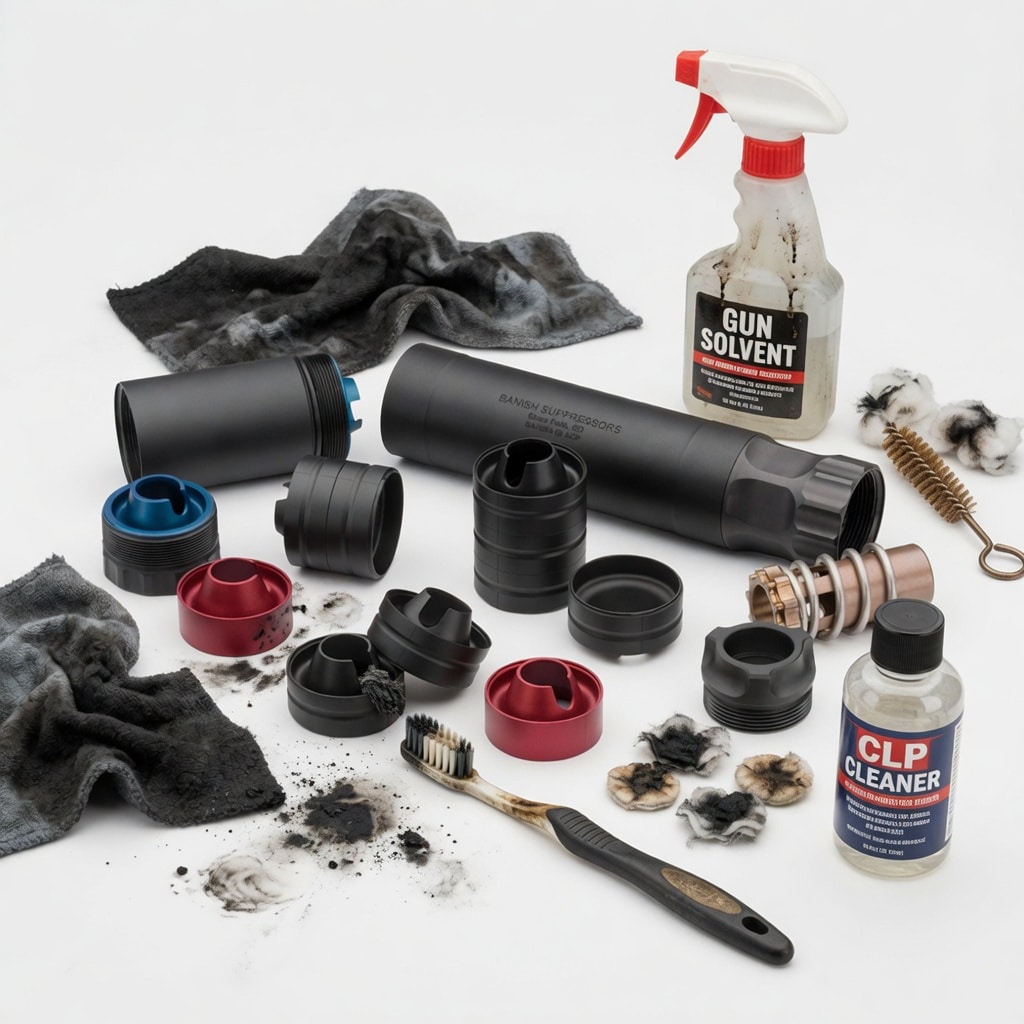
While rifle suppressors are largely self-cleaning through the heat of sustained fire, they are not maintenance-free. Pistol and rimfire suppressors accumulate significant carbon and lead fouling that degrades performance and can eventually cause damage if not addressed. User-serviceable suppressors should be disassembled and cleaned periodically — frequency depends on the caliber, round count, and whether wet or dry shooting conditions are used. Even sealed rifle suppressors benefit from periodic inspection for baffle strikes, erosion of the blast baffle, and structural integrity of the tube and mounts.
Suppressor myths — Myth 6: Suppressors Significantly Hurt Accuracy
Most quality suppressors have a negligible effect on accuracy — and some actually improve it. The added weight on the muzzle can reduce felt recoil and muzzle rise, which benefits follow-up shot accuracy. Point of impact often shifts slightly when a suppressor is first added, requiring a zero adjustment, but once zeroed the suppressor is consistent. Some precision rifle competitors specifically choose suppressed configurations for their accuracy and recoil benefits. The idea that suppressors are inherently accuracy-degrading comes from substandard products or misaligned mounts, not quality suppressors properly installed.
Suppressor myths — Myth 7: Suppressors Are Only for Military and Law Enforcement
Civilian suppressors have existed in America since Hiram Maxim patented his Maxim Silencer in 1909 — predating their military adoption by years. Throughout much of the 20th century, suppressors were sold through hardware stores and sporting goods shops with minimal regulation. The NFA’s registration requirement was added in 1934, but civilian ownership has always been legal in most states. Today, civilian shooters use suppressors for hunting (reducing noise pollution and hearing protection in the field), recreational target shooting, competitive shooting sports, and home defense. The military and law enforcement use is a subset of suppressor application, not the defining use case.
Suppressor myths — Myth 8: Suppressors Are Expensive and Inaccessible
While high-end suppressors from premium manufacturers can cost $1,000–$2,000, quality suppressors are available at accessible price points — particularly for rimfire and pistol calibers, where effective models often sell in the $300–$600 range. The January 2026 elimination of the $200 NFA tax stamp removed what was effectively a regressive surcharge on suppressor ownership. Combined with the broader availability of suppressor-ready threaded-barrel handguns and rifles, the total cost of entry for suppressor ownership is lower in 2026 than at any point in the modern era.
Myth 9: Suppressors Are a Recent Trend
Suppressors are over 115 years old. Hiram Percy Maxim — son of the machine gun inventor — developed and patented the first commercially viable suppressor in 1909. Early 20th century advertisements marketed them as neighborly and sporting tools, sold for a few dollars through general merchandise catalogs. Their association with criminal activity emerged largely from 1930s gangster-era legislation and subsequent Hollywood portrayal. The modern suppressor renaissance — driven by improved manufacturing, materials science, and greater public awareness — is a return to the original sporting vision for the technology, not a new invention.
Frequently Asked Questions About Suppressor Myths
Are suppressed guns as quiet as in the movies?
No. Movie sound designers use artificially quiet sound effects for dramatic effect. Real suppressors reduce gunshot sound by 20–35 dB — significant but not silent. A suppressed firearm is still clearly audible. Subsonic ammunition paired with a quality suppressor produces the quietest real-world results, typically in the 110–130 dB range depending on caliber and platform, but this remains louder than most power tools.
Do suppressors slow down bullets?
No — most suppressors slightly increase bullet velocity by 10–25 fps because the additional length lets propellant gas act on the bullet slightly longer. This effect is small and typically has no practical accuracy implications. Subsonic ammunition does leave the muzzle at lower velocity by design, but that is a function of the cartridge load, not the suppressor.
Can suppressors be made at home legally?
Manufacturing a suppressor without an ATF Form 1 approval is a federal felony regardless of the materials used. A licensed manufacturer (SOT) can produce suppressors for transfer. An individual can manufacture a suppressor for personal use on an approved ATF Form 1, which follows a similar application and waiting process to the Form 4 transfer. Making a suppressor — even from materials as simple as automotive parts — without this approval carries severe federal penalties.
Disclosure: PopularSuppressors.com is a media property of Brand Avalanche Media, Inc. All editorial opinions are our own.
Related guides: suppressor vs. silencer, Pew Science suppressor testing, and how to clean a suppressor.
Similar Posts




More Questions
Are suppressors only for criminals?
No — the vast majority of suppressor owners are hunters, competitive shooters, and recreational shooters using them as hearing protection. Suppressors are involved in an extremely small fraction of gun crimes. They are legal in 42 states and owned by law-abiding civilians.
Do suppressors make a gun fully automatic?
No. A suppressor has no mechanical effect on a firearm's rate of fire. It is a muzzle device that reduces sound — nothing more. A semi-automatic firearm with a suppressor attached remains semi-automatic.
Do I need a special license to buy a suppressor?
No special license is required beyond the standard NFA process: ATF Form 4, background check, and ATF approval. The $200 tax stamp ended on 1 January 2026.