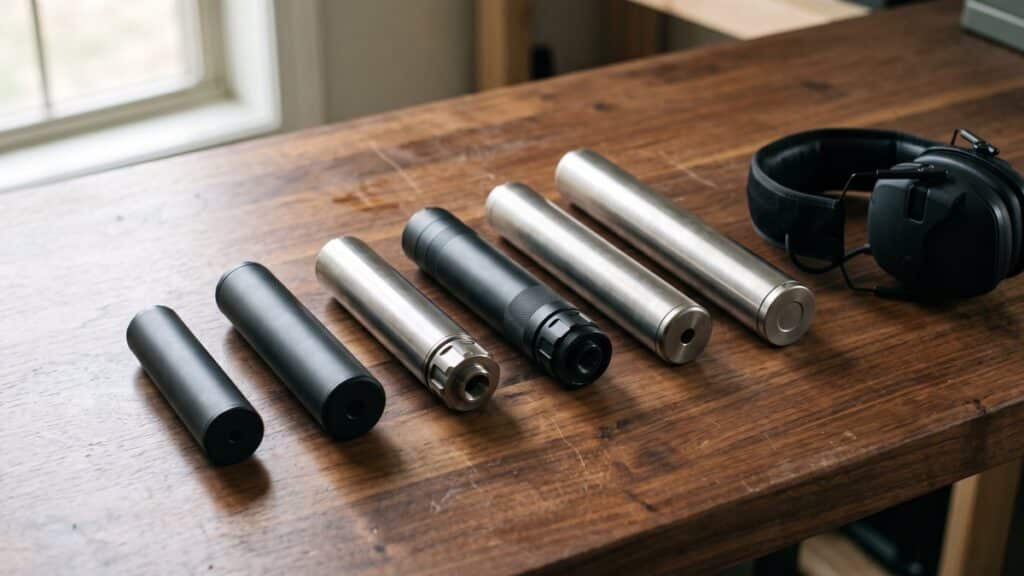
Does a Suppressor Affect Accuracy? What the Tests Measured
Does a suppressor affect accuracy? Yes, it usually moves your zero a few inches at 100 yards, but groups mostly hold or even tighten.
In This Article
Originally published: October 23, 2026
Suppressor point of impact shift, often called POI shift or zero shift, is how far a rifle’s group moves on paper once a suppressor goes on the muzzle. It is most of what people mean when they ask, “Does a suppressor affect accuracy?” Group size is a separate measurement, and in the published tests below it held or tightened far more often than it grew. Check alignment with the rifle unloaded, re-zero, and the group comes along for the ride.

Safety note. Mount a suppressor and check its alignment with an unloaded firearm, follow the maker’s mounting and torque instructions, and never fire a caliber larger than a suppressor is rated for. Suppressor ownership and hunting rules vary by state; check yours.
Every fall somebody threads a new suppressor onto a deer rifle and watches the group land somewhere new (more often low than high, going by the published numbers). Nothing broke. The rifle needs a fresh zero before opening day, and the shooter needs to know which changes are normal and which mean something is loose.
Suppressor Accuracy at a Glance
- Zero: It usually moves. The measured shifts below run from none to 3.5 inches at 100 yards.
- Groups: Mostly held or tightened. RECOIL’s test tightened in 8 of 9 rifle-and-load pairs and tied in the ninth.
- Why: Weight at the muzzle changes how the barrel vibrates, and muzzle gas changes how the bullet exits.
- The fix: Re-zero with the suppressor on, then confirm one shot from a cold barrel and a cold suppressor.
- The real risk: A loose or crooked suppressor. One misaligned adapter cost an Outdoor Life writer about six feet at 100 yards.

Does a Suppressor Affect Accuracy? What the Tests Measured
I trust a tape measure more than a sales sheet, so here are the published tests that put a number on it. Makers and retailers are labeled (they have something to sell, and so do I).
| Source | Rifle and cartridge | Suppressor tested | Point-of-impact shift (as published) | Group size change (as published) |
|---|---|---|---|---|
| Outdoor Life (Tyler Freel), 2026 | 6.5 Creedmoor, 6mm Creedmoor, .22 LR; models not named | Not named in the article | On vs. off not reported. Cold-suppressor test: 6.5 Creedmoor center moved about 0.5 in., within normal spread | 20 shots, 100 yd, size / mean radius: 6.5 Creedmoor 1.45 / 0.43 → 0.95 / 0.30 in.; 6mm Creedmoor 1.73 / 0.46 → 1.67 / 0.36; .22 LR 2.08 / 0.59 → 2.54 / 0.77 (wind) |
| OutdoorHub (Tom McHale), 2018 | Daniel Defense DDM4V5, .300 Blackout supersonic | SilencerCo Specwar 762; Sig SRD762Ti on Sig QD mount; titanium “Griffin Armament Thunder Beast Ultra” (author’s wording) | Specwar about 2 in. down, 1.5 in. right; Sig 1 in. down (both at 100 yd); titanium none measurable (distance not stated) | Not measured on this rifle |
| OutdoorHub (Tom McHale), 2018 | S&W Performance Center M&P 10, 6.5 Creedmoor 140-gr. match | Q Full Nelson | 3.5 in. down, 1 in. right at 100 yd | Not measured with this suppressor |
| OutdoorHub (Tom McHale), 2018 | Masterpiece Arms BA Lite; S&W M&P 10; 6.5 Creedmoor | SilencerCo Specwar 762 | Not reported for these groups | Five-shot averages, 100 yd: BA Lite 0.63 → 0.90 in.; M&P 10 0.98 → 1.03; M&P 10 handloads 1.02 → 0.65 |
| RECOIL (Todd Woodard), 2025 | Savage 10PT-SR .308 Win; Remington 700 SPS-T and Ruger American Ranch .300 Blackout | Rugged Surge 7.62, 9-inch setup | Not reported; groups and velocity only | 10 three-shot groups per load, 100 yd: tighter in 8 of 9 rifle-and-load pairs, tied in 1; best 1.0 → 0.4 in. |
| Shooting Sports USA (NRA), Chip Lohman, 2012 | .338 straight-pull bolt action, SIG 716 .308 Win and AR-15 .223 Rem, fired from the bench | Elite Iron Sierra; 7.62-SDN-6 on a quick-attach mount; SCG 5.56/.223 | Not measured; the article lists it for future testing | Five-shot groups, 200 yd: .338 1.380 → 1.367 in.; .308 1.658 → 0.947; .223 1.682 → 1.481; lower velocity standard deviation on all three |
| Gunwerks (rifle maker; maker content), 2025 | Not named on the page | Not named; replaced a muzzle brake | About 2 in. up; distance not stated | “Improved”; no size given |
| Gun Digest (Patrick Sweeney), 2017 | AR-15, match ammo | Not named in the article | “Almost an inch” at 100 yd | Sub-MOA rifle; no sizes given |
| Guns.com, 2024 | SIG M400 SDI X-Series 5.56 NATO; FN SCAR 17S .308 Win | Griffin Armament RECCE 5K; SilencerCo Chimera .30 | 5.56 a “slight drop,” no number; .308 no similar shift | 100 yd: 5.56 about 2 MOA both ways; .308 about 3 → 2.5 to 3 MOA, pulled fliers included |
| Silencer Shop (suppressor retailer), 2024 | Aero Precision Solus, 6.5 Creedmoor 140-gr. ELD-M | SilencerCo Scythe Ti | Not reported | One five-shot group each way, 100 yd: just over 1 in. → under 1 in. |
Numbers are as each source published them, in inches or MOA at the distance stated. Small groups swing on their own, so read the pattern across the rows, not any single row.

So what does the table say? The zero moves, the group survives, and the move belongs to your rifle alone. Even the writers disagree on how often. Gun Digest’s Patrick Sweeney says few suppressors change point of impact, and only slightly. OutdoorHub’s Tom McHale saw it move almost every time, usually down a couple of inches. Outdoor Life’s Tyler Freel writes that some combinations move 10 to 12 inches at 100 yards.
Having worked behind the counter for over 20 years, I get asked about this every deer season, and the answer never changes. Nobody can tell you your shift without shooting your rifle (and that includes the guy behind the counter).
Why Point of Impact Moves
A rifle barrel vibrates when it fires (Sweeney says it “hums like a tuning fork”), and the bullet goes wherever the muzzle points at the instant it leaves. Hang a half-pound to a pound and a half of suppressor on the end, as Sweeney puts it, and you change that timing. Freel calls it a downward leveraging force that alters the barrel’s harmonics. Our suppressor comparison chart lists weights, if you want to see what you are hanging out there.
Australian defense researchers tested the idea in 1994 with plain weights and flash suppressors on a light machine gun barrel. Adding a mass, they concluded, will alter the mean point of impact “but not necessarily the size of the dispersion pattern.” That is this whole article in one government sentence.
Gas plays a part, too. The same report said muzzle gas appeared to play a significant role in where the bullets went. Sweeney credits a suppressor with stripping turbulent gas right where the bullet is “most suggestible to change.” A Silencer Shop Q&A adds that its testing found the rifle’s threads drive the first shift more than the suppressor does.
Notice I keep saying rifle and suppressor together. Shooting Illustrated’s Steve Adelmann wrote that some suppressor weights are “just right” for a barrel, while other pairs “do not play well together.”
Why Groups Often Hold or Tighten
Outdoor Life shot 20-shot samples, and by Freel’s count both centerfire rifles grouped about 25 to 30 percent tighter suppressed, against a normal swing of 15 to 20 percent. He credits barrel damping some of the time, but more often a rifle that is easier to shoot without the blast. In RECOIL’s test, a subsonic 220-grain load went from 6-inch patterns to 0.6-inch groups in a Remington 700 once suppressed.
Does a suppressor always help? No. McHale’s Masterpiece Arms rifle opened from 0.63 to 0.90 inch, and Outdoor Life’s .22 LR got worse too (Freel blames the wind). Think about it: if muzzle weight were magic, every row would read better.
How to Re-Zero After Adding a Suppressor
Re-zeroing a suppressed rifle is the same job as any sight-in, with a check at each end. Here is my order.
- Unload and check alignment. Dead Air’s manual calls for a caliber-appropriate alignment rod to confirm the suppressor sits on the bore’s centerline, and says to stop if it does not.
- Mount it to spec. Use your maker’s numbers. Dead Air’s, for its own muzzle devices, are 25 plus or minus 5 foot-pounds and never over 30, with the suppressor hand-tight against the barrel’s shoulder.
- Shoot groups, not single shots. Sight in as you would without the suppressor. Our sister site’s guide on how to sight in a rifle scope covers the groups and the clicks.
- Check velocity if you dial. Freel notes velocity often shifts slightly with a suppressor on.
- Cool everything, then fire one cold shot. Let the barrel and suppressor cool completely, confirm the cold-bore, cold-suppressor shot, and adjust.
- Write down both zeros. If the suppressor comes off or moves between rifles, record the with-and-without difference for each one.

Mounts and Repeatability
Direct thread or quick-detach? The sellers disagree. Dead Air, a suppressor maker, says in its FAQ that “A QD system like our Xeno or Keymo is always superior to direct thread, no matter the action type of your host rifle.” An older Silencer Shop Q&A warns that many locking quick-attach designs lose accuracy as the suppressor shifts on the mount between shots, so many accuracy shooters stay with direct thread. Our guide to suppressor mounting systems compares direct thread, quick-detach and HUB.
Direct thread has its own weak spot. Dead Air’s manuals warn that all direct-thread suppressors loosen with use, and a loose one shifts point of impact and can let a bullet strike the baffles. Freel, a direct-thread man himself, calls a loose suppressor the most common source of accuracy woes.
My take: the mount style matters less than whether it returns to the same spot. Zero it, pull the suppressor, put it back, and shoot again. If the group wanders, suspect the mount first. Match the threads with our thread pitch chart, see one maker’s adapter lineup in our Rearden Mfg mounts guide, and price a mount for every extra rifle in the suppressor cost calculator.
Heat Mirage Off a Hot Suppressor
Mirage is the shimmer of hot air rising off the suppressor body, right in front of your scope. Creedmoor Sports, a retailer, says at long range it can cause aiming errors. Burn Proof Gear, a cover maker, says a suppressor climbs about 7°F per round with 5.56 NATO and sells covers built to “cut mirage” (maker claims, both).
Mirage moves the picture, not the bullet, and since heat builds with every round, it bites at the range far more than in a deer stand. Our beginner’s guide to suppressor covers walks through the wraps, and cooling between groups costs nothing.
The First Shot From a Cold Suppressor
Here is the shot that matters to a hunter: the first one, from a cold barrel and a cold suppressor. Freel fired 20 single shots from a 6.5 Creedmoor, pulling and cooling the suppressor before each. The group center moved about half an inch, which he called normal spread. Truly sub-inch rifles wander about .25 to .35 inch between 20-shot samples, he says, and more in the 1 to 1.5 MOA class.
His .22 LR shifted .44 inch at 50 yards, and he has noted distinct first-round shifts with some .22 suppressors, so test your own. That cold first shot also tends to be the loud one, especially with older designs (shooters call it first round pop). So confirm your zero cold. Your deer does not care where your third shot goes.

Alignment and Baffle Strikes
Want a big point-of-impact shift? Freel mounted a lower-priced suppressor whose adapter was way out of alignment and saw his shots land about six feet right at 100 yards. Six FEET. A rod check catches that before the first shot.
Dead Air’s manuals spell it out. Check alignment with a caliber-appropriate rod on an unloaded rifle, skip crush washers, and have a competent gunsmith confirm the threads are concentric with the bore if you cannot. If groups turn erratic, Adelmann says to clear the rifle, pull the cooled suppressor, and inspect the baffles and end cap for strikes. A shift of 8 MOA or more (8 inches at 100 yards) is the Silencer Shop Q&A’s signal to have a gunsmith check the threads.
Most of you don't have a suppressor on the deer rifle yet. Among those who do, titanium leads steel by more than three to one.
Frequently Asked Questions
Do you have to re-zero after adding a suppressor?
Yes, if you want to hit where you aim. Gunwerks, a rifle maker, calls re-zeroing essential and says the direction and amount of the shift vary, so nobody can hand you the correction in advance.
Do suppressors make guns more accurate?
Sometimes. Adelmann estimates that 60 percent of the rifles he builds or evaluates shoot tighter groups with a suppressor. Some loads also shoot better suppressed than others, so try a couple before you settle.
Does point of impact return when you take the suppressor off?
It should. Sweeney writes that the shift goes away when the suppressor comes off and returns when it goes back on, and the Silencer Shop Q&A calls the initial shift repeatable with most suppressors. If yours does not return, check the threads and the mount.
Does a hot suppressor change point of impact?
It can. Freel writes that the first round can land differently from later ones as a suppressor heats up and holds warm gas, more so with some rimfire suppressors. Heat cycles can also loosen a mount, and Dead Air’s manuals call for a high-temperature thread locker when that happens.
Does a quick-detach mount hold zero?
A good one should, and the test is simple: zero, remove, re-attach, shoot. The Silencer Shop Q&A put most quick-attach systems at 1.5 MOA or better, and Adelmann notes the QD designs notorious for play date to the 1990s.
So thread it on, check it with a rod, and shoot a fresh zero before the season opens. Skip that, and opening morning becomes a Dirty Harry moment where you ask yourself one question: do you feel lucky? Paper is cheaper than a wounded deer.
Sources: Outdoor Life, “Yes, a Suppressor Can Make Your Rifle More Accurate”; Outdoor Life, “How to Zero a Suppressed Rifle”; OutdoorHub, “Do Suppressors Affect Performance and Accuracy?”; RECOIL, “Testing the Effects of Suppressors on External Ballistics”; Shooting Sports USA, “Sound Suppressors in Competition” (November 2012); Gunwerks, “Do I Need to Re-Zero After I Put On My Suppressor”; Gun Digest, “How Does A Suppressor Alter Accuracy?”; Silencer Shop, “What is POI Shift?”; Silencer Shop, “Does a Suppressor Affect Accuracy?”; Guns.com, “Will a Suppressor Affect My Accuracy?”; Shooting Illustrated, “Suppressor POI & Accuracy Issues”; DSTO (Australia), “Experiments to Determine the Effects of Different Flash Suppressor Designs on Accuracy of an F89 Light Machine Gun”; Dead Air, FAQ; Dead Air, RXD30Ti manual; Dead Air, Sandman manual; Dead Air, Nomad Ti XC manual; Burn Proof Gear, home page; Burn Proof Gear, “Suppressor Cover Heavy”; Creedmoor Sports, “Do suppressors affect accuracy?”
Similar Posts