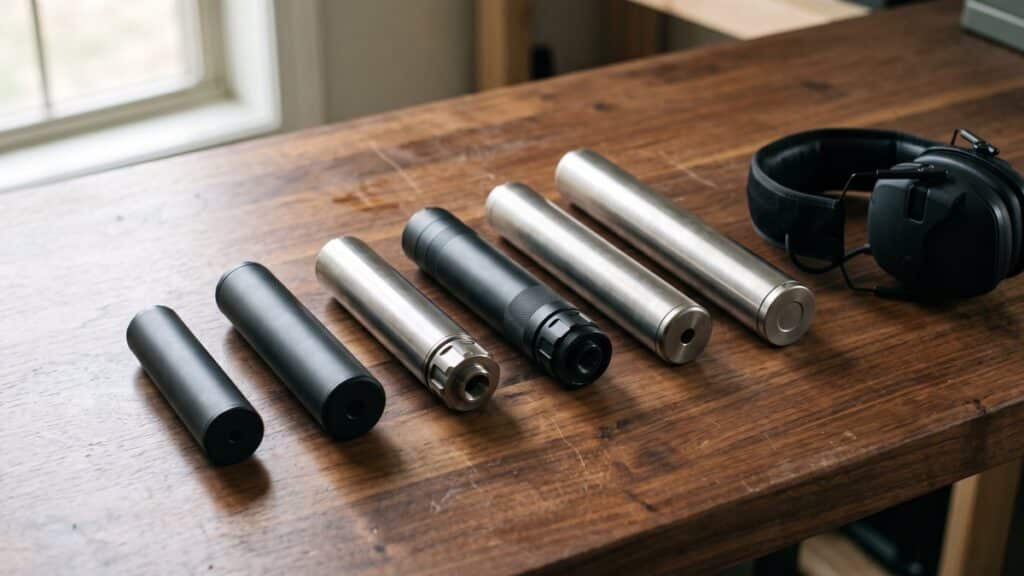
Does a Suppressor Reduce Recoil? Tested vs. Muzzle Brakes
Does a suppressor reduce recoil? Yes: a 9-inch suppressor cut it 27% to 28% in force tests, while the best muzzle brakes cut 44% to 46%.
In This Article
- Does a Suppressor Reduce Recoil? The Measured Numbers
- Muzzle Brake vs Suppressor: Which Cuts More Recoil?
- How Much Louder Is a Muzzle Brake?
- What Outdoor Life’s Sled Test Showed
- Suppressors With a Brake on the Front
- What Is the Downside of a Suppressor?
- Brake or Suppressor on a Hunting Rifle?
- Frequently Asked Questions
Originally published: October 23, 2026
Suppressor recoil reduction is the share of a rifle’s kick that a suppressor (often called a silencer) removes by trapping the powder gas behind the bullet and letting it out slowly. The distinction that matters is the comparison: a muzzle brake throws that gas sideways and cuts more recoil, while a suppressor cuts less, runs far quieter and, like a brake, belongs only on threads made for it. So does a suppressor reduce recoil? Yes, just less than a good brake.

Safety note. Mount a brake or suppressor only on threads it was made for, check alignment with an unloaded firearm, and never fire a caliber larger than a suppressor is rated for. Wear hearing protection with either one; in the tests below, every brake read louder than a bare muzzle. Suppressor ownership and hunting rules vary by state; check yours.
Ask “do suppressors reduce recoil” on a gun forum and one guy swears his suppressed .308 kicks like a .22 while another swears it did nothing. Both are guessing. Two independent tests bolted brakes and suppressors onto the same rifles and measured the shove and the noise, and they settle the suppressor vs muzzle brake recoil argument better than any of us at the counter (myself included).
Suppressor Recoil at a Glance
- Suppressor: a 9-inch suppressor cut recoil 27% on a .308 and 28% on a .300 Norma Magnum in force-sensor tests.
- Best muzzle brake: 44% on that .308 and 46% on the .300 Norma, and 13.9 dB louder than bare behind the rifle.
- Brake on a suppressor: a Recoil X brake typically took 12 to 13 inches off Outdoor Life’s sled travel for three to four ounces.
- Noise: the 9-inch suppressor read 29.4 dB under a bare muzzle behind the rifle; brakes read 4.9 to 13.9 dB over.

Does a Suppressor Reduce Recoil? The Measured Numbers
Precision Rifle Blog’s Cal Zant measured recoil with force sensors at the rifle’s butt, ran a bare muzzle and a long line of brakes on four rifles, and tried 9-inch Thunder Beast suppressors on three. It is the closest thing to apples-to-apples I have found, so it anchors this table.
| Device | Recoil cut vs. bare muzzle | Sound behind the rifle, near the shooter | Source |
|---|---|---|---|
| Bare muzzle | Baseline (0%) | 150.6 dB | Precision Rifle Blog, 20-inch .308 |
| Flash hider | Not measured in either test | Not measured in either test | Searched both; Outdoor Life’s data file lists none |
| Muzzle brake | 18% to 44% on the .308 (best: APA Fat B*); best 45% on the 6XC, 46% on the .300 Norma Mag | 4.9 to 13.9 dB louder than bare | Precision Rifle Blog brake tests |
| Suppressor, 9-inch | 27% on the .308 and 6XC; 28% on the .300 Norma Mag | 29.4 dB quieter than bare (Ultra 9) | Precision Rifle Blog: Thunder Beast Ultra 9 and 30P-1 |
| Suppressor with built-in brake (maker figures) | Over 60% on a .300 Win Mag, vs. 29% with a flat end cap | Magnus-K-RR: about 10 dBA louder at the shooter’s ear than without the brake | Thunder Beast Arms Magnus page; test method not shown |
Each Precision Rifle Blog percentage averages two cuts, total push (momentum) and peak force, over several shots per device (Zant settled on three per brake). On the .308 and .300 Norma, the Ultra 9 was threaded over Thunder Beast’s Compact Brake, its mount. The sound meter sat 64.5 inches behind the muzzle, behind the shooter. The last row is the maker’s claim. Rifles differ between rows, so compare devices within a test.
Read the suppressor row twice. A 27% cut is nothing to sneeze at, but 15 of the 17 brakes did better on the .308, and most did better on the other two rifles. Remember, these are two suppressors from one maker, not the whole market.
Muzzle Brake vs Suppressor: Which Cuts More Recoil?
The brake, and the reason is physics. SAAMI’s recoil formula counts two things shoving the rifle back: the bullet, and the powder gas leaving the muzzle at about 1.75 times the bullet’s speed in a high-powered rifle. On Zant’s .300 Norma load (a 230-grain bullet at about 2,700 fps over 82 grains of powder), the gas is roughly 38% of the rearward push, by our arithmetic.
A suppressor traps that gas and lets it out the same hole the bullet used, so it cut that rifle’s total push 22%. A brake throws the gas sideways, and its baffles let the gas push the rifle forward (Zant’s recoil primer explains it), so the best two brakes cut 43% and 44%. SAAMI notes its formula ignores gas redirected by brakes or suppressors, which is why somebody had to measure it.
For your own cartridge’s free-recoil number, Popular Ammo’s rifle recoil chart runs SAAMI’s formula with every input shown.

So why would anybody pick the suppressor? Because recoil is not the only thing that hits you, and a brake gets its numbers by throwing the blast sideways and back. Let’s look at the bill.
How Much Louder Is a Muzzle Brake?
For his sound test, Zant put the meter 64.5 inches behind the muzzle of a 20-inch .308, behind the shooter’s position. The bare muzzle read 150.6 dB. Every brake read LOUDER, from 4.9 dB over to 13.9 dB over for the APA Fat B*, the same brake that topped his .308 recoil chart. His Thunder Beast Ultra 5, Ultra 7 and Ultra 9 suppressors read 18.1, 26.0 and 29.4 dB under it.

Zant figures the 43 dB gap between the quietest suppressor and the loudest brake sounds about 16 times quieter to the ear. Most brakes sounded about twice as loud as the bare rifle. Beside the rifle his brakes read less than 2 dB apart, but behind it the spread grew to 9 dB, because baffles angled back throw blast at the shooter and spotter. A big brake plays Oprah on the firing line: you get a blast, and YOU get a blast.
Outdoor Life’s meter, one meter left of the muzzle, told the same story: 165 dB bare, 165.7 to 168.9 dB for six brakes, 129.9 dB for the quietest suppressor. OSHA’s workplace noise rule says impulse noise should not exceed 140 dB peak. Is a suppressed rifle quiet, then? No, but it is a whole lot less loud, which is the point.
What Outdoor Life’s Sled Test Showed
Outdoor Life shooting editor John B. Snow and Montana shooter Joseph Ewing ran more than 100 suppressor and brake setups on one 6.5 Creedmoor, firing 145-grain Barnes Match Burner handloads at about 2,800 fps. The rifle rode a sled on tracks, and a ruler showed how far each shot pushed it back.
| Setup | Sled travel (lower is less recoil) | Sound, 1 meter left of muzzle | Weight |
|---|---|---|---|
| Bare muzzle | 39.5 in. | 165 dB | No device |
| CHAD brake (least recoil) | 16.5 in. | 168.9 dB | 14.7 oz. |
| Recoil X Gen 2 brake alone | 21.9 in. | 165.7 dB | 13.9 oz. |
| SilencerCo Omega 300 with Recoil X Gen 2 | 21.9 in. | 148.1 dB | 18.4 oz. |
| SilencerCo Omega 300, flat cap | 36.7 in. | 141 dB | 15.7 oz. |
| SilencerCo Scythe Ti with Recoil X Gen 2 | 22.1 in. | 142.3 dB | 12 oz. |
| SilencerCo Scythe Ti, factory cap | 32.1 in. | 137.8 dB | 7.3 oz. |
| Mack Bros Zenith K, flat cap | 39.3 in. | 149.8 dB | 7.7 oz. |
Inches of sled travel, not percentages: four shots per suppressor setup, three per brake. Outdoor Life dropped its ear-position readings because the bench bounced the sound. Weights come from its full results file.
Look at the pairs. A Recoil X on the front took the Omega 300 from 36.7 to 21.9 inches and the Scythe Ti from 32.1 to 22.1. The light Zenith K with a flat cap moved the sled 39.3 inches against the bare muzzle’s 39.5 (next to nothing for recoil, though it did cut the noise).
Snow is careful with his own numbers, and I like him for it. He figures an inch of travel is about 4% of felt recoil and doubts most shooters could tell 21 inches from 23. Rank setups with the sled and leave the decimals alone.

Suppressors With a Brake on the Front
Outdoor Life says this middle ground, modular suppressors with multi-port brakes, cropped up to serve long-range competitors. A Recoil X brake typically added three to four ounces and took 12 to 13 inches off the sled travel; on the Omega 300 it took 14.8 inches off for 2.7 ounces.
Here is the part I like best. The Recoil X alone moved the sled 21.9 inches at 165.7 dB. On the front of the Omega 300 it moved the sled the same 21.9 inches at 148.1 dB: same shove, 17.6 dB less noise beside the rifle.
The catch is your ear. On the same suppressor, the brake raised the reading over the flat or factory cap, 141 to 148.1 dB on the Omega 300 and 137.8 to 142.3 dB on the Scythe Ti. At the 2024 Suppressor Summit Thunder Beast hosted, the shooter’s-ear microphone measured average sound energy (a different yardstick from the peaks above): 112.5 dBA for its Magnus and 120 dBA for the Magnus RR, the same suppressor with a brake on the end.
Thunder Beast’s Magnus page (maker figures, test method not shown) claims over 60% recoil reduction for the RR versions on a .300 Winchester Magnum, against 29% with a flat end cap. It also says the Magnus-K-RR runs about 10 dBA louder at the shooter’s ear. Outdoor Life’s sled put a Magnus K RR at 25.9 inches against 39.5 bare on its 6.5 Creedmoor. Different rifle, cartridge and yardstick, so the numbers need not agree, and I lean on the one anyone can check.
Some suppressor mounts are a brake or flash hider themselves: Rearden’s Plan B muzzle devices serve as the mounting point for a suppressor’s taper-mount adapter, and our Rearden mount guide covers the hider and brake versions. Neither test measured a flash hider’s recoil. Match the thread first and check alignment with a rod and an unloaded rifle, as our thread pitch chart shows.
What Is the Downside of a Suppressor?
Weight and length, hung at the worst possible spot. Outdoor Life calls the way a suppressor throws off a rifle’s balance a perennial drawback, and its setups weighed 5.5 to 29.9 ounces (the heaviest with a brake). Our best hunting suppressor guide puts titanium hunting models at about 7 to 13 ounces.
That weight buys a little recoil back, since SAAMI counts a suppressor as part of the rifle’s weight. The rest you have read: less recoil cut than a good brake, a louder ear with a braked suppressor, and a real price, which our suppressor cost calculator totals with your own numbers.
Brake or Suppressor on a Hunting Rifle?
Having worked behind the counter for over 20 years, I get asked this one a lot, and for a hunting rifle my answer is the suppressor. A brake wins the recoil test, no argument. But I think a big part of a flinch is the blast, not just the shove, and the suppressor cuts the blast hard while still trimming roughly a quarter of the shove.
Think about it: the shot that matters on a hunt is usually the first one, and a hunter who is not bracing for a crack has one less reason to yank the trigger. That is opinion, not test data. Your hunting partner will agree after standing next to a brake (Outdoor Life’s brakes all read over 165 dB at one meter).
Check the law before the price. Our suppressor laws by state page counts 42 jurisdictions that allow ownership under state law. One state, Connecticut, bans hunting with one even though owning one is legal (Connecticut General Statutes § 26-75).
Most of you don't have a suppressor on the deer rifle yet. Among those who do, titanium leads steel by more than three to one.
Frequently Asked Questions
How much recoil does a suppressor reduce?
About a quarter in Precision Rifle Blog’s force tests, and it changes the feel more than the total. On Zant’s 6.2-pound .308, the suppressor cut peak force 37% but total push only 16%, so it feels like a shove instead of a slap. He cautioned that shorter suppressors often do worse.
Is a muzzle brake better than a suppressor for recoil?
For recoil alone, yes, and top competitors agree. In Precision Rifle Blog’s July 2024 survey of the 200 top-ranked Precision Rifle Series shooters, 77% ran a brake only, 10% a suppressor only and 13% switched by match. They shoot two-day matches; a hunter’s problem is usually one shot.
Does a suppressor reduce muzzle rise?
A little. In Zant’s laser test at 25 yards, the muzzle moved 24 MOA with the suppressor and 27 MOA bare, about 8% better, and every brake held steadier than both. Some suppressors port the end cap to fight rise, such as KGM’s R30K and R65K with eight tunable ports.
Can you shoot a muzzle brake and a suppressor together?
Yes, when the brake is built as that suppressor’s mount. Zant notes Thunder Beast designed its Compact Brake to double as a thread-over mount for its suppressors, and alone it cut recoil 29% to 36% on his four rifles. Use only a mount that matches your suppressor’s rear thread and mount standard.
Does a heavier suppressor reduce recoil more?
Only a little. In SAAMI’s formula, free recoil energy drops in step with total rifle weight, so a full pound added to an 8-pound rifle trims it about 11%, by our arithmetic. In Outdoor Life’s data, the 5.5-ounce Tenet Limited 6.5 moved the sled 31.1 inches and the 13-ounce Thunder Beast Ultra 9 Gen 2 moved it 34.4.
So here is my verdict. If recoil is all you care about, buy a good brake, double up on hearing protection and apologize to the guy on the next bench. If you want less kick and a lot less noise, run a suppressor, and if that is still too much shove, put a brake on its front. The tape measure has spoken.
Sources: Outdoor Life, “We Tested More Than 100 Suppressors and Brake Combos for Sound and Recoil” and its full results file; Precision Rifle Blog, “Muzzle Brakes: Recoil Primer, Test Equipment & Rifles”; Precision Rifle Blog, “Muzzle Brakes: Recoil Results for 6mm & 6.5mm”; Precision Rifle Blog, “Muzzle Brakes: Recoil Results for 308 & 300 Magnum”; Precision Rifle Blog, “Muzzle Brakes: Ability To Stay On Target”; Precision Rifle Blog, “Muzzle Brakes: Sound Test”; Precision Rifle Blog, “Suppressor vs. Muzzle Brake – What The Pros Use”; Precision Rifle Blog, 2024 Suppressor Summit data; SAAMI, “Gun Recoil – Technical”; OSHA, 29 CFR 1910.95, occupational noise exposure; Connecticut General Statutes § 26-75, silencers while hunting (Justia mirror); Thunder Beast Arms, “Magnus” product page (maker figures); Rearden Mfg, “Plan B System” (maker page).
Similar Posts