Best Hunting Suppressor: Complete Buying Guide
The best hunting suppressor is the one light enough to carry all day and rated for your cartridge, and this compares them on both counts.
In This Article
Originally published: September 20, 2026

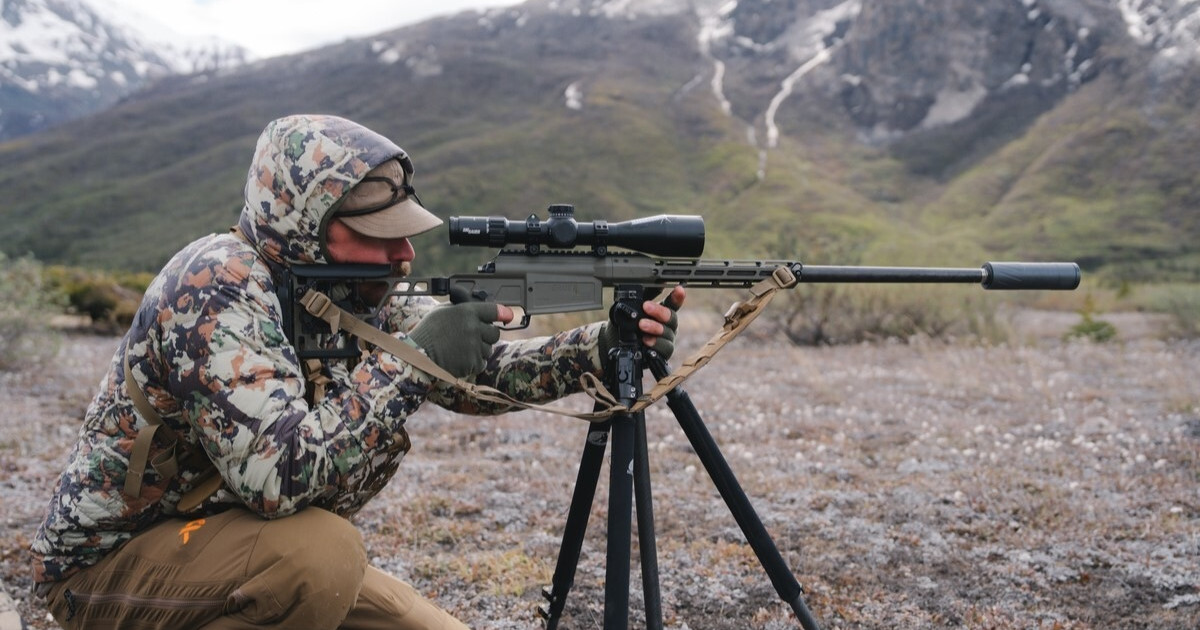
A suppressor built for the range and a suppressor built for the field solve two different problems. At the bench, weight barely matters and durability under sustained fire is everything. In the field, you’re carrying that rifle — and the suppressor hanging off the end of it — for miles, often in bad weather, and you’re firing a handful of shots per outing rather than a hundred rounds per session. That difference in priorities is why “best hunting suppressor” deserves its own guide instead of just pointing you at a general best-sellers list, and why the picks below skew toward weight, weatherproofing, and multi-caliber flexibility rather than sustained-fire duty ratings.
What Makes a Suppressor Good for Hunting
Weight is the dominant factor, and it’s not a minor consideration — a suppressor that adds a pound to the front of a rifle you’re carrying up a mountain for a week changes how that rifle handles offhand, not just how it feels at the end of the day. That’s why titanium construction, often Grade 5 or Grade 9, has become so popular for hunting-specific cans: it lets manufacturers build suppressors in the 7 to 13 ounce range instead of the 14 to 18-plus ounces typical of comparable stainless steel or Inconel builds, at a real price premium. Titanium is also generally more prone to baffle erosion under high round counts than steel, but that’s a much smaller concern for a hunter firing a handful of shots per season than it would be for a range or duty gun.
Durability and weatherproofing matter differently in the field than at the range, too. Hunting cans face mud, rain, snow, and rougher handling than a suppressor that lives in a range bag, which is why several manufacturers build hybrid cans that put stainless steel or Cobalt 6 baffles near the blast chamber — where erosion is worst — while using titanium elsewhere to save weight. Multi-caliber versatility is another major consideration: a hunter running a .223 predator rifle, a .308 or 6.5 Creedmoor deer rifle, and a .300 Win Mag elk rifle can register one modular suppressor rated across that whole range instead of buying and registering a can per gun, though editorial testing generally shows single-caliber-optimized cans outperform multi-caliber cans acoustically on their specific designed cartridge — a real tradeoff, not a free lunch.
Point-of-impact shift matters if you plan to move a suppressor between rifles rather than dedicating one can per gun — attaching and removing a suppressor, or swapping it between hosts, changes point of impact, so hunters who share a can across multiple rifles need to re-zero each host and should look for suppressors known for repeatable shift. Packability also depends heavily on hunting style: a shorter 5 to 6-inch can is easier to carry through brush or in a tight ground blind, while a longer 8 to 9-inch can trades length for lower back pressure and typically better sound suppression — more tolerable when the rifle isn’t being carried far, like stand or blind hunting.

Top Hunting Suppressors for 2026
| Brand | Model | Weight | Material | Notable Feature |
|---|---|---|---|---|
| SilencerCo | Scythe-Ti | 7.3 oz | Grade 5 & 9 titanium | Rated .223 through .300 RUM; among the lightest actually magnum-capable cans on the market |
| Thunder Beast Arms | Ultra 9 Gen2 | 10 oz (CB mount) | Titanium, tubeless welded | Rated up to .300 RUM, precision-rifle pedigree in a lightweight package |
| Rugged Suppressors | Oculus22 | 4.3 oz (short) / 6.9 oz (std) | 17-4PH stainless | Dedicated rimfire/predator can for .22LR, .17HMR, and similar |
| Otter Creek Labs | Polonium-30 | 13.5 oz | H900 stainless, Cerakote | Durable stainless build, 5.56 through .300 Norma Magnum coverage |
| Dead Air | Nomad-30 | 14.5 oz | 17-4 PH stainless, welded | Rated to .300 Norma Magnum, built for durability over minimum weight |
| Silencer Central | Banish HNT 30 TI | 9.5–12.4 oz (adjustable) | 100% titanium | User-adjustable length between 6.4″ and 8.17″ configurations |
| Silencer Central | Banish HNT 46 TI | 15.3 oz | Titanium body, stainless blast baffle | Multi-caliber coverage from 5.56 through .460, one can for several rifles |
| SilencerCo | Omega 36M | 9.8–12.5 oz | 17-4 stainless & Grade 9 titanium | Modular multi-caliber body, one can for a whole rifle battery |
Notable Picks
SilencerCo Scythe-Ti — Best for Backcountry and Mountain Hunts
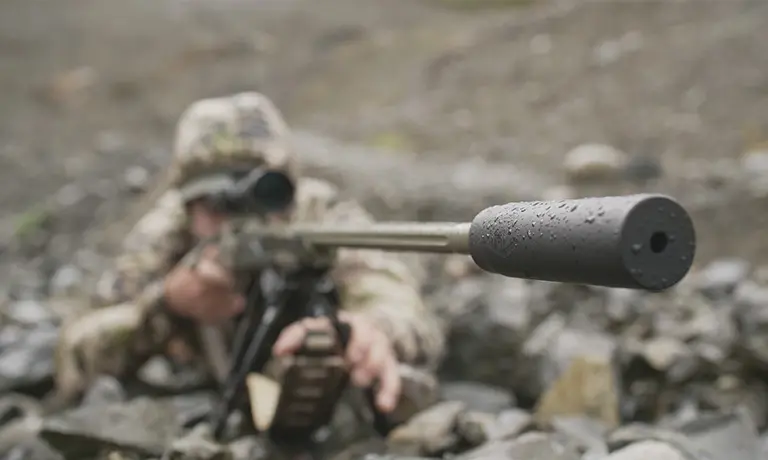
At 7.3 ounces, the Scythe-Ti is built for the hunter who’s counting ounces on a multi-day backcountry or mountain hunt. Its Grade 5 and Grade 9 titanium construction is rated all the way from .223 up to .300 RUM, meaning it can cover a predator rifle and a magnum elk rifle without a caliber change, and it ships with a 5/8×24 direct-thread mount. It isn’t full-auto rated and isn’t meant to be — this is a can optimized entirely around not being felt on a rifle carried for miles. For more on SilencerCo’s broader hunting-relevant lineup, see our SilencerCo suppressors guide.
Otter Creek Labs Polonium-30 — Best Durability-First Pick
The Polonium-30 takes a different approach than the titanium hunting cans above: it’s built from H900 heat-treated 17-4 stainless steel rather than titanium, trading some weight (13.5 ounces) for a more abrasion- and corrosion-resistant build that holds up better to mud, rain, and rough field handling over a long hunting career. It’s rated from 5.56 through .300 Norma Magnum and mounts via a 1.375×24 HUB with a 5/8×24 direct-thread adapter included, making it a actually versatile stand-hunting or general-purpose pick where the extra few ounces matter less than long-term durability. See our Otter Creek Labs suppressors guide for the rest of the lineup.
Silencer Central Banish HNT 46 TI — Best One-Can-Fits-Most-Rifles Pick
For a hunter who owns several rifles across different calibers and doesn’t want to register a suppressor for each one, the Banish HNT 46 TI is a strong modular option. Its titanium body with a 17-4 stainless blast baffle covers everything from 5.56 up through .460-class magnums across its 12-baffle design, at 15.3 ounces and an 8-inch length. It won’t be quite as light or quite as acoustically optimized as a dedicated single-caliber can on any one rifle, but the flexibility to run it across a predator rifle, a deer rifle, and a magnum big-game rifle with a single NFA registration is a genuine value proposition for a hunter building out a multi-caliber battery.
Rugged Suppressors Oculus22 — Best Dedicated Predator/Small-Game Pick
Not every hunting trip calls for a centerfire big-game suppressor. The Oculus22 is a dedicated rimfire can built for .22LR, .22WMR, .17HMR, .17WSM, and 5.7x28mm, weighing as little as 4.3 ounces in its short configuration. For predator calling, small-game hunting, or a suppressed .22 trainer rifle, a dedicated rimfire can like this outperforms trying to stretch a centerfire multi-caliber suppressor down to rimfire use. Our rimfire suppressors guide covers this category in more depth.
Buying Considerations
- Check your state’s hunting laws before you buy: Suppressed hunting is legal in most states where suppressor ownership is legal, but not all — a small number of states permit ownership but prohibit hunting with a suppressor, and a handful of states ban suppressor ownership outright. Always verify current state and local game-department rules before heading afield, since these can change.
- Weight versus durability is a real tradeoff: Titanium cans in the 7–13 ounce range are easier to carry all day but can be more prone to heat-related wear over high round counts than stainless steel or Cobalt 6 builds in the 14–18-plus ounce range. Most hunters fire few enough rounds per season that this favors titanium, but high-volume predator or varmint hunters may prefer the added durability of steel.
- Multi-caliber modular vs. dedicated single-caliber: A modular can rated across several calibers consolidates your rifle battery under one NFA registration, but a suppressor optimized for a single cartridge will generally be lighter and quieter on that specific caliber than a multi-caliber can asked to also handle a much larger round.
- Hearing protection is a genuine safety benefit: Unsuppressed rifle fire can exceed 175 dB at the muzzle, well above the roughly 140 dB threshold at which a single shot can cause permanent hearing damage. Many hunters shoot unsuppressed from a stand or blind with no hearing protection at all because earpro interferes with hearing approaching game — a suppressor is one of the few ways to reduce that single-shot exposure without sacrificing situational awareness.
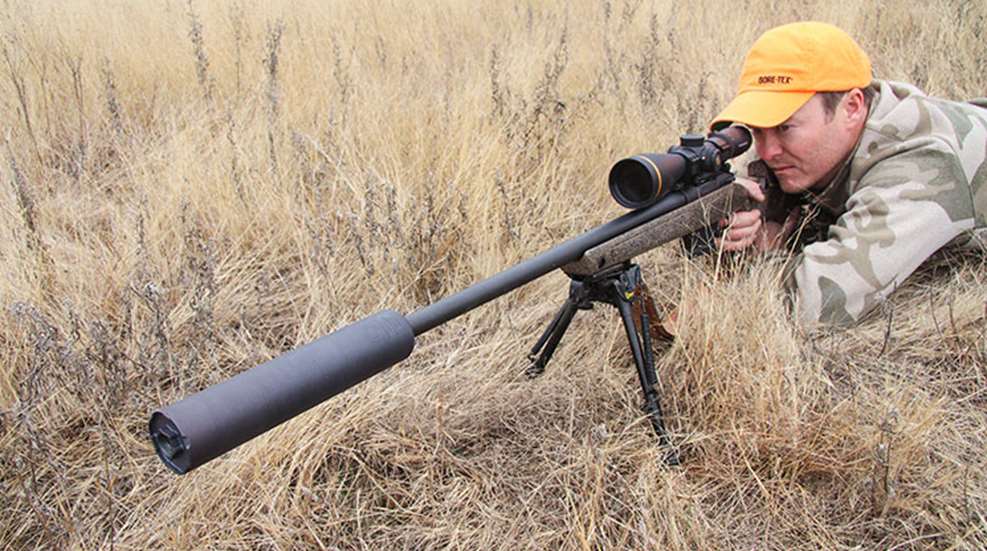
- Match the can to your hunting style: Backcountry and mountain hunters who carry a rifle for miles should prioritize sub-10-ounce titanium cans; stand or blind hunters who carry a rifle a short distance and leave it in place can comfortably run a heavier, more durable, and often quieter steel can since weight matters far less when the rifle isn’t on your back all day.
Frequently Asked Questions About Hunting Suppressors
Is it legal to hunt with a suppressor?
In most states where suppressor ownership is legal, hunting with one is also permitted, and that footprint has been expanding in recent years. A small number of states allow ownership but prohibit hunting with a suppressor, and suppressor ownership itself remains banned in a handful of states. Always check your specific state’s current game-department regulations before hunting suppressed, since rules vary and can change.
How much weight does a hunting suppressor add to a rifle?
Lightweight titanium hunting suppressors typically run 7 to 13 ounces, while more durable stainless steel or Cobalt 6 builds run 14 to 18-plus ounces. For a rifle carried long distances in the field, prioritizing a sub-12-ounce titanium can is usually worth the modest tradeoff in long-term durability.
Should I buy one suppressor for all my hunting rifles or a dedicated can per rifle?
Both are reasonable approaches. A modular, multi-caliber suppressor rated across your whole rifle battery consolidates cost and paperwork into a single NFA registration, but a suppressor optimized for one specific cartridge will generally be lighter and perform better acoustically on that cartridge than a multi-caliber can asked to also cover a much larger round.
Does a suppressor actually protect hunters’ hearing?
Yes. Unsuppressed rifle fire can exceed the roughly 140 dB threshold at which a single gunshot can cause permanent hearing damage, and many hunters shoot without any hearing protection because standard earpro interferes with hearing approaching game. A suppressor meaningfully reduces report while preserving situational awareness, which is a real, documented safety benefit rather than just a comfort feature.
Related guides: Start with our primers on how to buy a suppressor and suppressor mounting systems. For caliber-specific picks, see our .308 suppressors guide, 6.5 Creedmoor suppressors guide, and .300 Win Mag suppressors guide. If weight is your top priority, our titanium suppressors guide covers the material side of that decision in more depth, and our SilencerCo and Otter Creek Labs brand guides cover two of the strongest hunting-focused lineups on the market.


Similar Posts