Best .22 Suppressor in 2026: BANISH 22 vs. Sparrow 22 vs. Switchback 22
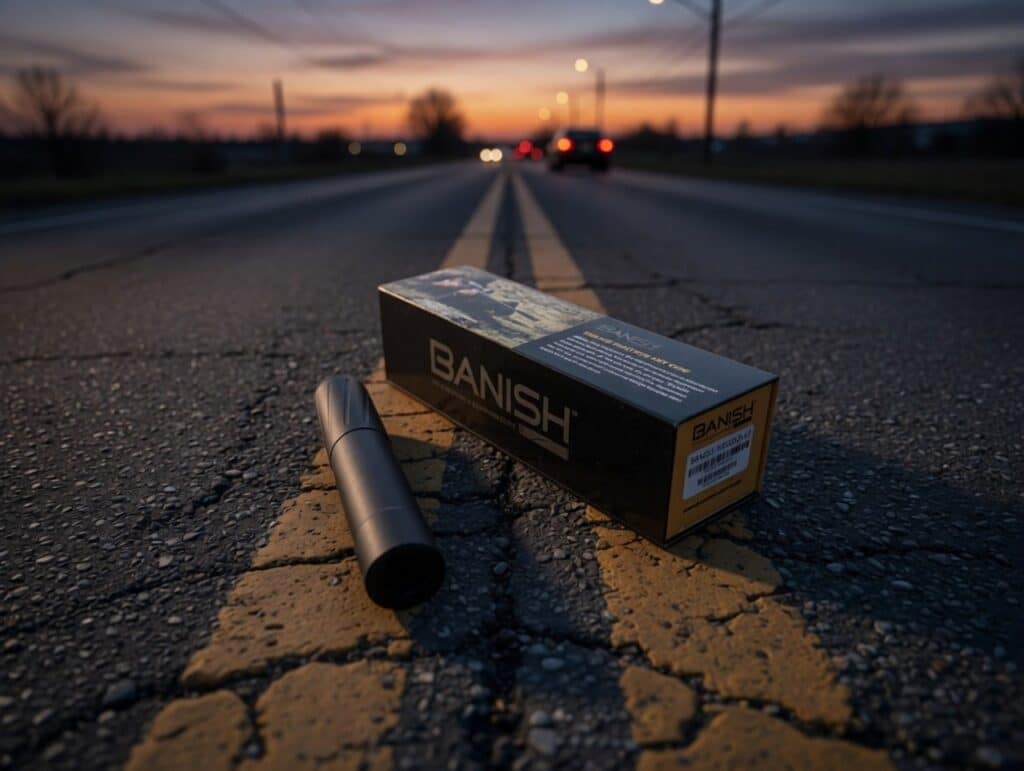
The best .22 suppressor for most shooters is the BANISH 22: 4.1 ounces of titanium, rated up to 5.7×28 and fully user-serviceable.
Last updated: October 19, 2026 · Originally published April 24, 2026
Often shopped as a 22 LR or rimfire suppressor, a .22 suppressor is a direct-thread suppressor sized for .22-caliber and smaller bullets. The distinction that matters is how it comes apart for cleaning, because lead fouling decides how long it lives. Weight second, price third. Check your state’s suppressor law first.
The question “what’s the best rimfire suppressor” has gone from niche gun-forum territory to dinner-table conversation since January 1, 2026. On January 1, 2026, the One Big Beautiful Bill Act zeroed out the federal NFA transfer tax on suppressors. First-time buyers have poured in ever since. A first rimfire suppressor is the gateway to the NFA world for most shooters. Get the decision right, and you’ve got a tool that outlives the rifle it’s screwed to. Get it wrong, and you’re buying a second suppressor in 18 months because your first suppressor choked on lead fouling or didn’t match the caliber you actually shoot. Here’s the honest, category-deep breakdown of the three rimfire suppressors worth considering right now — why each one exists, who it serves best, and how the BANISH 22 stacks up against each.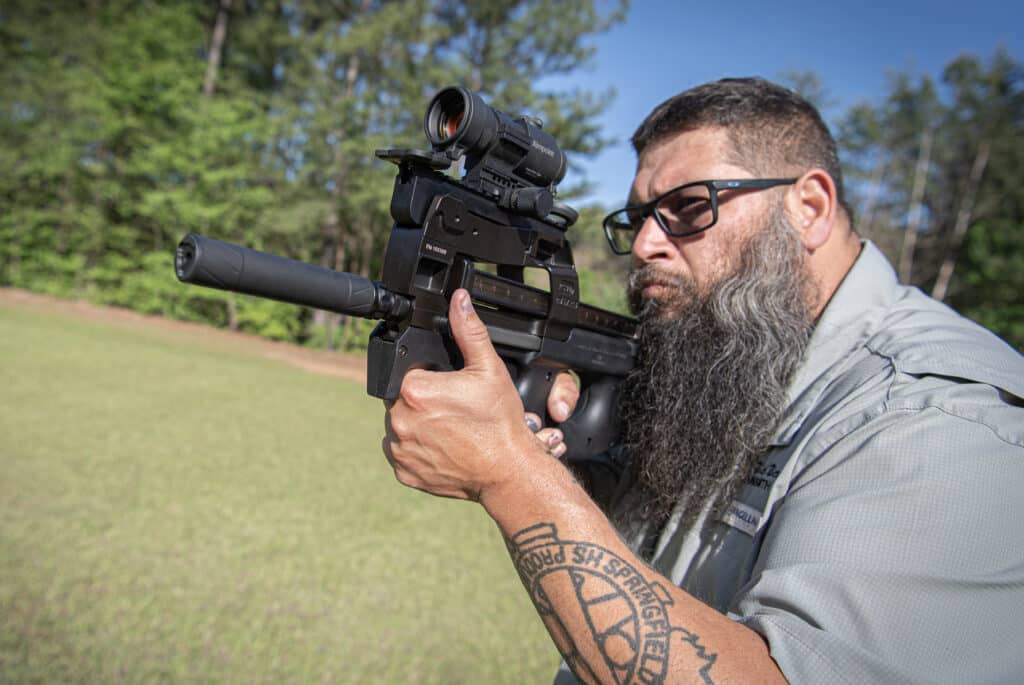
The Short Answer
For most shooters, the BANISH 22 is the strongest pick for a rimfire suppressor. It’s one of the lightest rimfire suppressors in its class (4.1 oz), it handles .22 LR through FN 5.7×28mm, it’s fully user serviceable, and at $629 MSRP it is priced close to the modular SilencerCo Switchback 22 ($579). That doesn’t mean it’s the right answer for every shooter. If you want bulletproof simplicity at the lowest price, the Sparrow 22 is one of the most proven designs ever built. If you run a suppressed pistol and a suppressed rifle and want one suppressor for both, the Switchback 22’s modularity is genuinely useful. The comparisons below explain which is which.What Actually Separates Rimfire Suppressors: Three Engineering Decisions
Every rimfire suppressor has to answer three engineering questions, and those answers determine which shooter the suppressor serves.1. Sealed, Partial Takedown, or Full Takedown
Sealed designs (welded or pinned end caps, no user disassembly) are lighter, cheaper to manufacture, and slightly quieter on a fresh-from-the-factory baseline. Their weakness is fouling, because .22 LR is a filthy cartridge. Bulk-pack ammo sheds lead bullet shavings, wax lube residue, and unburnt powder into the baffles at a rate that no centerfire suppressor comes close to matching, and a sealed suppressor gives you no way to get it back out. A rimfire suppressor that comes apart and can be cleaned by its owner is the one that lasts.
Partial takedown (clamshell or single-piece baffle core that drops out but doesn’t fully disassemble) is a compromise. The SilencerCo Sparrow 22 uses this approach and the Patented Multi-Part Containment design lets you split the core for cleaning without breaking down the individual baffles. You get 85% of the longevity benefit of full takedown with less fiddling.Full takedown (every baffle separable, every component serviceable) is what the BANISH 22 delivers. BANISH says the RF 22 TI is 100% titanium with 8 baffles. Every part comes out. Every part gets cleaned. Every part gets reassembled. This is the longest-lived design approach available at a consumer price point.
2. Fixed Length or Modular
Fixed length means what it says: the suppressor is one size, and that size is a compromise between the “short is quieter on a pistol” and “long is quieter on a rifle” physics. Most rimfire suppressors are fixed, and for 90% of buyers this is fine. Modular length (the SilencerCo Switchback 22 is the current market leader) lets you configure short or long depending on the host. On a .22 pistol, you want 2.8–4.0″ of suppressor length; on a rifle, 5.5–6.5″ yields meaningfully better reduction. If you genuinely run both hosts regularly, modular is a real win. If you mostly shoot one or the other, you’re paying a weight and cost premium for flexibility you won’t use.3. Single-Caliber or Multi-Caliber
Most rimfire suppressors are rated for .22 LR and the handful of related rounds (.22 Short, .22 WMR). A smaller set handles .17 HMR. A much smaller set handles FN 5.7×28mm. This matters more than buyers typically realize. The FN Five-seveN pistol and the FN Reserve / Ruger LC Carbine are both popular suppressor hosts, and 5.7×28mm runs hotter than any standard rimfire round. If you own a 5.7 host and your suppressor isn’t rated for it, you either buy a second suppressor or stop running 5.7 suppressed. The BANISH 22 and the other two suppressors here all carry a 5.7×28mm rating, which is less common among rimfire suppressors.
Best .22 Suppressor Head-to-Head
Here are the three suppressors worth comparing in 2026, with the makers’ own published figures. Prices are MSRP; check stock with your dealer.| Suppressor | MSRP | Weight | Length | Maker’s sound figure | Takedown | Multi-caliber | Caliber ceiling |
|---|---|---|---|---|---|---|---|
| BANISH 22 | $629 | 4.1 oz | 5.375″ | 116.8 dB (.22 LR, 16-in barrel, microphone spot not stated) | Full | Yes | FN 5.7×28mm |
| SilencerCo Sparrow 22 | $349 | 6.5 oz | 5.08″ | 111.9 dB (.22 LR, at muzzle) | Partial (clamshell) | Yes | FN 5.7×28mm |
| SilencerCo Switchback 22 | $579 | 3.7–6.9 oz | 2.8–5.75″ | 107.8 dB (.22 LR, at muzzle) | Full | Yes | FN 5.7×28mm |
BANISH 22 — Our Lead Pick
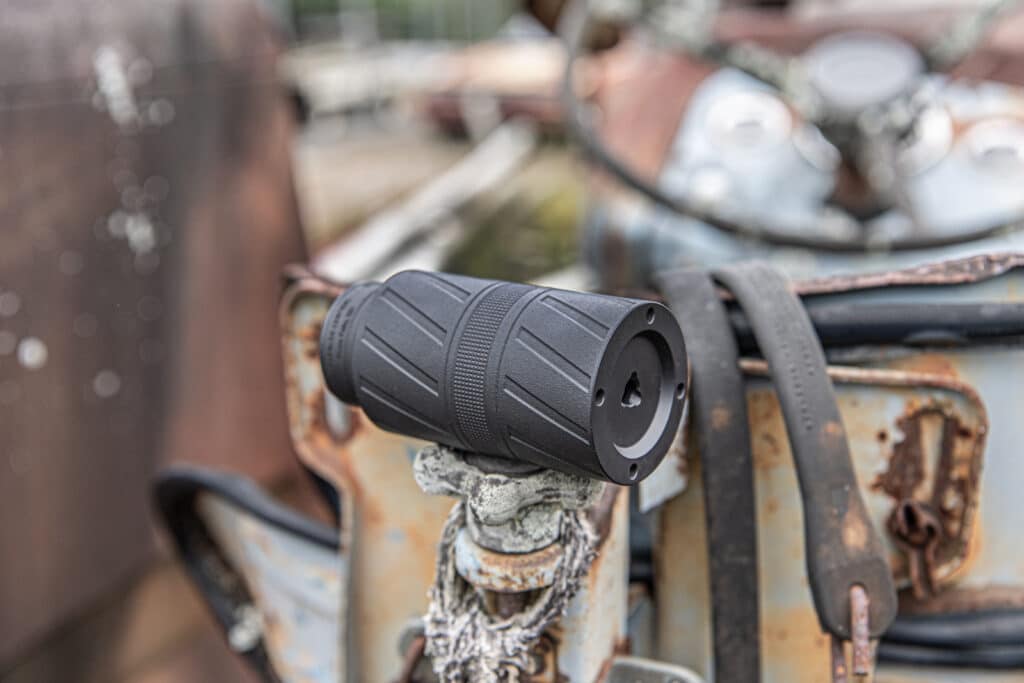
Why it wins: the combination of weight (4.1 oz), caliber breadth (including FN 5.7×28mm), full takedown, and $629 price is hard to match for a full-takedown titanium rimfire suppressor. The titanium tube and end cap are notably lighter than stainless competitors. BANISH lists the RF 22 TI as 100% titanium with 8 user-serviceable baffles, and its spec sheet says “titanium construction.”
Where it’s not the answer: if you specifically want SilencerCo’s decade-plus Sparrow track record and don’t need full takedown, the Sparrow 22 is a fine alternative at $280 less. If you need dual pistol/rifle length flexibility, the Switchback 22 earns its weight penalty.SilencerCo Sparrow 22 — The Proven Default
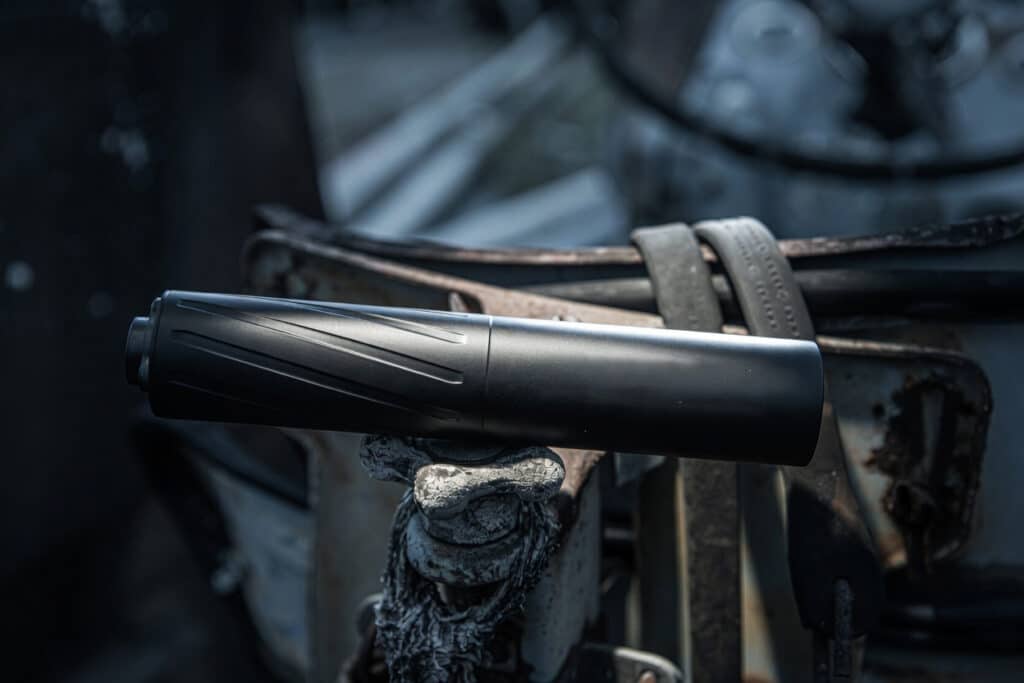
Why it wins: the Sparrow has been the default rimfire suppressor for over a decade. Stainless steel construction means it’s essentially immortal with basic maintenance. The clamshell design is genuinely easy to clean — two halves, baffle core out, done. At $349 MSRP it’s the cheapest proven rimfire suppressor in the field. Where it’s not the answer: it’s 6.5 oz — half again the weight of the BANISH 22 — which you feel on a light-barreled bolt-action. And it’s stainless, not titanium, which is durable but heavier. Who should buy it: the shooter who wants a suppressor that will outlive them, doesn’t need caliber flexibility, and values track record over weight savings.SilencerCo Switchback 22 — The Modular Option
Why it wins: modular length is a real feature, not a gimmick. You can run it at 2.8″ on a .22 pistol (still effective because K-baffle geometry is efficient at short stack counts), or extend to 5.75″ for maximum reduction on a bolt-action rifle. Full-auto rated, which matters to nobody in a rimfire context but signals the build quality. Full multi-caliber ceiling including 5.7×28mm. Where it’s not the answer: at 6.9 oz it’s the heaviest of the three, which matters most on a pistol. Current price point $579.00 MSRP puts it above the Sparrow and below the BANISH 22. Who should buy it: the dual-host shooter — suppressed Mark IV pistol plus suppressed CZ 457 — who genuinely wants one suppressor to serve both.
How Should You Read .22 Suppressor Reviews and dB Numbers?
Carefully, because the numbers in most .22 suppressor reviews are not measured the same way. SilencerCo publishes muzzle readings for the Sparrow 22 and Switchback 22. BANISH publishes 116.8 dB for the BANISH 22 on a 16-inch .22 LR barrel in its spec sheet, and 23 dB of reduction at the ear on a 10/22 in its manual. NIOSH researchers measured the same suppressed shots at four microphone spots, near the muzzle, at each ear and behind the shooter, and got different readings at each.
So before you crown a winner, check three things: where the microphone was, what barrel and ammo were used, and whether the figure is a final level or a reduction. A review that will not tell you those is selling, not measuring (and yes, that includes the manufacturer’s).
Other Rimfire Suppressors Worth a Look
If none of the three above fits, these three are the rimfire suppressors most often cross-shopped against them.Dead Air Mask HD
The Mask HD runs 5.1 inches and 6.6 ounces, with 17-4 stainless baffles in a Grade 9 titanium tube. It is rated for .22 LR, .22 Magnum, .17 HMR, .17 WSM and up to 5.7×28, and it is full-auto rated. Pick it if you want one stainless-baffle can that handles every rimfire host you own.Rugged Oculus22
The Oculus22 is built entirely from 17-4 stainless: 5.25 inches and 6.9 ounces long, or 3.25 inches and 4.3 ounces short. In PEW Science’s CZ 452 test it scored a Suppression Rating of 92.8 long and 86.8 short. Pick it if independently measured quiet matters more to you than weight.HUXWRX FLOW 22 Ti
The FLOW 22 Ti is Grade 5 titanium, 5.53 inches and 3.9 ounces, full-auto rated for .22 LR, .22 Magnum, .17 HMR and 5.7×28. That makes it a touch lighter than the BANISH 22. Pick it for a rimfire pistol where every ounce on the muzzle shows.Which New .22 Suppressors Came Out in 2026?
Five new rimfire models made American Rifleman’s 2026 roundup, and every one of them lists under $600, which tells you where the market went once the tax stamp hit $0. Inland Manufacturing’s AM-22 is aluminum, 4.6 ounces and 5.5 inches at $319. IWI US’s IWS22 mixes Grade 9 titanium and 7075 aluminum at 6 ounces, 6 inches and $439. Lone Wolf’s Eliminator 22 is 4.8 ounces and 4.8 inches at $299.
Sonicore’s Skarv 22 is the featherweight at 3.2 ounces and $199, rated to .22 WMR. Angstadt Arms’ Vanquish 22 is a different animal: an 18-inch, 20.7-ounce aluminum shroud built for the Ruger Precision Rimfire, at $599. Three of the five list 5.7×28 as their top cartridge; confirm the full caliber list on the maker’s own page before you buy.
| Model | Weight | Length | Material | Top cartridge | MSRP |
|---|---|---|---|---|---|
| Inland Manufacturing AM-22 | 4.6 oz | 5.5 in | Aluminum | 5.7×28 | $319 |
| IWI US IWS22 | 6 oz | 6 in | Grade 9 titanium / 7075 aluminum | 5.7×28 | $439 |
| Lone Wolf Eliminator 22 | 4.8 oz | 4.8 in | 17-4 stainless / 7075-T6 aluminum | 5.7×28 | $299 |
| Sonicore Skarv 22 | 3.2 oz | 5 in | 6026-T9 aluminum | .22 WMR | $199 |
| Angstadt Arms Vanquish 22 | 20.7 oz | 18 in | Aluminum | .22 LR | $599 |
Cost of Ownership Math: What You’re Actually Paying For
MSRP is only part of the story. Here’s the real ownership math on a rimfire suppressor in 2026.Purchase cost
- BANISH 22: $629 + $0 tax stamp (post-OBBB) = $629
- Sparrow 22: $349 + $0 tax stamp = $349
- Switchback 22: $579 + $0 tax stamp = $579
Optional threading
If your rifle is not threaded, add a gunsmith’s threading fee; ask a local shop for a quote. Factory-threaded rifles (CZ 457 MTR, Tikka T1x MTR, Ruger 10/22 Takedown and others) skip this line.
Form 4 processing time (only if you file one)
- E-file as individual: 6 days (ATF average, updated October 15, 2026)
- E-file through trust: 20 days
- Paper filing: 28 days individual, 37 days trust. Since October 9, 2026, ATF has not enforced the Form 4 for suppressors, but filing is still the safe path in the 20 states that tie suppressors to federal registration.
Ongoing maintenance cost
An ultrasonic cleaner and citrus/CLR dip runs $80–$150 one-time and cleans every suppressor you’ll ever own. No consumables. Baffles are not replacement parts on any of these three suppressors — if a baffle fails, the suppressor is sent back to the manufacturer under warranty.Expected service life
- Sparrow 22: A lifetime of rounds with clamshell cleaning (o-rings will need to be replaced)
- BANISH 22: A lifetime of rounds with full takedown cleaning
- Switchback 22: A lifetime of rounds with modular cleaning
The Myth of Point-of-Impact Shift on Rimfire
Centerfire suppressor buyers often worry about POI shift — the phenomenon where a suppressor changes barrel harmonics enough to move your zero. It’s real on centerfire rifles (typical shift: 0.5–1.5 MOA).On rimfire, POI shift is a much smaller worry. Here’s why: rimfire’s peak chamber pressure is about 24,000 psi (.22 LR); centerfire rifle rounds run 50,000 to 65,000 psi. The gas volume driving the harmonic change on centerfire is not present on rimfire. Still, every rifle and load is its own case.
Practically: most rimfire shooters screw a suppressor on and off without a meaningful change in zero, but check yours once with your own rifle and ammunition before you hunt with it.
Subsonic Ammunition — The Factor Nobody Explains Clearly
Every rimfire suppressor article should have this section and most don’t. A suppressor can only silence the muzzle report. It cannot silence the ballistic crack of a supersonic bullet. The speed of sound at sea level is ~1,125 fps. Standard-velocity .22 LR (CCI Mini-Mag, Federal American Eagle) runs 1,200–1,260 fps. That bullet is supersonic for the first part of its flight, and every observer within a few hundred yards will hear the sonic crack. True subsonic .22 LR (CCI Standard Velocity ~1,070 fps, CCI Quiet 22 ~710 fps, Aguila Super Colibri ~500 fps, Eley Subsonic Hollow ~1,040 fps) does not break the sound barrier. Combined with a suppressor, the result is action-cycling noise plus a muted muzzle report. The practical shooter’s play: stock 5,000 rounds of CCI Standard Velocity as your default subsonic. Keep 500 rounds of Mini-Mags for semi-auto cycling reliability (some blowback rifles won’t cycle subsonics). Try Aguila Super Colibri for backyard plinking at sub-500-fps levels. Match-grade subsonic (Eley, Lapua) for paper targets.Caliber Breadth: Why 5.7×28mm Matters
FN 5.7×28mm is not technically a rimfire round (it’s centerfire), but it’s threaded into the same class of host firearms — the FN Five-seveN pistol, the FN PS90, the Ruger LC Carbine, the PSA Rock 5.7. These are growing segments, and shooters who own them want to run suppressed.Here’s the challenge: 5.7×28mm runs peak pressures around 50,000 psi and muzzle velocities of 2,100 to 2,400 fps from a pistol barrel. That is centerfire rifle territory compressed into a pistol host, and many rimfire suppressors are not rated for it. The BANISH 22’s titanium build is rated for it. Whatever you buy, the maker’s caliber rating is the rule, not the material.
If you own a 5.7 host, this is a real feature that narrows your buying field. The BANISH 22 and Switchback 22 and the Sparrow 22 are all rated for 5.7.Which Is the Best .22 Suppressor for You?
- The first-time NFA buyer, .22 LR only: BANISH 22 for the weight and serviceability; Sparrow 22 for the track record and lower entry cost.
- The first-time NFA buyer with a 5.7 host: BANISH 22 for its titanium construction and light weight.
- The dual-host shooter (pistol + rifle): Switchback 22. Modular length genuinely earns its cost here.
- The high-volume trainer (10,000+ rounds/year): BANISH 22. Splurge for the lightest suppressor
- The minimum-effort owner who wants to clean twice a year: Sparrow 22. Clamshell design is quick.
- The small-game hunter: BANISH 22. Weight matters when you’re carrying the rifle.
Most of you don't have a suppressor on the deer rifle yet. Among those who do, titanium leads steel by more than three to one.
Best .22 Suppressor FAQ
What is the best 22LR suppressor?
For most shooters, the BANISH 22: 4.1 ounces, full takedown for cleaning, and rated from .22 LR through 5.7×28mm at a $629 MSRP. The SilencerCo Sparrow 22 is the proven lower-cost pick at $349, and the Switchback 22 suits a shooter who runs both a pistol and a rifle.
Which .22 suppressor is the quietest?
No one can say from maker numbers, because they are measured differently. SilencerCo lists muzzle readings of 107.8 dB for the Switchback 22 and 111.9 dB for the Sparrow 22; BANISH lists 116.8 dB for the BANISH 22 on a 16-inch barrel without naming the microphone spot. Subsonic ammunition makes a bigger difference than any one model.
What is the best .22 pistol suppressor?
The SilencerCo Switchback 22, because it can run as short as 2.8 inches and 3.7 ounces on a pistol, then extend to 5.75 inches on a rifle.
What is the best 22LR suppressor for the money?
The SilencerCo Sparrow 22 at $349 MSRP. Its clamshell core is easy to clean and it is rated from .22 LR through 5.7×28mm.
Do I still need a tax stamp for a .22 suppressor in 2026?
No. The federal tax stamp dropped to $0 on January 1, 2026. And since October 9, 2026, ATF has not enforced the Form 4 approval or registration requirement for suppressors, for anyone, though a dealer still runs a background check. In the 20 states that tie suppressors to federal registration, filing a Form 4 is still the safe path. Check your state’s law too.
What is the best .22 LR suppressor under $350?
On makers’ list prices, the SilencerCo Sparrow 22 at $349 is the proven pick, and 2026 added cheaper new models such as Lone Wolf’s Eliminator 22 at $299 and Sonicore’s Skarv 22 at $199. Check each maker’s caliber rating.
Does BANISH publish a dB figure for the BANISH 22?
Yes, two. Its July 2026 spec sheet lists 116.8 dB with .22 LR from a 16-inch barrel, and its owner’s manual lists 23 dB of reduction at the ear on a 10/22. They measure different things.
How often should you clean a .22 suppressor?
Often. BANISH tells BANISH 22 owners to clean every 100 to 200 rounds so lead and carbon do not fuse the baffles. Check your own maker’s manual.
About This Article
Written by James Nicholas (The XDMAN), 07/02 NFA Firearms Manufacturer & Professional Gunsmith. Silencer Central was a paid sponsor of the 100 Days of Silence series on PopularSuppressors.com, which has ended. BANISH suppressors are made by Silencer Central. PopularSuppressors.com now has no sponsors and no affiliate relationships. Prices, weights, lengths and caliber ratings re-checked against banishsuppressors.com and silencerco.com on October 6, 2026. Sound figures are the makers’ own published muzzle readings; your results will vary with host, ammunition and measurement method. Form 4 processing times are ATF’s own averages from its processing-times page, updated October 15, 2026.More from PopularSuppressors.com
Set on the BANISH 22? Read our full BANISH 22 review.
Similar Posts