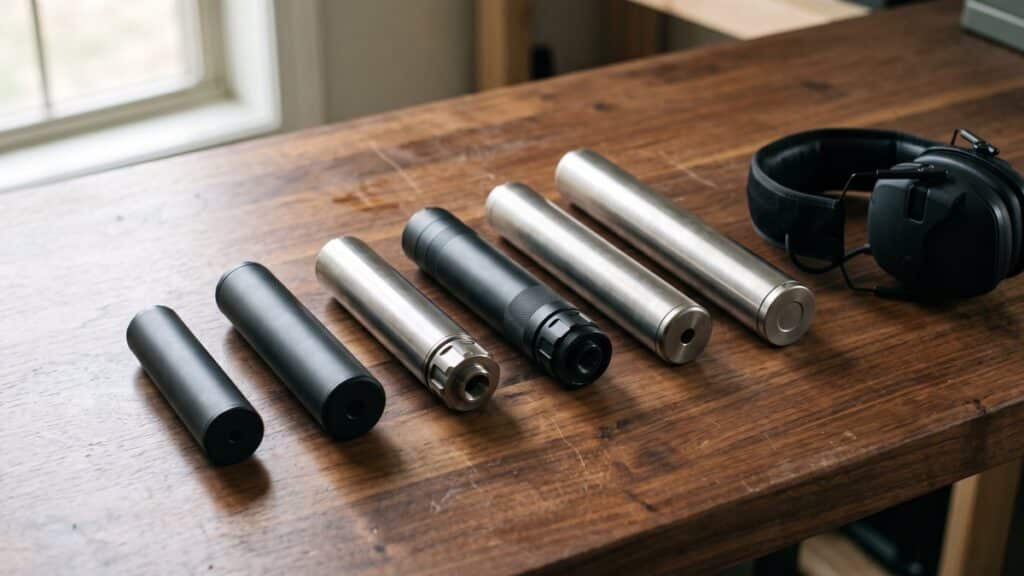
Suppressor First Round Pop: Why the First Shot Is Louder
Suppressor first round pop is the louder first shot from a cold suppressor, when oxygen trapped inside burns with leftover powder gas.
In This Article
Originally published: October 23, 2026
Suppressor first round pop, usually shortened to FRP, is the sharper report a suppressor gives on its first shot after sitting cold. The air inside still holds oxygen, and it burns with the hot powder gas that follows the bullet. What matters is how you measure it. PEW Science’s free data often puts the first shot’s peak decibel reading close to the test average, yet its hearing-damage estimates found that shot worse for bystanders on 8 of the 10 setups below. Wear hearing protection anyway, and let your suppressor’s maker decide what goes inside it.

Safety note. Check suppressor alignment with an unloaded firearm, follow the maker’s mounting instructions, and never fire a caliber larger than a suppressor is rated for. Never put liquid, gel or gas into a suppressor unless its maker approves it. A suppressed rifle is still loud, so everyone near the muzzle needs hearing protection. Suppressor ownership and hunting rules vary by state; check yours.
Picture opening morning. You sit for three hours, a buck steps out, and you fire one shot through a suppressor that has hung cold on the rifle since before daylight. That shot is the one most of the suppressors below handle worst (the quieter follow-ups come after the deer is down or gone).
Suppressor First Round Pop at a Glance
- What it is: The first shot from a cold suppressor, made harsher when oxygen inside burns with the powder gas.
- How much worse: PEW Science put the first-shot penalty for bystanders at up to about 20% on one .308 and nearly ten times on a .22 pistol; on another .308, the pop may be imperceptible.
- The meter misses it: Where both numbers were published, the first shot’s peak sat within 5 dB of the test average, and one came in lower.
- Hunting: The shot at game is usually the first of the day, so judge a hunting suppressor by its first shot.
- What helps: Suppressor design and barrel length. Wet use only where the maker allows it; most rifle suppressors run dry.

Suppressor First Round Pop, Measured
I trust a microphone more than a sales sheet. PEW Science, an independent lab, prints first-shot numbers for named suppressors in its free Sound Signature Reviews, and every row is from those reviews. Our guide to how PEW Science tests suppressors covers its method.
| Suppressor | Host and cartridge | First shot vs. later shots (PEW’s finding) | First-shot peak vs. test average, dB | Source |
|---|---|---|---|---|
| Thunder Beast ULTRA 9 (original model) | Savage Model 10, 20-in., .308 Win. | No clear first-shot spike; shot 2 had the highest peak. PEW: the pop may be imperceptible | 141.6 vs. 142.3 | PEW Science, 2020 |
| Silencer Central Banish 30 Gold | Savage Model 10, 20-in., .308 Win. | Perceptible to bystanders, “not extreme” | 143.8 vs. 143.4 | PEW Science, 2022; maker helped fund |
| Silencer Central Banish 30, long setup | Savage Model 10, 20-in., .308 Win. | “Significantly perceptible” to bystanders; worse when shortened | 147.3 vs. 144.7 | PEW Science, 2022; maker helped fund |
| PWS BDE 762, long setup | Savage Model 10, 20-in., .308 Win. | Up to about 40% more severe for bystanders | 148.7 vs. 144.8 | PEW Science, 2023; maker helped fund |
| Savage AccuCan AC30 | Savage Model 10, 20-in., .308 Win. | Up to about 20% more severe for bystanders | First-shot peak not in the free review; average 150.0 | PEW Science, 2024; maker helped fund |
| Magco Arms EDS-30L | Savage Model 10, 20-in., .308 Win. | About 50% more severe for bystanders | First-shot peak not in the free review; average 141.9 | PEW Science, 2026; maker helped fund |
| Otter Creek Labs Hydrogen-L | Q mini FIX bolt-action pistol, 8-in., subsonic 300 BLK | Over 64% more severe for bystanders | 131.3 vs. 127.9 | PEW Science, 2022; maker helped fund |
| Rugged Razor762 | Q mini FIX bolt-action pistol, 8-in., subsonic 300 BLK | Up to about 200% more severe for bystanders | 150.9 vs. 145.9 | PEW Science, 2023 |
| Rugged Oculus, long setup | CZ 452 bolt-action rifle, 16-in., .22 LR standard velocity | No first-shot spike in peak pressure; PEW found the change in its other measures | Shot 4 was highest at 123; average 122.8 | PEW Science, 2020 |
| SilencerCo Sparrow | Beretta 21A pistol, 2.4-in., .22 LR standard velocity | “Almost an order of magnitude” (nearly ten times) more severe for bystanders | First-shot peak not in the free review; average 131.3 | PEW Science, 2025 |
Numbers as PEW Science published them, from its microphone 1 meter (39.4 inches) left of the muzzle; shooter’s-ear data is for paying members. “More severe” is PEW’s hearing-damage estimate for a bystander, first shot against later shots. The test average includes the first shot. Loads: Federal XM80 or XM80C 149-grain (.308), Discreet Ballistics 190-grain subsonic (300 BLK) and CCI Standard Velocity (.22 LR). “Maker helped fund” is PEW’s own disclosure.

Two patterns jump out. Short barrels and subsonic loads do not save you, since both 8-inch 300 BLK setups carried big first-shot penalties. And a .22 is not automatically gentle: the Sparrow on a 2.4-inch pistol ran nearly ten times worse.
Our subsonic ammo guide explains why a bullet under the speed of sound skips the supersonic crack, and Popular Ammo’s 300 Blackout ammo guide sorts the loads, but expect the first shot to stand out anyway.
What Causes First Round Pop?
Fresh air. Before the first shot, the suppressor holds ordinary air, about 21% oxygen by the count of Discreet Ballistics, which sells an anti-pop device. The hot gas behind the bullet still carries unburned powder, and when it meets that oxygen it keeps burning inside the suppressor. Silencer Shop, a retailer, calls it a secondary ignition; Stalon, a silencer maker, says the extra burn raises the pressure and makes the first shot louder.
After that shot, the chambers are full of spent gas with little oxygen left, so the next shot has less to burn. PEW Science repeats it in review after review: first-round signatures “always differ from subsequent shots, as the atmosphere within the silencer changes.”
Barrel length feeds it. On the Sparrow, PEW wrote, the extra burning “occurs unimpeded during the first shot” and gets worse with a short barrel’s higher pressure and leftover powder. Capitol Armory, another retailer, says longer barrels burn more powder before the bullet leaves, which typically reduces the effect.
Why a Decibel Meter Misses It
Look at the decibel column again. Where PEW published both numbers, the first shot’s peak sat within 5 dB of the test average (our arithmetic), and on the ULTRA 9 the first shot came in under it. Yet PEW still rated most of those first shots more severe. How? PEW says it outright: “The FRP phenomenon cannot always be shown by viewing only the peak sound pressure.”
A peak is one instant. The first blast also builds faster and carries more push, which PEW measures as impulse, and PEW scores its recordings with hearing math built on the U.S. Army Research Laboratory’s model of the human ear. Those estimates are the percentages in the table. Remember that the next time you compare decibel claims.

Why It Matters for Hunting
Having worked behind the counter for over 20 years, I get asked how quiet a suppressor is all the time, and almost never how quiet its first shot is. For a hunter, that is BACKWARD. Most mornings you fire once, maybe twice, from a suppressor that has sat cold since you left the truck. Judge a hunting suppressor by its first shot, because on a good morning it is the only one the deer hears.
PEW’s free numbers come from 1 meter beside the muzzle, roughly where a hunting partner or a kid in a two-person blind sits. PEW’s hearing page uses a hunting buddy a yard away as its example of an “unwarned” listener, whose inner-ear muscles never tightened because he did not know the shot was coming. The shooter may fare better; on the Magco EDS-30L, PEW found the first-shot difference less pronounced for the shooter than for bystanders.
Will the first shot spook game? I could not find a test that measured it; Silencer Central’s blog says the pop most likely will not startle game, without citing one. Hunting rules for suppressors vary by state, so check our suppressor laws by state page, and our best hunting suppressor guide covers weights and sizes.

What Reduces First Round Pop
Design does most of the work. PEW believed the original ULTRA 9 was the first centerfire rifle suppressor it tested to almost completely mask the pop, and wrote that the Sparrow needs more baffles, more advanced internal shapes, or both. Venting can work against you: PEW saw more first-shot severity when more gas vents at the front, as on Otter Creek Labs’ Infinity with a vented end cap. Silencer Shop, a retailer, names the Dead Air Mask, SilencerCo Spectre II and Thunder Beast Dominus-SR as designed to cut the pop (claims, not measurements).
Setup matters too. Modular suppressors are a coin toss: PEW found the Banish 30’s first shot more severe when shortened, but the PWS BDE 762’s less severe in its short setup. Our suppressor comparison chart is the place to start a shortlist, with weights, lengths and published sound figures, but read the review for your model before you judge a first shot.
Cooling works against you. Silencer Shop and Stalon both say a suppressor left to cool for 10 to 15 minutes will likely pop again (Stalon says it refills with oxygen). A quick follow-up is quieter, but the shot at a deer rarely is one.
Purging is the last trick. PEW notes the first shot will differ unless the shooter is “employing a novel gas-displacement apparatus to inject a material other than air into the silencer, or using some kind of ablative media.” Discreet Ballistics sells a carbon dioxide injector that claims up to 9 dB less noise, without naming the suppressor or rifle it tested (a maker figure). Nothing goes into a suppressor without its maker’s approval. No home remedies.
Wet vs Dry Suppressors
Shooting “wet” means adding a little liquid or gel to a suppressor built for it, and Capitol Armory says the benefit shows mostly in the first few shots. SilencerCo, a maker, puts the gain at 3 to 10 decibels (its figure) but says most rifle suppressors are not designed to run wet. Silencer Central’s blog agrees on rifles: “The risk of damaging your suppressor, gun, and yourself is too high to justify getting rid of a first-round pop.”
PEW’s notes on its M4 test rifle say first-shot pop “can not be ‘tuned out’ of the system without the use of some type of ablative medium,” the kind of material SilencerCo says goes in a wet suppressor. Shooting Illustrated’s Steve Adelmann says to follow the maker’s instructions carefully; a friend of his blew his AR into large pieces after filling his suppressor improperly. So a rifle suppressor runs dry unless its maker’s manual says otherwise.
First Round Pop vs First Round Flash
First round flash is the visible cousin. Discreet Ballistics calls first round pop the audible reaction to that trapped oxygen and first round flash “the visible reaction,” a flash outside the suppressor. PEW tied the two together on a Surefire SOCOM556-RC3 on a short-barreled MK18, whose unpredictable first-shot signature “may result in both increased blast hazard, as well as flash signature during the first shot.” At the edges of legal light, the first shot is the one most likely to show.
Most of you don't have a suppressor on the deer rifle yet. Among those who do, titanium leads steel by more than three to one.
Frequently Asked Questions
Why is the first shot from a suppressor louder?
It meets a suppressor full of fresh air instead of spent gas. Silencer Shop adds that suppressors with more internal volume tend to pop harder because they trap more oxygen, and Capitol Armory says high humidity can reduce it (both retailers, neither citing a test).
How much louder is first round pop?
In PEW’s subsonic 300 BLK tests, the first shot carried over 98% more peak impulse than later shots with the Otter Creek Labs Hydrogen-L, and over 280% more with the Diligent Defense Enticer L-Ti.
Does every suppressor have first round pop?
By PEW’s measure, yes, in some form. PEW calls the shift in how fast the first blast builds “always present.” Hearing it is another matter. The Oculus was sometimes advertised as having no first round pop, and PEW found none in peak pressure but some in its other measures. The original ULTRA 9 was advertised with “very little to ‘no’ first round pop,” which PEW wrote its test verified.
Does first round pop hurt hearing?
The first shot adds to a noise that is already over the line. OSHA’s workplace rule says impulse noise should not exceed 140 dB peak, and every .308 test average in the table tops that at the bystander microphone. Silencer Central’s blog says the pop itself is not loud enough to hurt your hearing; PEW put first shots up to about 50% more severe on the .308 setups that got a number. Wear protection, and hand some to your partner.
Does a “purged” suppressor get rid of first round pop?
Not by the name alone. PEW describes Battle Born Supply Co.’s Whiskey Quebec 5.56 “Purged” model as the standard model plus a small array of vents near the front, and found its first shot more severe, compared with later shots, than the standard model’s. Read the test, not the label.
So shop for the shot that counts. The quietest suppressor on paper is not always the quietest on its first shot, so put hearing protection on everybody in the blind and remember the Highlander rule of deer hunting: there can be only one (and it is the loud one). Then price your pick, mounts and all, in our suppressor cost calculator.
Sources: PEW Science, “Suppressor Sound Signature Reviews” (reviews linked in the table); PEW Science, “Diligent Defense Co. Enticer L-Ti 300 BLK Subsonic Suppressor Test”; PEW Science, “Battle Born Supply Co. Whiskey Quebec 5.56 Purged AR15 14.5-in M4 Suppressor Test”; PEW Science, “Surefire SOCOM556-RC3 5.56 AR15 SBR Suppressor Test”; PEW Science, “Silencer Sound Standard – Hearing Effects”; OSHA, “1910.95 – Occupational noise exposure”; SilencerCo, “How and When To Shoot a Suppressor Wet”; Silencer Central, “First Round Pop: What It Is and Why We Care”; Discreet Ballistics, “Why PopStop and why does FRP (First Round Pop) matter?”; Stalon, “Why does the first shot sound louder? FRP and silencers for hunting”; Silencer Shop, “What is First Round Pop?”; Capitol Armory, “What is first round pop?”; Shooting Illustrated, “Suppressor Basics”.
Similar Posts