Cheapest Suppressor by Caliber: 2026 Maker Prices
Cheapest suppressor prices in stock on October 31, 2026: $259 for .22 LR, $299 for 5.56, $299 for .30 cal and $299 for 9mm.
In This Article
Originally published: November 1, 2026
Safety and price note. Mount any suppressor with the firearm unloaded, check alignment before the first shot, and never fire a caliber larger than a suppressor is rated for. Prices are each maker’s own listed price, and stock was checked on October 31, 2026. Prices change, so check the maker before you buy. No link on this site earns us a commission. Suppressor ownership and hunting rules vary by state; check yours.

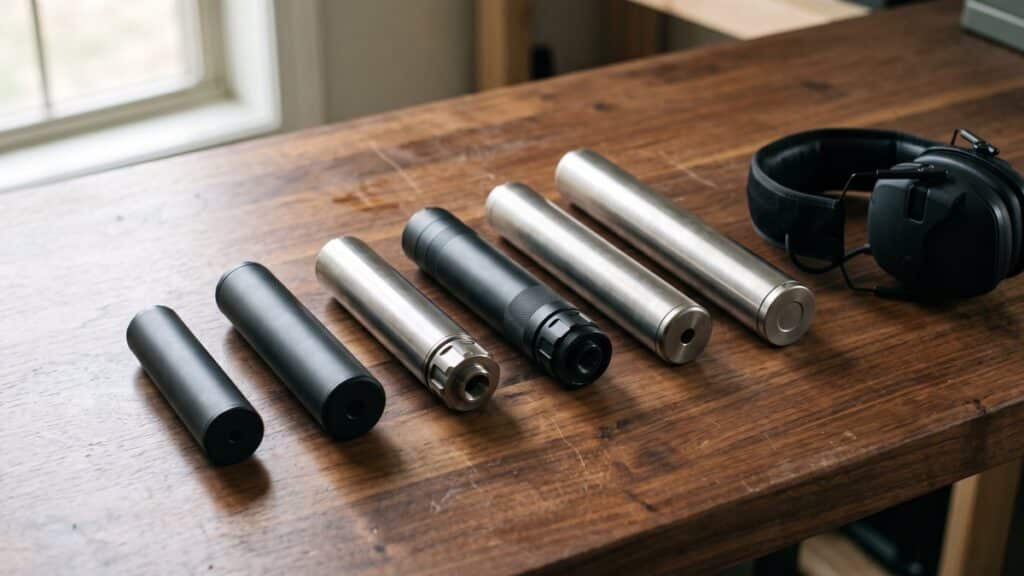
Suppressors have moved from a specialized accessory to a practical part of many shooters’ setups, yet price remains the biggest obstacle for most people. A .22 LR can is a far simpler and less expensive product than a centerfire rifle suppressor built to handle high-pressure .30-caliber or magnum rounds, so the cheapest viable option changes dramatically depending on caliber. In 2026, manufacturer pricing still reflects those differences in materials, size, and internal design, making it useful to look at current maker prices rather than street deals that come and go.
This comparison focuses on the lowest advertised manufacturer prices by caliber, highlighting options that prioritize affordability without dropping below basic performance and durability standards. Whether you’re looking at rimfire, pistol, or rifle cans, the goal is to show what the market’s entry-level pricing actually looks like from the companies that make them, so you can set realistic expectations before shopping.
Cheapest Suppressor Prices at a Glance
- Lowest in stock: Hi-Point Hush-Point 22, $259 MSRP, rated .22 Short through .22 WMR.
- 5.56: Witt Machine Big Body Tu-Tu-Three, $299, in stock at Witt.
- 9mm: Witt Machine Naughty 9, $299, in stock in FDE, listed for fixed-barrel guns.
- Shotgun: YHM Victra-12, $979.95, plus a $106.95 mount.
- Federal tax: $0. ATF says Congress eliminated the making and transfer taxes on suppressors.

Cheapest Suppressor by Caliber
The cheapest suppressor available for any given caliber is shaped by the pressures and volumes the can must contain, which is why rimfire models remain the clear entry point while centerfire rifle suppressors cost substantially more. In late 2026, with the federal tax stamp at $0 and transfers handled on a standard Form 4473 background check, manufacturer pricing is the main variable left to compare. Rimfire cans from established makers are commonly listed in the $250–$500 range, 9mm and pistol-caliber options typically start higher, and dedicated 5.56 or .30-caliber rifle suppressors generally begin in the mid-to-high hundreds before climbing past $1,000 for more robust or multi-caliber designs. The figures below focus on current manufacturer-advertised prices rather than temporary dealer specials, highlighting the lowest viable options in each common caliber class so the differences in cost and construction are easy to see.
| Caliber | Lowest in-stock maker price | Next-cheapest | What the cheaper one gives up | Rated for (lowest pick, per the maker) |
|---|---|---|---|---|
| .22 LR | Hi-Point Hush-Point 22, $259 (MSRP); in stock at Capitol Armory and KYGUNCO | CMMG Zeroed 22, $274.95; listed in stock by CMMG (30 to 60 business days to ship) | Hush-Point: 6.19 in., 4.9 oz, one-piece aluminum core, not full-auto rated. Zeroed 22: 5.5 in., 5.6 oz, stainless baffles, full-auto rated on .22 LR | .22 Short, .22 LR, .22 WMR, .17 Mach 2, .17 HMR, .17 WSM |
| 9mm | Witt Machine Naughty 9, $299; in stock at Witt (FDE finish) | Hi-Point Hush-Point 9/45, $439 (MSRP); in stock at Capitol Armory and KYGUNCO | Naughty 9: 4 in., 13.8 oz, 416 stainless, full-auto rated, listed for fixed-barrel guns, suppressor sales final. Hush-Point: 7.87 in., 12.8 oz, aluminum core, not full-auto rated, but rated from .380 to .45 Auto and 10mm | 9mm; Witt lists no barrel-length limit |
| 5.56 / .223 | Witt Machine Big Body Tu-Tu-Three, $299; in stock at Witt | YHM R9, $599.95; listed in stock by YHM, which rates it for 5.56 NATO on a 16-in. or longer barrel | Tu-Tu-Three: 4 in., 14.1 oz, 1⅝ in. wide, no barrel restriction, 1/2×28 only, full-auto rated. R9: $300.95 more, 5.5 in. and 11 oz with the 1/2×28 adapter it ships with, and a 16-in. minimum barrel on 5.56 | .223/5.56 on a 1/2×28 thread |
| .30 caliber | Witt Machine Dirty .30, $299; in stock at Witt | YHM R9, $599.95; YHM rates it for .308 Win on a 16-in. or longer barrel | Dirty .30: 4 in., 13.8 oz, 5/8×24 only, fixed-barrel guns, suppressor sales final. R9: 5.5 in. with the 1/2×28 adapter it ships with, so a 5/8×24 mount is $89.95 more | 30 caliber; Witt names .300 Win Mag and .300 Blackout, no barrel-length limit |
| 300 Blackout | Witt Machine Dirty .30, $299; in stock at Witt | Hi-Point Hush-Point 9/45, $439; in stock at Capitol Armory and KYGUNCO | Dirty .30: 5/8×24 thread, fixed barrels. | |
| SGX 12: 12.2 in. and 22.4 oz at full length with mount, JK lists all shot types | 12 gauge: 3½-in. shells on 16-in. barrels, 3-in. on 10-in., 2¾-in. on 7½-in. |
Prices are the maker’s own listed price (Hi-Point labels its figures MSRP). A model made the table only if the maker’s page showed it in stock or two major dealers (Silencer Shop, Capitol Armory, KYGUNCO) listed it in stock on October 31, 2026. Weights and lengths are the maker’s numbers. Sound is not ranked, because no single test covers these models.

What the Cheapest Suppressor Costs All In
The all-in price of the cheapest suppressor is now much closer to the manufacturer’s listed price than it was in prior years. The federal transfer tax has been $0 since January 1, 2026, and as of October 9, 2026, ATF is no longer enforcing Form 4 approval, registration, fingerprints, or tax-stamp requirements for suppressors. In states that allow it, a dealer can transfer the can on a standard Form 4473 and NICS background check—the same process used for ordinary firearms, so the old $200 stamp and multi-week wait are gone from the equation
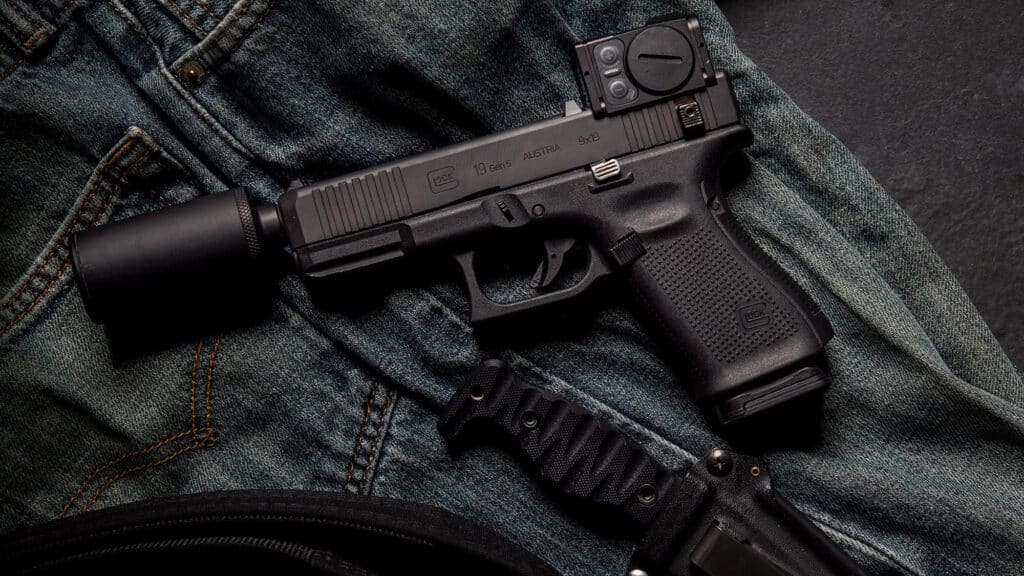
What remains are ordinary dealer costs plus the parts needed to make the suppressor actually work on your gun. Transfer fees typically run $0 to $50 when you buy from the same shop, though incoming transfers from online sellers can reach $50–$80 depending on the dealer. Shipping, sales tax, a threaded barrel ($100–$300), or suppressor-height sights for a pistol can add more. More importantly, many of the cheapest suppressors ship with only a basic direct-thread interface or as a bare HUB-compatible body, so you may still need to buy a booster (Nielsen device) for a tilting-barrel pistol, a specific muzzle device, or an adapter to match your host. These extras often run $40–$150 and are especially common on budget models that keep the sticker price low by leaving the mounting hardware out. For a budget rimfire can in the $250–$300 range bought locally with a low or zero transfer fee and a simple direct-thread setup, the realistic all-in total is often only a few dozen dollars above the sticker price. Centerfire options start higher, and the same mounting and host-prep costs still apply, so the final number depends more on the caliber, the host, and what the can actually includes than on federal paperwork. State laws still vary, and a handful of states either ban suppressors or continue to require registration, so local rules can change the practical total.
| Caliber | Lowest pick | Mount | Federal tax | Total before dealer fee |
|---|---|---|---|---|
| .22 LR | Hush-Point 22, $259 | 1/2×28 host cap on the suppressor | $0 | $259 |
| 9mm | Naughty 9, $299 | Threads straight onto 1/2×28 or 5/8×24 (choose at checkout) | $0 | $299 |
| 5.56 / .223 | Big Body Tu-Tu-Three, $299 | Threads straight onto 1/2×28 | $0 | $299 |
| .30 caliber | Dirty .30, $299 | Threads straight onto 5/8×24 | $0 | $299 |
| 300 Blackout | Dirty .30, $299 | Threads straight onto 5/8×24 | $0 | $299 |
| 12 gauge | Victra-12, $979.95 | Victra-12 mount for your shotgun brand, $106.95 | $0 | $1,086.90 |
Totals are the maker’s price plus any mount the maker sells separately. A direct-thread suppressor fits only if your barrel has the same thread.
Run your own numbers in our suppressor cost calculator, which keeps the tax line at $0 and lets you add a second host. And before you buy any direct-thread model, match it to your barrel with our thread pitch chart, which lists 1/2×28 as the most common rimfire, 9mm and 5.56 thread and 5/8×24 for .30-caliber barrels.
The Lowest Stickers Were Sold Out
So why is the cheapest number you saw on a forum not in the table? Because I could not find anyone selling it on October 31. Here is what was listed lower than our picks and what the stock check found:
- Sonicore (Lyman): Skarv 22 $199.95, Valor 9 $299.95 and Paradox DT $279.95 on Lyman’s pages, which point you to dealers. The Skarv 22 and Valor 9 were out of stock at Silencer Shop, Primary Arms and KYGUNCO. The Paradox DT showed in stock only at Midwest Gun Works (the .30 version) and out of stock at Silencer Shop, Brownells, KYGUNCO and Primary Arms. Lyman also says the Paradox is meant for bolt-action, lever-action and single-shot guns, and it does not recommend running it much on a semi-auto.
- Witt Machine: the Canooter Valve at $248.75 and the Ravener-12 at $699.99 showed out of stock on Witt’s own store.
Think about it. A $199.95 rimfire suppressor you cannot buy saves you nothing over a $259 one you can. When those come back in stock they take over their rows; until then, a table of things you cannot order is a wish list.
What a Cheap Suppressor Gives Up
A cheap suppressor usually gives up durability, materials, and refinement more than basic function. Budget models are more often built from heavier steel or stainless rather than titanium or advanced alloys, so they tend to weigh more and can be more prone to carbon locking or corrosion if not cleaned regularly. Sound reduction is frequently a few decibels behind premium cans of similar length, and many entry-level options are fixed-length or limited in modularity, with simpler baffle designs that prioritize cost over the lowest possible backpressure or the quietest possible report. Mounting systems are also more basic which are often direct-thread only or requiring separate adapters raising the cost. Warranties or customer support can can also be a trade-off. The problems with budget suppressors, is rarely that the can is unusable; most of the cheapest suppressors still deliver meaningful noise reduction and hold up under normal recreational use. What they typically surrender is long-term toughness under high round counts, light weight, refined gas dynamics, and the polish that higher-priced models provide.
Rimfire
The Hush-Point 22 uses a one-piece aluminum core (Hi-Point calls it a monolithic baffle) in an aluminum body with a stainless host cap, and Hi-Point says it is not full-auto rated. The CMMG Zeroed 22 costs $15.95 more and brings 17-4 stainless baffles, a 1-in. diameter that CMMG says removes the need for suppressor-height sights on many pistols, and a full-auto rating on .22 LR. If you plan to shoot it a LOT, the stainless baffles are where I would spend the $15.95.
9mm
The Naughty 9 is 4 in. and 13.8 oz of 416 stainless, full-auto rated, and comes threaded 1/2×28 or 5/8×24. Witt lists it for fixed-barrel guns and names the MPX, a PCC or a truck gun, and on October 31 only the FDE finish was in stock (the black one was sold out). If your 9mm is a pistol, read that fixed-barrel line twice. The Hush-Point 9/45 costs $140 more and covers everything from .380 to .45 Auto, plus 10mm and 5.7×28. Its page lists host caps in 1/2×28 and .578×28 but says nothing about a booster (the piston assembly YHM sells for running its R9 on a handgun), so ask Hi-Point or your dealer about your pistol before you buy. YHM is plain about it: the R9 “can be used with handguns in conjunction with our Nielsen Booster Assembly,” sold separately, and it also takes .300 Blackout and .308.

5.56, .30 Caliber and 300 Blackout
The Witt suppressors are short and simple. The Big Body Tu-Tu-Three is 4 in. long with no barrel restriction, and the Dirty .30 is 4 in., threads onto 5/8×24 only and is listed for fixed-barrel guns. Witt’s pages also say suppressor sales are final, so be sure of your thread and your caliber before you check out. The Dirty .30 page gives its weight as 13.8 oz in the description and 13.7 oz in the spec box (not a big deal, but it tells you how closely to read).
12 Gauge
Shotgun suppressors are some of the most expensive no matter what brand or model. The Victra-12 mounts on your shotgun’s factory choke threads through a brand-specific mount that YHM sells separately, and YHM warns against running high-density shot such as Hevi-Shot, Federal TSS, tungsten or bismuth, or slugs, through a full choke. The JK SGX 12 costs $115.05 more than the Victra-12 alone, and JK lists it as compatible with all shot types. Our shotgun suppressor guide covers the mount and ammo limits in more detail.
Mounts Change the Math
Remember, a cheap direct-thread suppressor is only cheap if your barrel already wears the right thread. The R9 ships with a 1/2×28 direct-thread adapter; put it on a 5/8×24 .308 barrel and YHM’s direct-thread HUB adapter adds $89.95 (YHM’s store listed the 5/8×24 version in stock on October 31). The Victra-12 needs a $106.95 mount for your brand of shotgun, from Remington to Benelli to Mossberg 500. Price one mount per gun. So when two are close, buy the one that threads onto the gun you own. Call it The Price Is Right rule: closest to your gun without going over your caliber rating.
Are Cheap Suppressors Worth It?
I have watched people overspend on their first suppressor more often than they underspend. A cheap suppressor that fits your gun and your caliber rating will make it quieter, and that is the whole job. Where the money goes up is weight, length, full-auto ratings, extra mounts and multi-caliber flexibility. The one place I would not cut corners is the caliber rating. My advice is to always pick an honest budget and then look at what calibers you want to shoot and then you could see what’s in stock to find your perfect match. To compare pricier models side by side, our suppressor comparison chart lists 11 of them with price, caliber and weight.
Are Suppressor Prices Going Down?
There is no way to really tell what’s gonna happen in market wide. But what what I can say is that every day I am seeing new suppressor manufacturers, and there are some great deals to be had. But in all honesty quality is always gonna cost more. A cheap suppressor is gonna have to cut corners somehow to be able to make those rock bottom prices. In reality what’s actually happening is that the prices aren’t going down you’re just getting more choices.
How to Buy One After October 9
ATF’s October 9, 2026 guidance says it will not enforce the requirement to apply for and receive ATF approval before making or transferring a suppressor. It also says “licensed dealers must still complete Form 4473s, run NICS background checks, keep records,” so you still buy through a dealer and you still pass a background check. Witt Machine, for one, takes the order online and has you name a local dealer to receive the suppressor. State law is the other half. ATF’s guidance “does not supersede state and local laws that restrict NFA firearms,” and individuals “must also continue to comply with state law, which may be more restrictive.” Look up your state on our suppressor laws by state page before you spend a dime.
Most of you don't have a suppressor on the deer rifle yet. Among those who do, titanium leads steel by more than three to one.
Frequently Asked Questions
Is there still a $200 fee for suppressors?
No federal tax applies to suppressors. ATF’s October 9, 2026 guidance says Congress eliminated the making and transfer taxes, and that the $200 tax remains only for machine guns and destructive devices. Your dealer’s transfer fee and any state fees are separate.
What is the cheapest .30 caliber suppressor?
The lowest in-stock .30 caliber price we found on October 31, 2026 was the Witt Machine Dirty .30 at $299 on Witt’s store. Lyman lists its Sonicore Paradox DT .30 at $279.95, but only one of the five dealers we checked showed it in stock.
What is the cheapest 9mm suppressor?
Of the models in stock on October 31, 2026, the Witt Machine Naughty 9 was lowest at $299 on Witt’s store (FDE finish only), and Witt lists it for fixed-barrel guns. The Hi-Point Hush-Point 9/45 was next at a $439 MSRP. Lyman’s Sonicore Valor 9 lists at $299.95 but was not in stock where we looked.
Can I buy a suppressor straight from the maker?
Some makers, such as Witt Machine and JK Armament, list in-stock suppressors on their own online stores. Others show a price and point you to a dealer, as Lyman does on its Sonicore pages. Either way the dealer completes the Form 4473 and the background check. My verdict: buy the cheapest suppressor that is rated for your caliber, threads onto the gun you own and is in stock, in that order. And if the sticker looks too good, check the stock line first, because the $199.95 one does not shoot any quieter while it is sold out.
Sources: ATF, “ATF issues guidance on National Firearms Act transfers” (Oct. 9, 2026); Hi-Point Firearms, Hush-Point 22 and Hush-Point 9/45; CMMG, Zeroed 22; Yankee Hill Machine, R9, Victra-12, Victra-12 mount assemblies and direct-thread HUB adapter; Witt Machine, Canooter Valve, Big Body Tu-Tu-Three, Dirty .30 and Naughty 9; JK Armament, SGX 12GA; Lyman Products, Skarv 22, Valor 9 and Paradox DT. Stock checked October 31, 2026 on each maker’s store and at Silencer Shop, Capitol Armory, KYGUNCO, Primary Arms, Brownells and Midwest Gun Works.
Similar Posts