Best .308 Suppressor: A Gunsmith Picks by Rifle Type
The best .308 suppressor is a .30 caliber can rated past .308 Win: a full-auto-rated can for an AR-10, a light one for a bolt gun.
Last updated: November 25, 2026 · Originally published November 20, 2026
Safety and legal note. This article is general information, not legal advice. Only fire cartridges the manufacturer lists for your suppressor, respect the manufacturer’s minimum barrel length, and check alignment with an unloaded rifle before the first shot. Suppressors are still regulated under the National Firearms Act, and nine jurisdictions ban civilian possession. No link on this site earns us a commission.
.308 is the minivan of suppressor calibers. Nobody brags about it, and everybody ends up owning one. As a gunsmith of more than twenty years and a 07/02 license holder, I have heard the .308 question more than any other rifle can question. It almost always starts in the wrong place: “What is the quietest?”
So here is the thing. The right 308 suppressor depends on the rifle more than the decibel claim, because an AR-10 and a bolt gun want different cans. The picks below are split by rifle type. Every spec and price comes from the manufacturer’s page, checked September 30, 2026.
.308 Suppressors at a Glance
- What size: a .30 caliber can, and most are rated well past .308 Win.
- AR-10: pick a can the manufacturer rates full auto. The Dead Air Sandman-S and SilencerCo Omega 300 both are.
- Bolt gun: weight matters more than abuse rating. The Banish HNT Backcountry TI is listed at 7.8 ounces.
- Sound: OSHA’s ceiling for impulse noise is 140 dB peak. NIOSH measured one suppressed .308 at 150 dB beside the muzzle and 137 dB at the shooter’s ear.
- Law: the federal transfer tax is $0 since January 1, 2026, and since October 9, 2026 ATF says it will not enforce NFA registration for suppressors. State bans still apply.

Why Is .308 the Do-Everything Can Caliber?
Because a .30 caliber bore is the biggest hole most rifle owners need, and everything smaller fits through it. A suppressor is rated by the largest bullet it can pass safely and by the cartridges the manufacturer has tested. So when you buy a .308 suppressor, you have usually bought a can for half the safe, as long as the manufacturer lists those other cartridges.
Now look at the ceilings on the cans below. SilencerCo rates the Omega 300 from .223 Rem/5.56 NATO up to .300 Win Mag. Dead Air rates the Nomad 30 up to .300 Norma Mag. Banish rates the HNT 30 SS up to .300 RUM. None of them stops at .308, which is the point. Basically, a .308 suppressor sits in the middle of the menu, not the top.
Now, the forum answer to “best 308 can” is nine different cans from nine different guys, and every one of them is right about his own rifle. That is the problem. So here it is, sorted by the rifle you actually own.
Bolt Gun or AR-10?
They want a different 308 suppressor, and the reason is gas. A bolt-action rifle sends all of its gas out the muzzle and into the suppressor, then sits still while you work the bolt. A gas-operated AR-10 bleeds some of that gas back into the action to cycle the rifle. Then a suppressor raises the pressure in that system. Some of it comes back at the shooter through the ejection port and the charging handle (the famous AR-10 gas-to-the-face, which tastes about as good as it sounds).
Also, a semi-auto fires faster, so the can gets hotter and takes more punishment per minute. That is why I steer AR-10 owners to cans the manufacturer rates for full auto. It does not mean you will ever run one on a machine gun. It means the manufacturer built it to survive heat and pressure a bolt gun never makes.
On the flip side, a bolt gun is the opposite job. You carry it more than you shoot it, and every ounce on the muzzle is an ounce you hold out at arm’s length. Banish describes its HNT 30 SS as “Ideal for Bolt-Action Rifles.” That is the kind of language to look for on a hunting can.

The Picks
Here are five .308 suppressor picks from three manufacturers, each chosen for a job. The table comes first, then the reasoning. The sound column says exactly what the manufacturer says and nothing more.
| Model | Weight | Length | Rated to | MSRP | Manufacturer sound figure, as published |
|---|---|---|---|---|---|
| Dead Air Sandman-S | 17.7 oz | 6.8 in | .300 RUM | $999 | Not published |
| SilencerCo Omega 300 | 12.6 oz | 6.98 in | .300 Win Mag | $699 | 133.2 dB on 308 WIN, “Muzzle Average,” conditions not given |
| Dead Air Nomad 30 | 14.5 oz | 6.5 in | .300 Norma Mag | $949 | Not published |
| Banish HNT 30 SS | 13 oz | 5.96 in | .300 RUM | $579 | 133.4 dB on a 20-inch .308 Win bolt rifle, microphone spot not given |
| Banish HNT Backcountry TI | 7.8 oz | 5.5 in | .300 RUM | $1,229 | 135 dB for .308 Win “at the ear,” method not given |
Specs, ratings and MSRPs from each linked manufacturer page, September 30, 2026. The sound figures are not ranked against each other on purpose: one is a muzzle average, one names a host rifle, one is at the ear, and none gives the full measuring setup.

Best for an AR-10: Dead Air Sandman-S
Dead Air Sandman-S is the abuse can, and the AR-10 308 suppressor I would pick first. Dead Air lists it as full-auto rated with no barrel restrictions, rated up to .300 RUM. Inside are Cobalt 6 baffles and a welded 17-4 PH stainless core. It mounts on Dead Air’s KeyMo quick-detach system, which the manufacturer says gives “minimal point of impact shift and no loss of precision.” The trade-off is weight. At 17.7 ounces it is the heaviest can here, and you will feel it on the end of an AR-10. MSRP is $999. Dead Air does not publish a decibel figure for it.
Best for Both Rifles: SilencerCo Omega 300
SilencerCo Omega 300 is the one-can answer if you own both kinds of rifle, since one 308 suppressor covers the AR-10 and the bolt gun. SilencerCo says it is full auto rated and lists it at 12.6 ounces and 6.98 inches. It is rated from 5.56 NATO to .300 Win Mag. Read the warranty line before you buy, though: it is warrantied down to 16-inch barrels for 7.62 NATO and 20-inch barrels for magnum calibers. It ships with a .30 cal brake and a 5/8×24 direct-thread mount. MSRP is $699, the second-lowest price on this list.
Its sound figure is 133.2 dB on 308 WIN, labeled “Muzzle Average.” The page does not say how far the microphone sat from the muzzle, which barrel length was used, or what ammunition. Remember that when you compare it to anything else.
Best All-Round Bolt Gun Can: Dead Air Nomad 30
Dead Air Nomad 30 is the middle path. It weighs 14.5 ounces, measures 6.5 inches, and is rated up to .300 Norma Mag. It is fully welded 17-4 PH stainless steel and ships with a 5/8-24 fixed mount. Dead Air says it also works with its Xeno and KeyMo mounting systems. That flexibility is the reason to buy it. MSRP is $949, and Dead Air publishes no decibel number. The page does not list a full-auto rating, so I keep it on the bolt-gun side of the table.
Best Budget Pick: Banish HNT 30 SS
Banish HNT 30 SS is the budget 308 suppressor here, at $579 MSRP. It is stainless steel, 13 ounces, 5.96 inches long, and rated up to .300 RUM. It uses the 1.375×24 HUB thread at the back and ships with a 5/8×24 direct-thread HUB mount. Banish lists it as not full-auto rated and calls it ideal for bolt-action rifles, so keep it off the AR-10.
Banish gets credit for naming a host rifle. It lists “30 dB Sound Reduction (133.4 dB rating on 20-inch .308 WIN bolt-action rifle).” It still does not say where the microphone sat, so read it as one data point, not a ranking.
Best for a Mountain Rifle: Banish HNT Backcountry TI
Banish HNT Backcountry TI is the feather, the lightest 308 suppressor on this list. Banish lists it at 7.8 ounces and 5.5 inches (5.7 with the mount) in titanium, rated up to .300 RUM. That is less than half the weight of the Sandman-S. It is not full-auto rated, which is fine, because nobody hikes a ridge with an AR-10 and a light can. Banish lists 135 dB for .308 Winchester “at the ear.” The trade is price: $1,229 MSRP is the most expensive can here.
Our suppressor comparison chart keeps more cans side by side if none of these five fits your rifle.
Where to Buy: Five Online Dealers
Dealer prices run below the manufacturer’s MSRP on most of these cans. Here is what five of the biggest online suppressor dealers charged on November 21, 2026. Where fewer than five are listed, those are all the big online dealers we found selling that can. Dealer transfer fees are not included.
| Model | Manufacturer’s MSRP | Dealer prices today |
|---|---|---|
| Dead Air Sandman-S | $999 | Silencer Shop $849.00 (out of stock) · Capitol Armory $845.00 (out of stock). Only these two show a price today; Silencer Central’s page is erroring and no other big online dealer lists it. |
| Dead Air Nomad 30 | $949 | Silencer Shop $799.00 (backorder) · Silencer Central $799.00 · Capitol Armory $849.00 (in stock) · Brownells $799.00 (out of stock) · Sportsman’s Warehouse $799.00 (restricted in this area) |
| SilencerCo Omega 300 | $699 | Listed as the Omega 300 DTM: Silencer Shop $595.00 (out of stock) · Silencer Central $594.15 (out of stock) · Capitol Armory $647.95 (in stock) · Brownells $594.15 (out of stock) · KYGunCo $594.15 (notify me) |
| Banish HNT 30 SS | $579 | Silencer Central $499.00. Only Silencer Central shows a price today. |
| Banish Backcountry | $1,229 | Listed as the HNT Backcountry TI: Silencer Central $1,099.00 · Brownells $1,099.00 · MidwayUSA $1,099.00 (mixed availability) · Sportsman’s Warehouse $1,099.00 (out of stock online) · Bass Pro Shops $1,099.00 (in store only) |
What Do the Manufacturer Sound Numbers Measure?
Less than you think. Because a 308 suppressor figure without a microphone position is not a measurement (it is a vibe), NIOSH set out to show it with one rifle. In a 2018 study, researchers fired a Remington 700 in .308 with Winchester 168-grain ammunition and a GEMTECH suppressor. They recorded the same shots at four spots. One sat 0.6 meters left of the muzzle, two sat at the ear positions 0.35 meters from the rifle’s centerline, and one sat about 1 meter behind the shooter’s head.
Same rifle, same shots, four numbers. With the suppressor on, the average peak was 150 dB at the muzzle microphone. It was 137 dB at the left ear, 136 dB at the right ear and 123 dB behind the shooter. Unsuppressed, the same positions read 176, 161, 161 and 150 dB.

Now put that next to the federal line. OSHA 29 CFR 1910.95 says, in a footnote to Table G-16, that “exposure to impulsive or impact noise should not exceed 140 dB peak sound pressure level.” The suppressed .308 in that study was under 140 at the shooter’s ears and 10 dB over it beside the muzzle.
The authors did not call that safe. Their conclusion reads: “The cumulative exposures of suppressed firearms can still present a significant hearing risk,” and they say shooters “should always wear hearing protection whenever using weapons.” I agree with them. Wear the hearing pro, ALWAYS.
Does Barrel Length Change the Blast?
Yes, and the manufacturers tell you where their line is. Since a shorter barrel burns less of the powder before the bullet leaves, more pressure and flame arrive at the suppressor. That is harder on the can and louder at the muzzle. SilencerCo warranties the Omega 300 down to 16-inch barrels for 7.62 NATO and 20-inch barrels for magnums. Dead Air lists no barrel restrictions for the Sandman-S.
Basically, if you run a short AR-10, read the warranty line before you read the decibel line. Remember, a 308 suppressor that is quiet on a 20-inch bolt gun may not be warrantied on your 13-inch build at all.
How Much Does a Can Add to the Rifle?
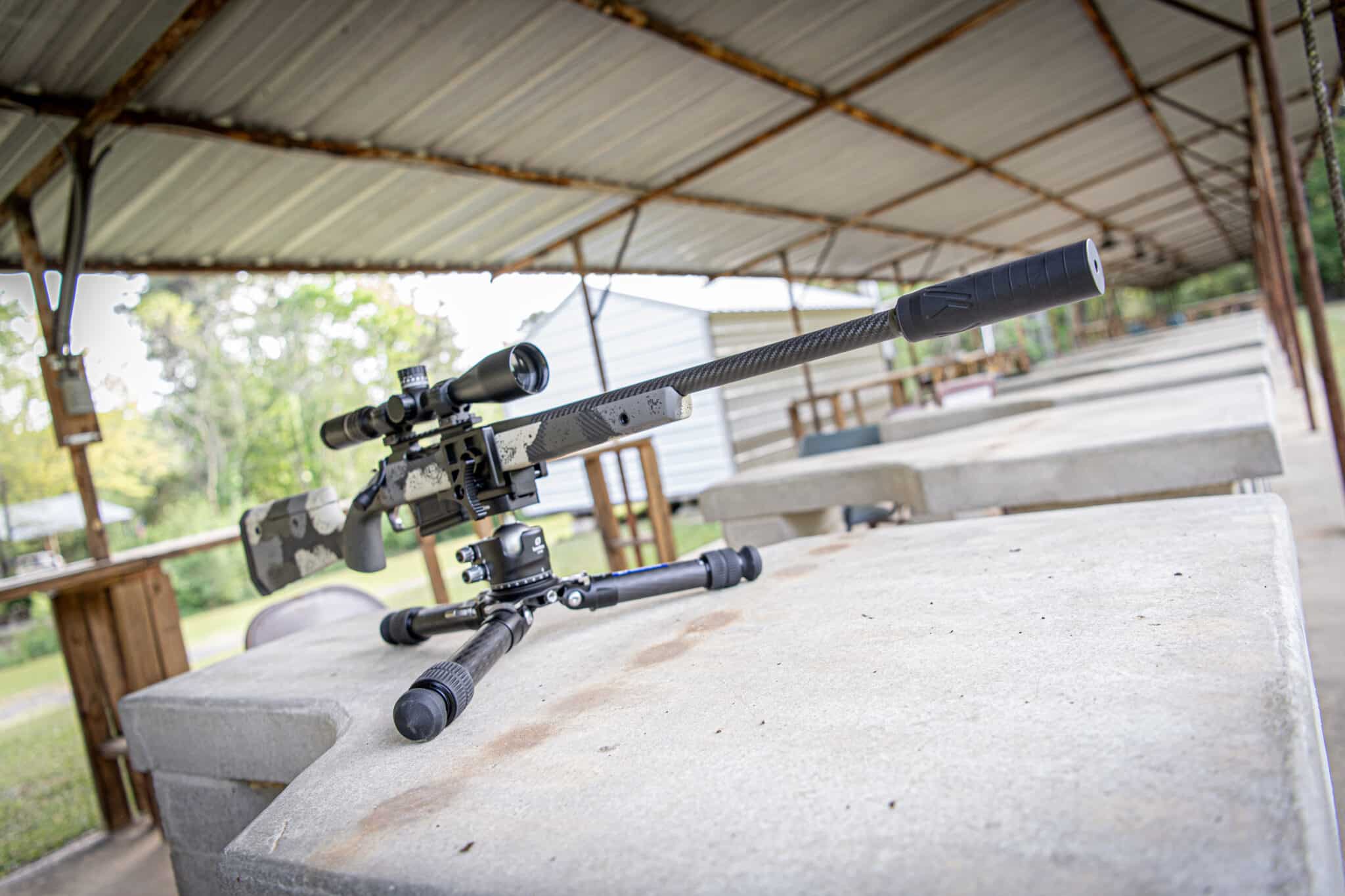
Every inch and ounce of a 308 suppressor goes on the end of the barrel, where it is felt most. Here is the static version of the “added to your rifle” math, using each manufacturer’s listed length and weight. Then add the barrel length you have, and you know what you will be carrying through the door.
| Model | Adds weight | Adds length | 20 in barrel becomes | 24 in barrel becomes |
|---|---|---|---|---|
| Sandman-S | 17.7 oz | 6.8 in | 26.8 in | 30.8 in |
| Omega 300 | 12.6 oz | 6.98 in | 26.98 in | 30.98 in |
| Nomad 30 | 14.5 oz | 6.5 in | 26.5 in | 30.5 in |
| HNT 30 SS | 13 oz | 5.96 in | 25.96 in | 29.96 in |
| Backcountry TI | 7.8 oz | 5.5 in | 25.5 in | 29.5 in |
Barrel length plus the manufacturer’s listed suppressor length. Mounts and muzzle devices can add more; Banish lists the Backcountry at 5.7 inches with its mount. Weights from the manufacturer pages, September 30, 2026.
Also, a muzzle-heavy rifle points differently and can shift your point of impact. SilencerCo’s own explanation is that “adding any weight and length to your gun’s barrel can shift point of impact.” Its advice is to zero the gun after adding a suppressor. Do that before season, not the morning of.
Direct Thread or Quick Detach?
A quick-detach mount is like a quick-release steering wheel: great until it is not. Direct thread screws the can straight onto the barrel threads. It is simple, it is light, and there is nothing to come loose except the can itself. The Omega 300 and Nomad 30 both ship with a 5/8×24 direct-thread mount. The HNT 30 SS ships with a 5/8×24 direct-thread HUB mount.
By contrast, quick detach clamps the can onto a matching muzzle device. Dead Air’s KeyMo on the Sandman-S is the example here, and it is faster to swap between rifles. The trade is one more part, one more interface and one more thing to check for tightness. Our suppressor mounting systems guide walks through the mount types in more detail.
Will a 30 Cal Suppressor Fit My .308?
Almost always, if the manufacturer lists .308 Win and your threads match. Before you buy any 308 suppressor, run this fit checklist:
- Is .308 Win (or anything larger, like .300 Win Mag) inside the manufacturer’s caliber rating? Never shoot a cartridge the manufacturer does not list.
- Does your barrel thread match the mount the can ships with? Most cans above ship with 5/8×24, but confirm your barrel. Our thread pitch chart lists the common thread by caliber.
- Is your barrel at or above the manufacturer’s minimum length for .308? SilencerCo lists 16 inches for 7.62 NATO on the Omega 300.
- Semi-auto? Look for the words “full auto rated” on the manufacturer’s page.
- Did you check alignment with the rifle unloaded? Do it every time the can goes on.
If you also shoot a 6.5, our 6.5 Creedmoor suppressor guide covers which .30 cans handle both. And if a .300 Blackout is the next rifle on the list, the .300 Blackout suppressor guide is the place to start.
Is a .308 Suppressor Legal?
In 42 of 51 jurisdictions, yes, and the paperwork changed twice in 2026. First, the federal transfer tax on a suppressor has been $0 since January 1, 2026. Second, on October 9, 2026, ATF announced it will not enforce NFA approval, registration or tax-stamp requirements for suppressors. A dealer now hands one over on a Form 4473 with a background check. The statute is still on the books, so that policy could change. Our NFA ruling explainer covers how we got here.
Then state law sits on top. Our suppressor laws by state map lists nine places that ban civilian possession: California, Delaware, D.C., Hawaii, Illinois, Massachusetts, New Jersey, New York and Rhode Island. The suppressor cost calculator does the math on what the $0 tax leaves you paying.
The Ruger 10/22 wins at 47%, with .22 pistols at 32% and bolt-action .22s at 19%.
Frequently Asked Questions
Is a 308 suppressor worth it?
For most shooters, yes. In the NIOSH test, the suppressor cut the peak at the shooter’s left ear from 161 dB to 137 dB on a .308 bolt gun. Keep wearing hearing protection anyway.
Can I shoot 308 through a 30 cal can?
Yes, if the manufacturer lists .308 Win. Every can in this article is rated past it, from .300 Win Mag on the Omega 300 to .300 RUM on the Sandman-S.
What size suppressor for 308?
A .30 caliber can, because that bore passes a .308 bullet. A smaller bore, like a 5.56 can, is not rated for a .308 bullet and should never see one.
Do I need a full-auto-rated can on a bolt gun?
No. Full-auto rating matters for heat and gas on a semi-auto. On a bolt gun, save the weight and the money.
Is the quietest 308 suppressor the one with the lowest dB number?
Not necessarily. The manufacturers here measure at different spots, and NIOSH showed one shot reading 137 dB at the ear and 150 dB at the muzzle. Compare cans only when the method matches.
My verdict on the best 308 suppressor: an AR-10 gets the Sandman-S or the Omega 300. A bolt gun gets the Nomad 30 or the HNT 30 SS, and a mountain rifle gets the Backcountry. Then go buy decent ammo, because no 308 suppressor will fix a bad load. Popular Ammo’s breakdown of .308 vs 7.62×51 explains why the two are not the same thing in your rifle.
Sources: SilencerCo, Omega 300 product page; Dead Air, Sandman-S product page; Dead Air, Nomad 30 product page; Banish, HNT 30 SS product page; Banish, HNT Backcountry TI product page (all checked September 30, 2026); OSHA 29 CFR 1910.95, Table G-16 footnote; Murphy et al., “The reduction of gunshot noise and auditory risk through the use of firearm suppressors and low-velocity ammunition,” International Journal of Audiology, 2018 (NIOSH); SilencerCo, “What Is Point of Impact, and What Determines It?” (May 15, 2026); Federal Register 2026-09155 (May 8, 2026); ATF, Open Letter to All Federal Firearms Licensees on Silencers (August 28, 2026); ATF, guidance on NFA transfers (October 9, 2026); Silencer Shop Foundation v. ATF, No. 6:25-CV-056 (N.D. Tex., August 5, 2026), and Dkt. 145 with the Solicitor General’s letter to Congress (September 24, 2026; filed October 1, 2026); Popular Suppressors laws by state map (September 2026).
Similar Posts