NFA Ruling 2026: Who Can Buy a Suppressor Without a Form 4
Last verified: October 6, 2026 — this NFA ruling tracker is updated as the case develops. Jump to the live status tracker.
Last updated: October 9, 2026 · Originally published August 22, 2026
The short answer: On August 5, 2026, a federal court in Texas ruled that NFA registration for suppressors, short-barreled rifles, short-barreled shotguns, and AOWs is unconstitutional now that the tax is $0 — and the court stayed its judgment for seven days from entry, so the injunction took effect August 12, 2026. But the NFA ruling is not nationwide. It protects only the plaintiffs and their members and customers, current and future. Some dealers (led by Silencer Shop) are transferring suppressors without a Form 4 to covered buyers; others (including Silencer Central) are not. Machine guns are excluded, state law is unchanged, and the Justice Department has told Congress it will not appeal.
Key takeaways
• The ruling is a taxing-power decision, not a Second Amendment one — the court held a $0 tax can no longer justify registration (final judgment, Aug 5, 2026).
• Coverage is party-limited: you are protected only if you fit a covered class (member, customer, or resident-state government — not resident).
• Buying through Silencer Shop’s network without a Form 4 is happening now in 27 states; Silencer Central is still running standard Form 4s.
• A suppressor owned by a trust is probably NOT covered by the trustee’s personal membership — the most dangerous trap in this story.
• Interstate transport restrictions were NOT enjoined. Do not cross state lines with an unregistered suppressor.
• No appeal is coming. The Solicitor General told Congress on September 24, 2026 that DOJ will not appeal, and the October 5, 2026 deadline passed with nothing filed. Nine states have asked the court to spell out who the ruling covers; DOJ’s answer is due October 12, 2026.
NFA ruling status tracker
Last verified: October 6, 2026. We re-check the docket, the ATF, and the parallel cases regularly and update this table when anything moves.
| Item | Status | As of | Primary source |
|---|---|---|---|
| Injunction | In effect (since Aug 12, 2026; the seven-day stay from the Aug 5 entry expired) | Sep 2, 2026 | Final judgment, No. 6:25-cv-00056-H (N.D. Tex.) |
| DOJ appeal | Declined. The Solicitor General told Congress in a Sept 24, 2026 letter that DOJ “has determined not to file an appeal.” The Oct 5 deadline passed with nothing filed. | Oct 6, 2026 | CourtListener docket; NRA-ILA Q&A (Aug 17) |
| ATF guidance | None issued. DOJ told the Texas court on Oct 1 that ATF is working to finalize public guidance; nothing posted on atf.gov through Oct 8; no procedure published for documenting protected-party status | Oct 9, 2026 | atf.gov/news; Federal Register |
| Brown v. ATF (E.D. Mo.) | Summary judgment still undecided. Now joined with a suit by Missouri and 10 other states. DOJ’s Oct 7 brief opposes statewide and nationwide relief and asks the court to drop 5 states that already won in Texas; status conference set for Oct 22. A ruling could extend coverage to SAF, ASA, NRA, and FPC members | Oct 9, 2026 | SAF case page; court docket |
| Roberts v. ATF (E.D. Ky.) | Summary judgment briefed, awaiting decision. On Aug 18 plaintiffs moved for leave to file the Silencer Shop Foundation opinion as supplemental authority (Dkt 52) | Aug 19, 2026 | SAF case page |
| Congress | No NFA-repeal floor action; the $0 tax (OBBBA, effective Jan 1, 2026) is what the ruling rests on | Aug 19, 2026 | congress.gov |

What the NFA ruling says
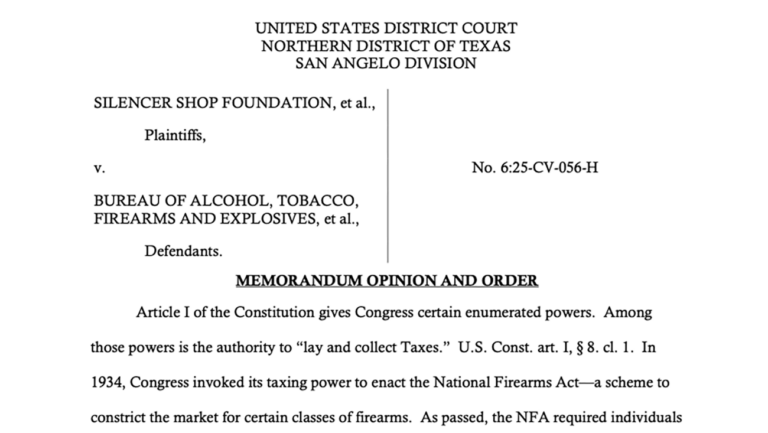
In Silencer Shop Foundation v. BATFE, No. 6:25-cv-00056-H (N.D. Tex.), consolidated with Jensen v. ATF, Judge James Wesley Hendrix entered final judgment on August 5, 2026, holding that the National Firearms Act’s registration-and-approval scheme for suppressors, SBRs, SBSs, and AOWs exceeds Congress’s taxing power now that the One Big Beautiful Bill Act zeroed the transfer and making tax on January 1, 2026. In the court’s words, “a tax set at $0 produces none” — no revenue, no taxing-power justification. The government’s Commerce Clause fallback was rejected (final judgment; Pierce analysis, Aug 5).
Two things this ruling is not: it is not a Second Amendment decision (the 2A claims were abandoned at argument), and it does not touch machine guns or destructive devices. The specific provisions enjoined:
| Enjoined | What it covers |
|---|---|
| 26 U.S.C. §5812(a)–(b) | Transfer application/approval (the Form 4 process) |
| 26 U.S.C. §5822 | Making application/approval (the Form 1 process) |
| 26 U.S.C. §5841(a)–(c), (e) | The registry itself (NFRTR registration requirements) |
| 26 U.S.C. §5861(b)–(f) | Possession/transfer/making offenses tied to registration |
| 27 C.F.R. §479.62(a)–(d), §479.84(a)–(d) | Implementing regulations |
Not enjoined: 26 U.S.C. §5861(j) (interstate transport of unregistered NFA items) — more on that below — and the entire Gun Control Act, which still requires a 4473 and NICS check at every dealer transfer.
Can I just walk in and buy a suppressor with a 4473 now?
Only if you’re covered, and only at a dealer willing to do it. The injunction is party-limited under Trump v. CASA — there is no nationwide relief. If you fit a covered class (below) and your state allows suppressors without tying legality to federal registration, a participating dealer can transfer with a 4473 and NICS check, no Form 4. Silencer Shop’s network began exactly these transfers at 12:01 a.m. on August 13 in Leander, Texas (Silencer Shop announcement). Everyone else should assume the old process still applies to them.
Who the NFA ruling covers
Coverage follows the plaintiffs, not geography. The two consolidated cases produced two coverage pools:
| Pool | Covered | Notes |
|---|---|---|
| SSF side | Silencer Shop Foundation; GOA; Gun Owners Foundation; FRAC; B&T USA, Palmetto State Armory, SilencerCo (and their customers); individual Brady Wetz; 15 state governments (TX, AK, GA, ID, IN, KS, LA, MT, ND, OK, SC, SD, UT, WV, WY) | Extends to current and future members/customers. Includes AOWs. State-government coverage does not flow to residents of those states |
| Jensen side | Individuals Jensen, Neusch, Smith; Hot Shots Custom LLC; TSRA, CCRKBA, FPC Action Foundation members (current + future; FPCAF donors of $10+/yr count) | No AOW coverage on this side (standing) |
| Not covered | The general public; residents of plaintiff states as such; NRA members as such (NRA is a Brown plaintiff, not a plaintiff here); trusts/LLCs based solely on a trustee’s membership | NRA-ILA promotes NRA–TSRA joint membership as its coverage path (NRA-ILA, Aug 12) |
Does joining GOA, CCRKBA, or SAF today cover me?
The organizations say yes; no court has confirmed it. The judgment’s language extends to future members, and CCRKBA’s Alan Gottlieb says new members are “automatically covered” (Outdoor Wire, Aug 14). SAF runs a $25 joint-signup page at saf.org/nfainjunction. But attorneys urge caution: as one puts it, no court has tested a purchase by someone who joined after the NFA ruling, and the Armed Attorneys’ view is that non-class-members are simply not covered. Both readings are plausible; nobody has litigated it.
MONITOR: Post-ruling joiner coverage is untested. If any court addresses it — or ATF publishes a documentation procedure — this section changes. Tracked in the status table.
I’m not a member of anything. Am I covered if I buy from Silencer Shop?
Silencer Shop’s position is yes, for items originating from Silencer Shop — because the injunction covers the Foundation’s customers, they state “no membership required” for their transfers. Their first no-Form-4 transfers were to GOA members, but the customer-coverage theory is what their 27-state program rests on (Silencer Shop FAQ). Understand what you’re relying on: the retailer’s legal interpretation of its own coverage — one the government has not conceded and no court has separately confirmed.
My suppressor is in a trust. Does my personal membership protect it?
Probably not — this is the trap. When a trust holds the suppressor, the trust is the legal possessor, and your GOA or TSRA card names you, not your trust. A trust or LLC whose only tie to the plaintiffs is a trustee’s personal membership is not on any coverage list. If you run NFA items through a trust, keep filing Form 4s until this is resolved. Full analysis: Suppressor Trusts After the Injunction, and see our standing NFA trust guide.
MONITOR: Trust/LLC coverage is unresolved. No court filing or ATF guidance addresses it as of August 22, 2026.
I have a Form 4 pending. Should I cancel it or let it ride?
For most people: let it ride. A pending Form 4 costs you nothing ($0 stamp), and an approved registration is bulletproof against every outcome — including a later ruling that narrows the order. Cancelling to re-buy without a form only makes sense in a narrow set of situations, and it depends on your state, your dealer, and your coverage status. We built a full decision tree: Pending Form 4 After the NFA Ruling: Cancel, Wait, or Convert?. Current approval times are in our ATF wait-time tracker.
MONITOR: ATF has not said how pending applications will be handled if the eForms queue changes. eForms is operating normally as of August 17, per NRA-ILA’s case Q&A.
Why your state still requires a Form 4 after the NFA ruling
Because state law never depended on this case. Roughly 8–9 jurisdictions ban civilian suppressor ownership outright, and about 15 “NFA states” write federal-registration compliance into their own statutes — per Silencer Shop’s own FAQ, that list includes AK, CO, CT, GA, MI, MS, MT, NV, NC, ND, OH, OR, PA, WA, and WI, several of which are plaintiff states on the government side of the case. In those states, an unregistered suppressor violates state law regardless of the federal injunction. The full picture: The 27/15/9 Map: State-by-State Suppressor Rules After the NFA Ruling.
Are SBRs, SBSs, and AOWs included?
The ruling covers suppressors, SBRs, SBSs, and AOWs — but the retail rollout doesn’t. Dealers moving without Form 4s are, so far, handling suppressors (and in some cases AOWs) only. Note the coverage asymmetry: the Jensen-side classes have no AOW coverage at all. Machine guns and destructive devices are excluded from the ruling entirely.
Can I take an unregistered suppressor across state lines?
No. 26 U.S.C. §5861(j) — transporting an unregistered NFA firearm in interstate commerce — was not enjoined, and 18 U.S.C. §922(a)(4)’s interstate-transport rules remain fully in force (Pierce, FFL compliance analysis). A suppressor you acquired without registration should stay in-state until the law settles. This is one of the sharpest edges in the entire ruling.
What about Form 1 builds, private sales, and what I show a game warden?
Form 1 builds: §5822 (making) and §5861(c),(f) were enjoined, so a covered person’s self-build arguably no longer requires an approved Form 1 — but engraving and marking requirements have separate GCA/ATF underpinnings, ATF has issued no guidance, and a narrowed ruling turns an undocumented build into evidence. Most attorneys’ practical advice: keep filing the free Form 1. Private sales: transfers between individuals were historically Form 4 transfers; a private transfer between two covered individuals is arguably within the injunction, but proving both parties’ coverage is on you. In the field: there is no card or document that proves protected status. Carry what you have: proof of membership predating purchase, dealer transfer records, and the 4473. That thinness is itself a reason many buyers are staying with the registered path for now.
Can the NFA ruling still be undone?
Not on appeal. That door closed on October 5, 2026. The Justice Department chose not to appeal, so the Fifth Circuit will not review this judgment. That does not make every question permanent. The trial court can still clarify or narrow who is covered (nine states have asked it to, and DOJ’s answer is due October 12, 2026), Congress can change the statute, and other courts can reach a different answer in separate cases. NFA offenses carry a 3-year statute of limitations (26 U.S.C. §6531), possession may be treated as a continuing offense, and no amnesty mechanism exists for registering items acquired under the injunction. If you are outside the protected group, the old rules still apply to you. Our full breakdown: If the Ruling Is Reversed: Statute of Limitations, Continuing Offenses, and the Amnesty Question.
MONITOR: DOJ declined to appeal (Solicitor General letter to Congress, September 24, 2026). Next date: DOJ’s answer to the states’ request that the court clarify who the ruling covers, due October 12, 2026.
Which dealers are transferring without a Form 4 — and which aren’t?
The industry split is the clearest signal of how unsettled this is. Silencer Shop is transferring without Form 4s in 27 states — same-day, 4473 + NICS. Silencer Central is not: it announced on August 12 it would continue standard Form 4 processing while the appeal window was open (Silencer Central blog). The American Suppressor Association is advising the industry to keep filing, and attorney John Pierce lists ten unresolved compliance problems for FFLs who jump early. Both litigants have an economic stake in their own advice — our side-by-side: Buying From Silencer Shop vs Silencer Central vs Your Local FFL Right Now.
Are machine guns next? And is the $200 stamp coming back?
Machine guns: no. They were expressly excluded — the Hughes Amendment and §922(o) are untouched, and no pending case in this line challenges them on this theory. The $200 stamp is already gone independent of this case: OBBBA set the transfer and making tax to $0 on January 1, 2026, for suppressors, SBRs, SBSs, and AOWs. There is no refund of previously paid $200 stamps, and the $0 “stamp” (the approval process) still exists wherever Form 4s are still being filed. The zeroed tax is, ironically, the entire legal foundation of the NFA ruling — Congress removed the revenue, and the court held that what remained was registration without a constitutional hook.
What the NFA ruling has done to suppressor demand
Demand moved before the NFA ruling did. ATF counted more than 6.65 million suppressors on the National Firearms Registration and Transfer Record as of August 4, 2026. That is over 500,000 more than three months earlier, and up from the roughly 6.1 million the National Shooting Sports Foundation reported in June.
Processing kept pace with the surge. ATF’s current-processing-times page, updated as of August 4, 2026, listed Form 4 approvals at 9 days for individuals and 33 days for trusts. The agency has finalized 1,045,503 Form 4s so far this year against 1,092,729 submitted. ATF Director Robert Cekada said in July that average processing across the four highest-volume forms had fallen to 18 days, even as annual filing volume climbed from under 485,700 in fiscal 2021 to more than 1.84 million through three quarters of fiscal 2026.
Those numbers matter to the litigation. Common use is the yardstick courts reach for in Second Amendment cases, and 6.65 million registered suppressors is a hard number to argue around. ATF publishes the processing figures on a rolling basis, so check the date stamp before you quote them. If you are shopping while the law settles, our 2026 suppressor comparison chart lists same-day prices, weights and stock status.

Where the NFA ruling goes next
Three paths matter. One: ATF publishes the written guidance it says it is finalizing, which will settle how dealers transfer to covered buyers. Two: Brown v. ATF (argued Aug 10, under submission) or Roberts v. ATF (briefed) rules the same way, extending coverage to SAF, ASA, NRA, FPC, JPFO, and Buckeye members and pushing the issue toward the circuits and, eventually, the Supreme Court. Three: Congress acts on the NFA directly. For the legal theory driving all of it, see our network’s legal-affairs analysis at Freedom’s Lodge: Jensen v. ATF and the taxing-power challenge to the NFA. New to suppressors entirely? Start with how to buy a suppressor.
NFA Ruling Alerts
We monitor the docket, the ATF, and both parallel cases. Get an email only when something changes — guidance issued, coverage clarified or extended.
One email when the story moves. Unsubscribe any time.
Sources and further reading
Primary: Final judgment (Aug 5, 2026) · CourtListener docket · Brown v. ATF · Roberts v. ATF. Analysis: Pierce (Aug 5) · Pierce, FFL compliance · NRA-ILA Q&A (Aug 17) · NRA-ILA (Aug 12). Industry: Silencer Shop · Silencer Central. Our coverage: first-reaction report (Aug 13) · ATF wait-time tracker.
How this guide was made: research-based synthesis of the court record, agency sources, and attorney analyses linked above; human-edited. This article is news and legal information, not legal advice — the law here is unsettled and party-specific. Talk to a firearms attorney before relying on the injunction. Written by James Nicholas; status table verified against primary sources on the date shown.