
NFA Gun Trust: The Best Way to Buy Your Suppressor
NFA Gun Trust Guide: How to Set Up and Use an NFA Trust for Suppressors
An NFA gun trust is a legal entity that holds title to National Firearms Act items — including suppressors — and allows multiple named trustees to legally possess and use those items without the original owner present. For suppressor buyers, a trust offers significant practical advantages over individual registration: it allows household members to use the suppressor lawfully, simplifies estate transfer, and provides legal protection should the owner become incapacitated. Understanding trusts before you buy can save you a future Form 4 re-registration fee and legal headaches.
In This Article
- NFA Gun Trust Guide: How to Set Up and Use an NFA Trust for Suppressors
- What Is an NFA Gun Trust?
- NFA gun trust: Individual Registration vs. Trust Registration
- NFA gun trust: How the ATF 41F Rule Changed Trust Requirements
- NFA gun trust: Who Should Be Named as Co-Trustees
- NFA gun trust — Trust Beneficiaries: Estate Planning for NFA Items
- NFA gun trust: How to Set Up an NFA Trust
- NFA gun trust: Adding or Removing Trustees After Approval
- Frequently Asked Questions About NFA Trusts
Last updated: September 15, 2026 · Originally published March 7, 2026

Related resources: How to Buy a Suppressor in 2026, Suppressors and the Law, NFA Tax Stamp Repeal Explained, About Silencer Central, and Suppressor Legal States 2026.
Key Takeaways
- NFA trusts allow multiple co-trustees to legally possess and use the suppressor
- No CLEO (Chief Law Enforcement Officer) sign-off required with a trust
- Trust simplifies transfer of the suppressor to heirs upon owner’s death
- Revocable living trusts are the most common NFA trust type
- Trust documents must be submitted with ATF Form 4 during the transfer
- All trustees must pass background checks (no prohibited persons allowed)
- A single trust can own multiple NFA items — suppressors, SBRs, etc.


What Is an NFA Gun Trust?
An NFA gun trust is a revocable living trust specifically drafted to hold NFA-regulated items such as suppressors, short-barreled rifles, short-barreled shotguns, and machine guns. Like all trusts, it is a legal arrangement where a trustee holds assets on behalf of the trust’s beneficiaries. The key difference from a standard trust is that NFA trusts are drafted specifically to comply with ATF regulations governing who may possess NFA items and under what circumstances. When a suppressor is registered to a trust rather than an individual, any named co-trustee can legally handle, use, and transport the suppressor — even when the primary trustee is not present. This is the central practical advantage of trust registration.
NFA gun trust: Individual Registration vs. Trust Registration
When buying a suppressor, you choose to register it as an individual or through a trust. Individual registration is simpler on paper — one person, one background check, one set of fingerprints and photos. But it carries significant limitations: only you can legally possess the suppressor. If your spouse picks it up from the safe, your child uses it at the range without you present, or a friend handles it while you step away, they are in technical violation of federal law. A trust resolves this by naming co-trustees who share full legal possession rights. Most suppressor attorneys and dealers — including Silencer Central — recommend trust registration for any buyer who lives with other adults or who wants to share the suppressor with family members.
NFA gun trust: How the ATF 41F Rule Changed Trust Requirements
Before July 2016, NFA trusts offered a significant bureaucratic shortcut: trust purchases did not require individual trustees to submit fingerprints or photos with the Form 4. ATF Rule 41F changed this. After July 13, 2016, all “responsible persons” in a trust — typically all named co-trustees — must submit fingerprint cards and passport photos with the Form 4, and each must pass a background check. This brought trust registration roughly in line with individual registration in terms of documentation burden, but trusts still offer the key legal possession advantages. The rule did not eliminate the usefulness of trusts; it simply removed the fingerprint shortcut that had made them attractive primarily for paperwork reasons.

NFA gun trust: Who Should Be Named as Co-Trustees
Co-trustees should be adults who you want to legally share possession of your NFA items and who can pass an ATF background check. This typically means a spouse or domestic partner, adult children, trusted family members, or shooting partners. You should not name anyone as a co-trustee who is legally prohibited from possessing firearms, who you would not want to have unsupervised access to your suppressors, or who is a minor. Each co-trustee added to the trust will need to submit fingerprints and photos with each Form 4 application going forward. Keeping your trust lean — typically just you and a spouse — reduces paperwork without sacrificing the primary benefit of shared possession rights.
NFA gun trust — Trust Beneficiaries: Estate Planning for NFA Items
One major long-term advantage of an NFA trust is estate planning. NFA items cannot be inherited the same way conventional firearms can. When an individual suppressor owner dies, the suppressor must be transferred through a new ATF Form 4 process before the heir can legally possess it — which means months of waiting and potential legal limbo during the estate process. A suppressor registered to a trust, however, passes to the trust’s named beneficiaries according to the trust document, subject to ATF procedures but without requiring a new Form 4 in most properly drafted trusts. This makes NFA trusts the preferred registration method for anyone who wants their suppressor collection to transfer cleanly to heirs.
NFA gun trust: How to Set Up an NFA Trust
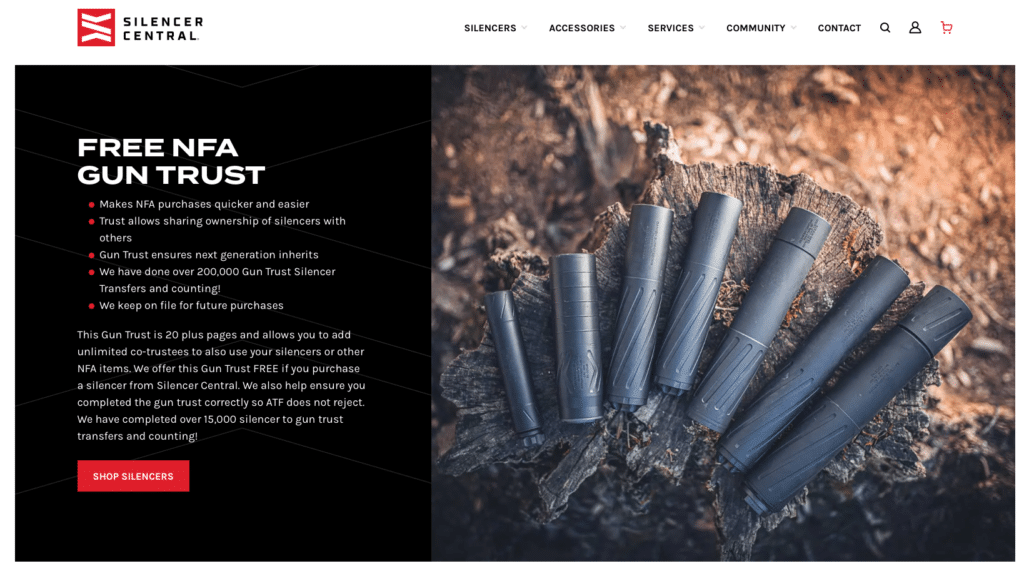
You have several options for creating an NFA trust. Silencer Central provides a free NFA trust as part of every suppressor purchase — this is one of the most significant value-adds in the industry and eliminates the need to hire a separate attorney. If you prefer an independently drafted trust, seek out an attorney who specializes in NFA law and trusts; generic living trusts from estate attorneys are often not properly drafted for ATF compliance. Online NFA trust services also exist, though quality varies widely. At minimum, your trust document should specifically authorize possession of NFA items, name your trustees and beneficiaries clearly, and comply with the laws of your state of residence. Once created, the trust document is submitted as part of your Form 4 application.
NFA gun trust: Adding or Removing Trustees After Approval
One practical advantage of trusts is that you can amend them to add or remove trustees without filing a new Form 4 for already-approved items. If you later want to add your adult child as a co-trustee, you can amend the trust document. However, any new NFA items purchased after the amendment will require the new trustee’s fingerprints and photos on the new Form 4. Removing a trustee from the trust removes their legal possession rights going forward. Trust amendments should be made in writing, signed according to your trust’s requirements, and kept with your trust documents. Never add someone as a co-trustee without verifying they are legally eligible to possess firearms and NFA items.
Frequently Asked Questions About NFA Trusts

Does an NFA trust cost money to set up?
It depends on where you get it. Silencer Central provides a free NFA trust with every suppressor purchase, which represents significant savings — independent NFA attorneys typically charge $150–$500 for a properly drafted NFA trust. Online services range from $50 to $200. If you already own NFA items registered individually and want to transfer them to a trust, that requires a Form 4 (individual to trust transfer), which now has no tax cost since the $200 stamp fee was eliminated in 2026, but still requires ATF wait time.
Can a trust own suppressors in states with restrictions?
A trust can only own suppressors in states where suppressor ownership is legal for civilians. The trust is a legal entity, but it is still subject to state law. If you move from a suppressor-legal state to a suppressor-prohibited state, your suppressor situation becomes legally complicated and you should consult an NFA attorney before the move. Trusts do not provide any workaround to state-level suppressor prohibitions.
What happens to trust NFA items if the trust is dissolved?
If you decide to dissolve an NFA trust, the NFA items held by the trust must be properly transferred before the trust can be wound up. This may involve transferring them to individual registration (Form 4), selling them through a licensed dealer, or transferring them to another trust or entity. Improperly dissolving a trust while leaving NFA items in legal limbo creates federal compliance problems. Consult an NFA attorney before dissolving any trust that holds NFA-regulated items.
Disclosure: PopularSuppressors.com is a media property of Brand Avalanche Media, Inc. All editorial opinions are our own.
Stay current on every ATF ruling and Second Amendment court case at Freedom’s Lodge, BAM’s dedicated gun rights and 2A news publication.


Similar Posts



More Questions
Do I need an NFA trust to buy a suppressor?
No — you can purchase a suppressor as an individual. But an NFA trust offers significant advantages: multiple people can be authorized to possess the suppressor, inheritance is simpler, and it protects against accidental NFA violations. Silencer Central creates an NFA trust for every buyer at no extra cost.
What are the benefits of an NFA trust?
An NFA trust allows multiple named trustees to legally possess the suppressor — meaning your spouse, adult children, or trusted partners can use it legally. It also simplifies inheritance. Silencer Central sets up trusts for all buyers at no charge.
How do I set up an NFA trust?
Silencer Central creates a compliant NFA trust for every buyer as part of the purchase process — at no additional cost. The trust is set up before your Form 4 is filed, ensuring all documents are consistent and compliant. Get started at SilencerCentral.com.