Registered Suppressors Hit 6.4 Million: What Six Months of $0 Tax Stamps Did
Updated July 5, 2026
In This Article
- Registered suppressors now dominate the NFA registry
- May 2026 set the pace: 116,821 silencer Form 4s in one month
- Form 4 wait times right now
- What the $0 tax stamp changed — and what it didn’t
- Is the ATF keeping up with the surge?
- What 6.4 million registered suppressors mean for your next purchase
- What to watch in the second half of 2026
- Frequently asked questions
Last updated: October 10, 2026 · Originally published July 5, 2026
There are 6,439,813 registered suppressors in the United States, according to ATF data updated June 24, 2026. In fact, that works out to roughly one suppressor for every 41 American adults. And six months after the federal tax stamp dropped to $0, the National Firearms Registration and Transfer Record is growing faster than at any point in its 92-year history.
Update, October 10, 2026: On October 9, ATF stopped requiring a Form 4, federal registration or a tax stamp for suppressors, SBRs, SBSs and AOWs, for everyone nationwide. State law still applies. How buying a suppressor works now.
Registered suppressors are NFA items that have cleared an approved ATF Form 4 or Form 1 and entered the federal registry. The registry now tells a clear story. In other words, suppressors are no longer a niche accessory. Instead, they are the mainstream choice for hearing protection at the range and in the field.
Here is what the newest federal data shows — and what it means if you have been waiting to file.
Registered suppressors now dominate the NFA registry
The ATF’s registry snapshot, current as of June 8, 2026, breaks down like this:
| NFA item type | Registered (June 8, 2026) | Share of registry |
|---|---|---|
| Silencers | 6,439,813 | 81.3% |
| Short-barreled rifles | 1,178,348 | 14.9% |
| Short-barreled shotguns | 206,062 | 2.6% |
| Any Other Weapons | 97,223 | 1.2% |
In short, four out of every five items in the NFA registry are now suppressors. And the share keeps rising. For comparison, the registry held roughly 2.6 million silencers in early 2023, per ATF’s published NFRTR figures. As a result, the count has more than doubled in about three years.

May 2026 set the pace: 116,821 silencer Form 4s in one month
But the monthly numbers are where the surge shows up. In May 2026 alone, the ATF received 222,550 NFA applications. Notably, 116,821 of those were Form 4 applications for silencers — 52% of everything that came through the door.
In fact, that single month rivals what the entire NFA system once handled in a year. TFB’s analysis of ATF data noted that all of calendar 2005 saw 147,484 NFA forms processed — total, across every form type. Indeed, May’s silencer Form 4s came within 31,000 of that on their own.
Likewise, year-to-date figures are just as striking. Through June 1, 2026, buyers submitted 819,481 Form 4 applications. In other words, buyers filed about 5,400 per day, including weekends and holidays.
Form 4 wait times right now
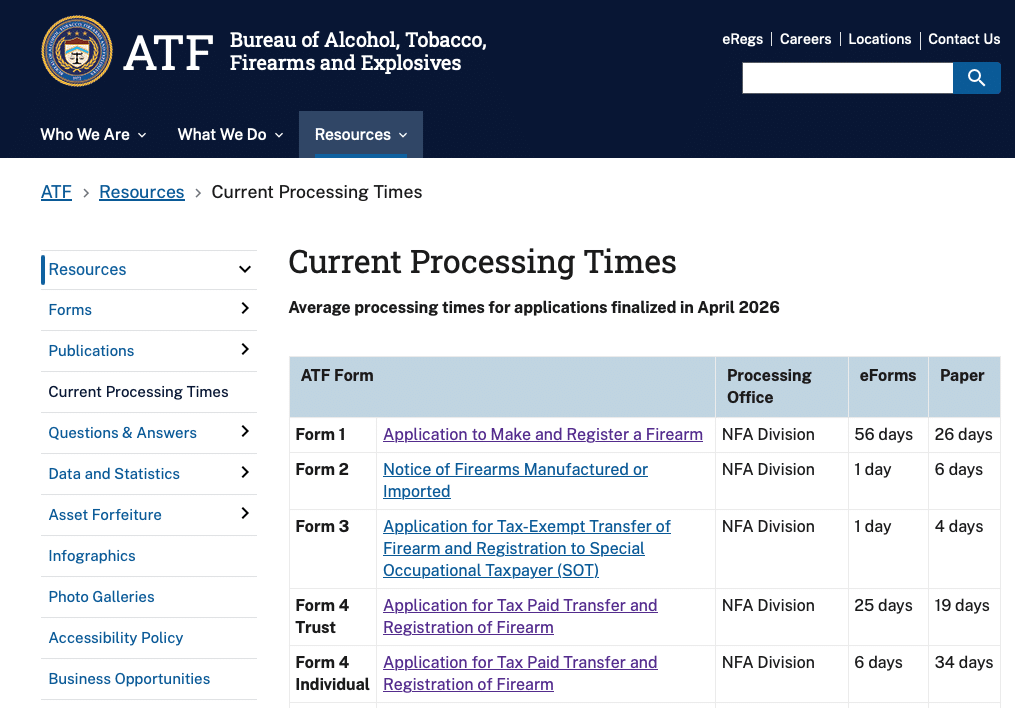
How long does a suppressor take to get in 2026? Today, the answer is days, not months, for buyers who file electronically. These are the averages for applications finalized in May 2026:
| Application type | eForms | Paper |
|---|---|---|
| Form 4 — Individual | 8 days | 63 days |
| Form 4 — Trust | 25 days | 25 days |
| Form 1 — Make and Register | 62 days | 33 days |
Currently, the median individual eForm 4 sits at 8 days. Veterans of the process remember 10-month and 14-month waits as recently as 2022. So an 8-day median is a structural change, not a blip.
Meanwhile, trust filings run 25 days, because every trustee gets a responsible-person check. So if speed matters most, file an individual eForm 4. Additionally, see our breakdown of ATF Form 4 wait times.
What the $0 tax stamp changed — and what it didn’t
On January 1, 2026, the One Big Beautiful Bill Act (P.L. 119-21) zeroed out the $200 federal transfer tax on suppressors, short-barreled rifles, short-barreled shotguns, and AOWs. The tax is gone. However, the process is not.
Every suppressor transfer still requires:
- A completed ATF Form 4, electronic or paper
- Fingerprints, photographs, and an FBI background check
- Registration in the NFRTR
- Transfer through a licensed SOT dealer
In short, the paperwork survived — the price of admission did not. For example, buyers who once paid $400 in tax on two suppressors now pay $0. As a result, that freed-up money is showing up in the application data. So if you are new to the process, start with our step-by-step guide on how to buy a suppressor in 2026.
Is the ATF keeping up with the surge?
Mostly, yes. Through June 1, the ATF had finalized 1,281,852 NFA forms in 2026 against 1,392,015 submitted. Still, that leaves a working gap of about 110,000 applications — roughly two weeks of throughput at current speed.
Moreover, May’s numbers suggest the agency is holding the line. It finalized 216,669 applications that month while receiving 222,550. The queue grew, but barely. The ATF also reports 106,598 actionable applications in process, which is under one month of volume.
However, the pressure point to watch is Form 1. Homemade-suppressor and SBR builders face a 62-day electronic wait, the longest in the NFA system. Because registration is now free, first-time Form 1 filers flooded the queue — and that lane is congested.
What 6.4 million registered suppressors mean for your next purchase
The data points one direction for buyers. Demand is high, approvals are fast, and the courts are engaged. Meanwhile, the legal ground is shifting too. The Fifth Circuit recently held that silencers qualify as “arms” — our sister site Freedom’s Lodge has the full Fifth Circuit suppressor ruling analysis.
Practical takeaways for the second half of 2026:
- File electronically. Currently, an individual eForm 4 medians 8 days. By contrast, paper filings run 63.
- Buy where inventory is real. Because demand is high, popular multi-caliber models sell through quickly. A versatile pick like the BANISH 9 multi-caliber suppressor covers eight calibers on one registration.
- Don’t wait on a “better deal.” After all, the tax is already $0. And there is no cheaper stamp coming.
And if you search “where can I buy a suppressor near me,” remember that modern dealers can handle the entire process online, with delivery direct to your door in the 42 states that allow ownership.
What to watch in the second half of 2026
Three storylines will shape the next six months of registered suppressors data. First, the courts. Industry-led litigation is directly challenging how the NFA applies to suppressors, and the Fifth Circuit’s “arms” holding gives those cases new footing. Consequently, a favorable ruling could reshape the registration framework itself.
Second, the Form 1 lane. If 62-day electronic waits persist, expect the ATF to shift examiner capacity toward maker applications. As a result, Form 4 medians could tick up slightly. Watch the monthly updates.
Third, seasonal demand. Fall hunting seasons and the holiday sales window historically drive the year’s heaviest suppressor buying. But this year, both arrive with a $0 stamp and single-digit approval times. December’s registry number could be remarkable.
Frequently asked questions
How many registered suppressors are there in the United States?
There are 6,439,813 registered suppressors in the United States as of the ATF’s June 8, 2026 registry snapshot. Suppressors make up 81.3% of all items in the National Firearms Registration and Transfer Record, excluding machine guns. In fact, the count has more than doubled since early 2023.
How long does a suppressor take to get in 2026?
The median individual eForm 4 approval took 8 days for applications finalized in May 2026. Trust eForm 4s averaged 25 days, and paper individual filings averaged 63 days. Therefore, filing electronically as an individual is the fastest path to approval.
Is the $200 suppressor tax stamp really gone?
Yes. The One Big Beautiful Bill Act eliminated the $200 NFA transfer tax on suppressors effective January 1, 2026. However, you still file a Form 4, submit fingerprints and photos, and pass an FBI background check. In other words, only the tax payment was removed, not the registration process.
Do I still need a background check to buy a suppressor?
Yes. Every suppressor transfer requires a completed ATF Form 4, fingerprints, photographs, and an FBI background check before approval. The suppressor must also transfer through a dealer holding a Special Occupational Tax license. In short, the $0 stamp changed the cost, not the vetting.
Can I buy a suppressor online and have it shipped?
Yes, in the 42 states that allow suppressor ownership. Licensed dealers can manage your Form 4, fingerprints, and background check remotely, then deliver the approved suppressor to your door or a local FFL. However, state law controls eligibility, so verify your state before you file.
Methodology note: Registry, application, and processing-time figures come from the ATF’s Current Processing Times page (updated June 24, 2026), reflecting applications finalized in May 2026 and registry counts as of June 8, 2026. Additionally, the historical 2005 comparison comes via TFB’s published analysis of ATF NFA data. Adult-population ratio uses the U.S. Census Bureau’s estimate of roughly 262 million adults.
Ninety-two years of the NFA produced the first 2.6 million registered suppressors. But the last three years produced nearly 4 million more. At May’s pace, the registry crosses 7 million before the year is out — and the quietest year in American shooting history is only half over.


Similar Posts