How Much Does a Suppressor Cost in 2026? Full Breakdown

The Biggest 2026 Change: $200 NFA Tax Stamp Eliminated
For decades, suppressors carried a $200 federal excise tax on top of the purchase price. That tax was required by the National Firearms Act and applied to suppressors, machine guns, short-barrel rifles, and a handful of other regulated items. The $200 cost, combined with a federal approval wait that once ran six to twelve months, made suppressor ownership expensive and time-consuming.
In This Article
- The Biggest 2026 Change: $200 NFA Tax Stamp Eliminated
- Suppressor Pricing by Caliber and Type: Complete Breakdown
- Hidden Costs: The Full Ownership Picture
- Total Cost of Ownership Example
- Financing Options: Making Suppressors Affordable
- Long-Term Value: Transferability and Lifetime Warranty
- Products and Brands Mentioned
- Official Resources
- Frequently Asked Questions
Last updated: October 19, 2026 · Originally published April 17, 2026
On January 1, 2026, the One Big Beautiful Bill Act eliminated that $200 tax entirely. This is monumental for suppressor affordability.
Previously, a typical suppressor purchase looked like this:
- Suppressor purchase: $600
- NFA tax: $200
- NFA processing: included
- Total out of pocket: $800
Now in 2026, the same suppressor costs $600 with no tax. The NFA registration process still applies, but with eForms it currently takes about three days for most buyers (see current ATF wait times), and there is no federal tax on top. If you are buying several suppressors for different calibers, the $200 savings multiply.
What This Means for Buyers
The end of the tax stamp makes suppressor ownership reachable for many more shooters. On a $600 suppressor, the old $200 tax added a third to the price. Experienced shooters can now more easily justify one suppressor for each firearm they shoot often.
If you have an older suppressor purchased before January 1, 2026, that $200 was a sunk cost. You’ll never get it back, but the good news is that your suppressor is already registered and transferable, making it a one-time cost for permanent ownership.

Suppressor Pricing by Caliber and Type: Complete Breakdown
Suppressor costs vary dramatically by caliber, materials, and intended use. Understanding these ranges helps you budget accurately and choose the right option for your specific needs and shooting goals. Price increases with caliber and materials because higher-pressure ammunition requires tougher construction.
.22 LR and Rimfire Suppressors: $300-$600
The most affordable entry point. Rimfire suppressors handle low-pressure ammunition and are often made from aluminum or carbon steel rather than titanium. These suppressors are popular for learners, competitive shooters, and anyone wanting to reduce noise pollution at a shooting range.
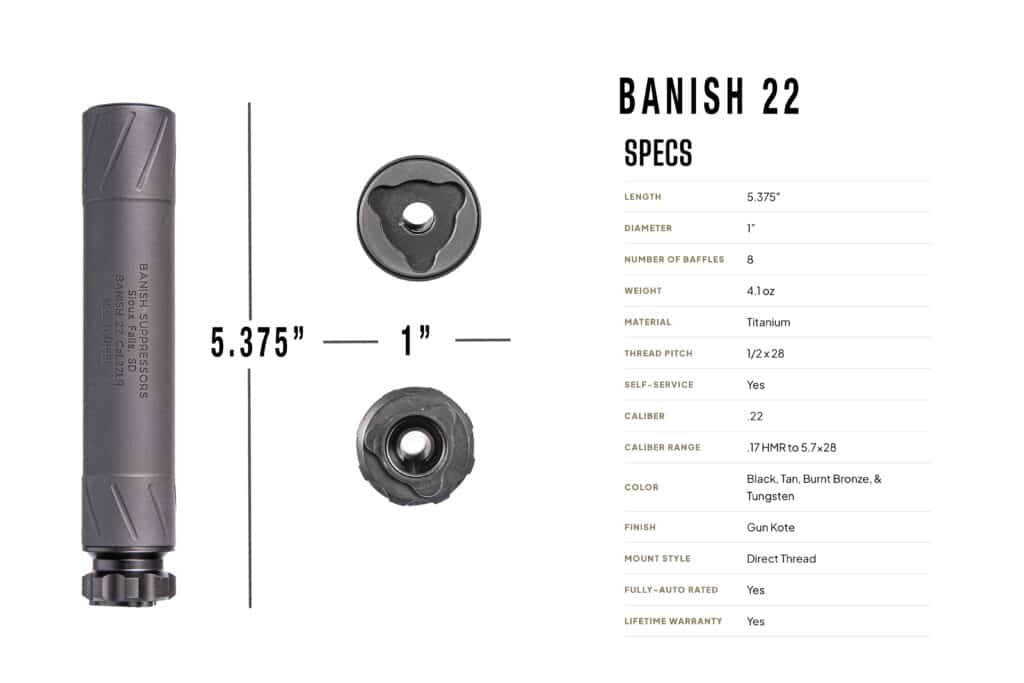
Examples in this range: entry-level models from major manufacturers, BANISH .22 LR line. Rimfire suppressors require periodic cleaning due to lead fouling but are otherwise low-maintenance. Subsonic .22 LR through a rimfire suppressor is one of the quietest combinations you can shoot.
9mm and Pistol Suppressors: $500-$800
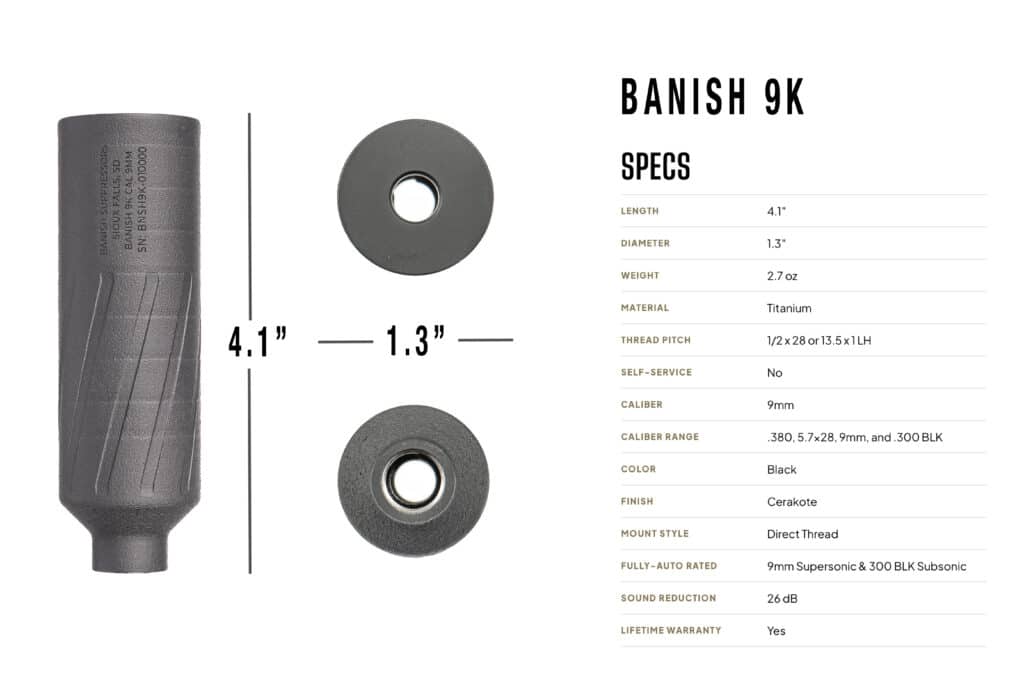
Handgun suppressors for 9mm, .40 S&W, and other pistol calibers require a threaded barrel and often suppressor-height sights. The suppressor itself typically runs $500-800. This category includes the BANISH 9 (Silencer Central), which delivers hearing protection for the most popular pistol cartridge in America.
Buyers in this range should plan for additional costs: a threaded barrel ($150-300) and suppressor-height sights ($100-200) if their slide doesn’t already accommodate them. Total investment for a suppressed 9mm handgun is roughly $700-1,300 once you include the suppressor, barrel work, and sights.
.45 ACP Suppressors: $600-$900
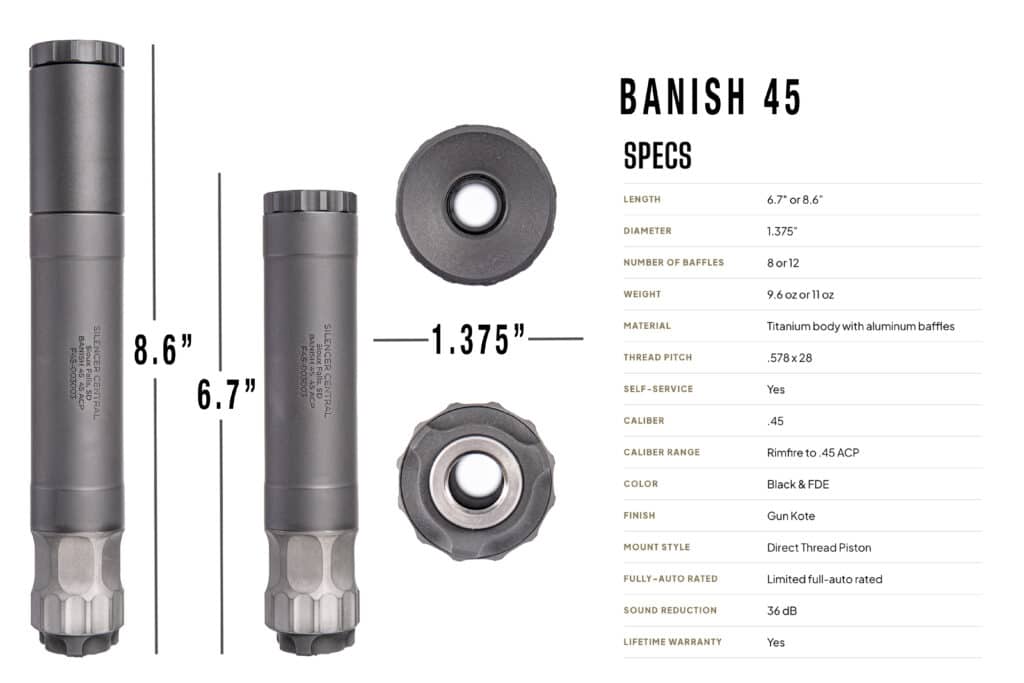
.45 ACP suppressors are popular because the round is already subsonic—it travels slower than the speed of sound inherently. This makes suppressors extremely effective with .45 ACP. The BANISH 45 (Silencer Central) falls in this range and pairs beautifully with 1911s, Glock 21s, and other .45 platforms.
Slightly more expensive than 9mm suppressor due to larger bore requirements and specialized design. Subsonic .45 ACP through a quality suppressor creates one of the most hearing-friendly shooting experiences available, even without foam earplugs.
Multi-Caliber Rifle Suppressors: $700-$1,200
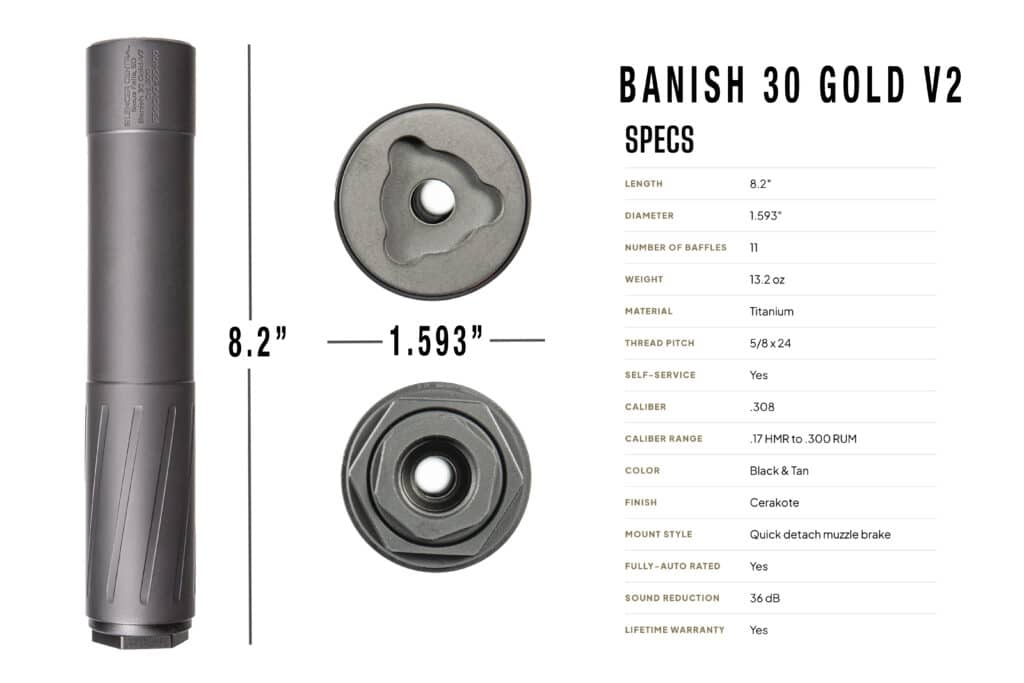
The most versatile option. Multi-caliber suppressors like the BANISH 30 Gold (Silencer Central) handle everything from .223 Remington to .308 Winchester with one suppressor and one mounting system. This versatility adds value because you can suppress multiple rifles without buying multiple suppressors.
The higher price reflects the engineering required to maintain performance across such a wide caliber range, the materials involved (titanium for durability and weight savings), and the reputation of manufacturers like BANISH. A $1,000 multi-caliber suppressor becomes cost-effective if you own three or more rifles.
Dedicated Rifle Suppressors (Single Caliber): $700-$1,100
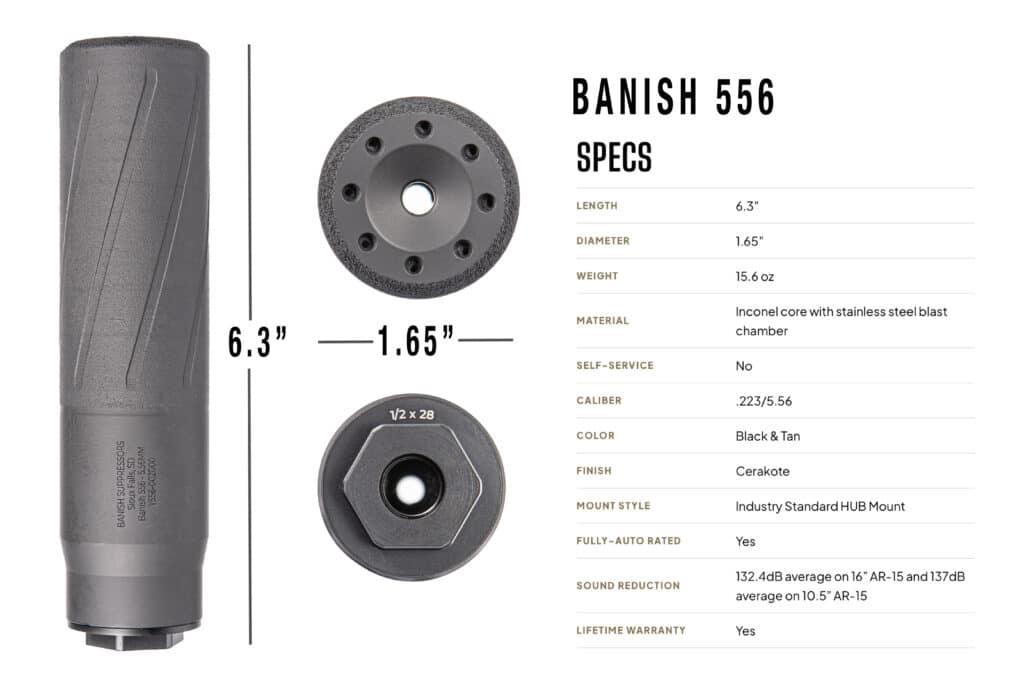
If you only hunt with .308 rifles or only shoot .223 at the range, a dedicated single-caliber suppressor optimizes performance for that specific round. These suppressors often deliver fractionally better sound reduction than multi-caliber designs because they’re engineered for one pressure curve.
Pricing reflects the same materials and engineering as multi-caliber models, but without the versatility premium. For a single-rifle owner, a dedicated suppressor is often the right choice.
Magnum and Large-Caliber Suppressors: $900-$1,400
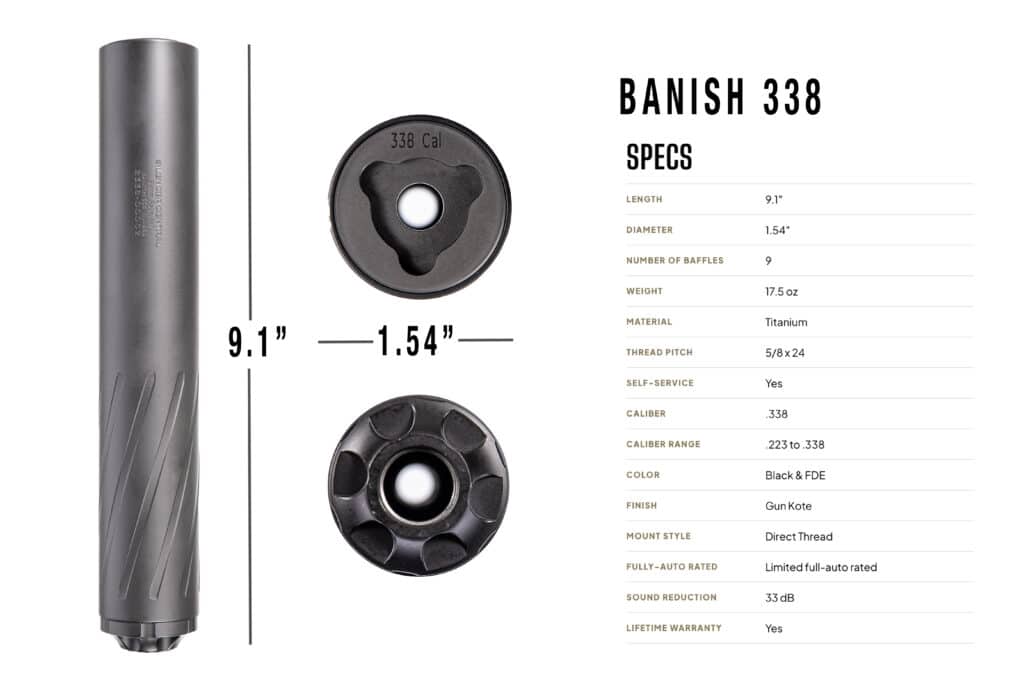
Suppressors for .300 Win Mag, .338 Lapua, .375 H&H and other magnum calibers command premium pricing. These suppressors must handle extreme pressure and velocity, requiring heavy-duty titanium construction and sophisticated baffle design. The BANISH 338 (Silencer Central) exemplifies this category—it’s built for the most demanding hunters and long-range competitors.
Magnum suppressors are less common in the civilian market, which keeps volume down and pricing up. But for someone hunting elk or running a precision rifle competition, a magnum suppressor is the right tool and worth the investment.
Hidden Costs: The Full Ownership Picture
The suppressor’s purchase price is just the beginning. Several hidden costs add to your total suppressor investment that first-time buyers often overlook. Planning for these expenses prevents sticker shock and helps you budget accurately for full suppressor ownership.
Threaded Barrels and Adapters: $100-$300
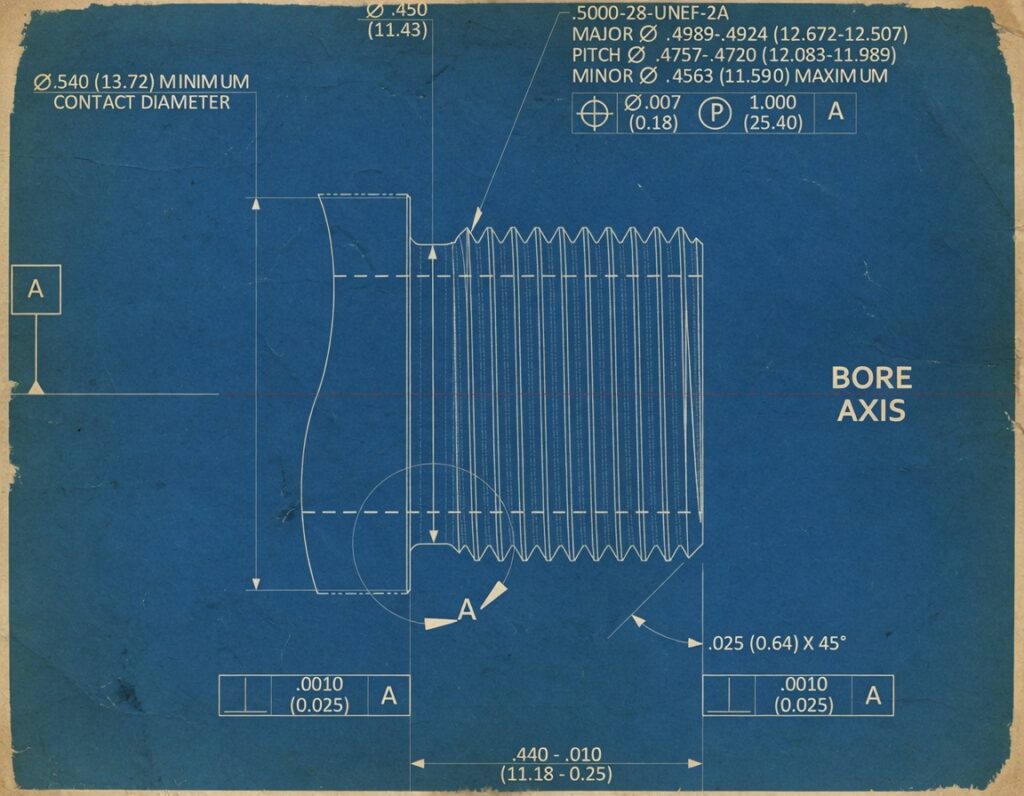
Most rifles and handguns don’t come factory with threaded muzzles designed for suppressors. You have two options: buy a factory barrel (usually $100-250) or have a gunsmith thread your existing barrel ($100-200 labor plus potential shipping and return postage). Some shooters acquire a complete upper receiver instead of threading an existing barrel—this can run $200-500 depending on the platform.
A few firearms come pre-threaded from the factory, saving you this cost entirely. Always check your specific firearm model before buying—some manufacturers like Daniel Defense, FN, and Ruger offer threaded barrels at no premium on certain models, making your rifle or pistol suppressor-ready from day one. With handguns, you might need a factory threaded barrel rather than threading your existing barrel, so factor in barrel replacement cost ($100-200).
Quick detach (QD) mounts add another $100-200 if you want fast-attach capability. Some shooters prefer direct-thread suppressors (no QD system), eliminating this cost but making the suppressor semi-permanent on that barrel.
Suppressor-Height Sights for Handguns: $100-$200
Attaching a suppressor to a handgun’s threaded barrel raises the sight line. Most suppressed handguns require suppressor-height sights to maintain proper sight picture over the suppressor. These sights cost $100-200 but are mandatory for practical shooting. Night sights add another $50-100.
This cost is unique to handgun suppressors. Rifle owners rarely need new sights because the suppressor hangs below the sight line.
Subsonic Ammunition: $0.50-$1.50 Per Round
Supersonic ammunition creates a sonic boom as the bullet travels faster than sound—this boom occurs regardless of suppressor effectiveness. To truly minimize noise, you need subsonic ammunition where bullets travel below 1,125 feet per second.
Subsonic ammunition costs more than standard loads: $0.50-1.50 per round versus $0.30-0.75 for standard loads. If you shoot 1,000 rounds per year, that’s a $200-1,200 annual cost difference. Many shooters accept this as hearing protection insurance.
The good news: subsonic loads still deliver excellent hunting performance and are plenty accurate for sport shooting. You’re not sacrificing performance, just paying for optimized ammunition.
NFA Registration Costs: $0 (2026)
The $200 NFA tax is gone for suppressors as of January 1, 2026. Filing an eForm 4 now costs nothing; you only wait for ATF approval, which currently runs about three days for most eForm 4 buyers.
This alone saves buyers $200 per suppressor, making ownership significantly more affordable.
Total Cost of Ownership Example
Let’s calculate what it actually costs to own a suppressed rifle in 2026:
Scenario: Suppressed .308 Hunting Rifle
- Rifle (existing in your safe): $0 (you already own it)
- Threaded barrel or barrel work: $150-250
- Multi-caliber suppressor (BANISH 30 Gold range): $900
- Subsonic .308 ammunition (1,000 rounds/year): $600-1,000 annually
- First-year total: $1,650-2,150
- Subsequent years: $600-1,000 (ammunition only)
That $1,650-2,150 investment delivers permanent hearing protection for your hunting rifle. Once purchased, your registered suppressor is yours for life and even transferable to family members. The effective cost per shot over 10 years of regular use becomes negligible.
Scenario: Suppressed 9mm Handgun
- Handgun (existing): $0
- Threaded barrel: $150-250
- Suppressor-height sights: $120
- BANISH 9 suppressor: $650
- Subsonic 9mm ammunition (500 rounds/month): $250-400 monthly
- First-year total: $920-1,420 plus ammunition
- Subsequent years: $3,000-4,800 (ammunition only)
For a handgun, ammunition costs dominate the annual budget because 9mm is affordable and shooters run high round counts. But the suppressor investment is a one-time cost that protects hearing permanently.
Financing Options: Making Suppressors Affordable
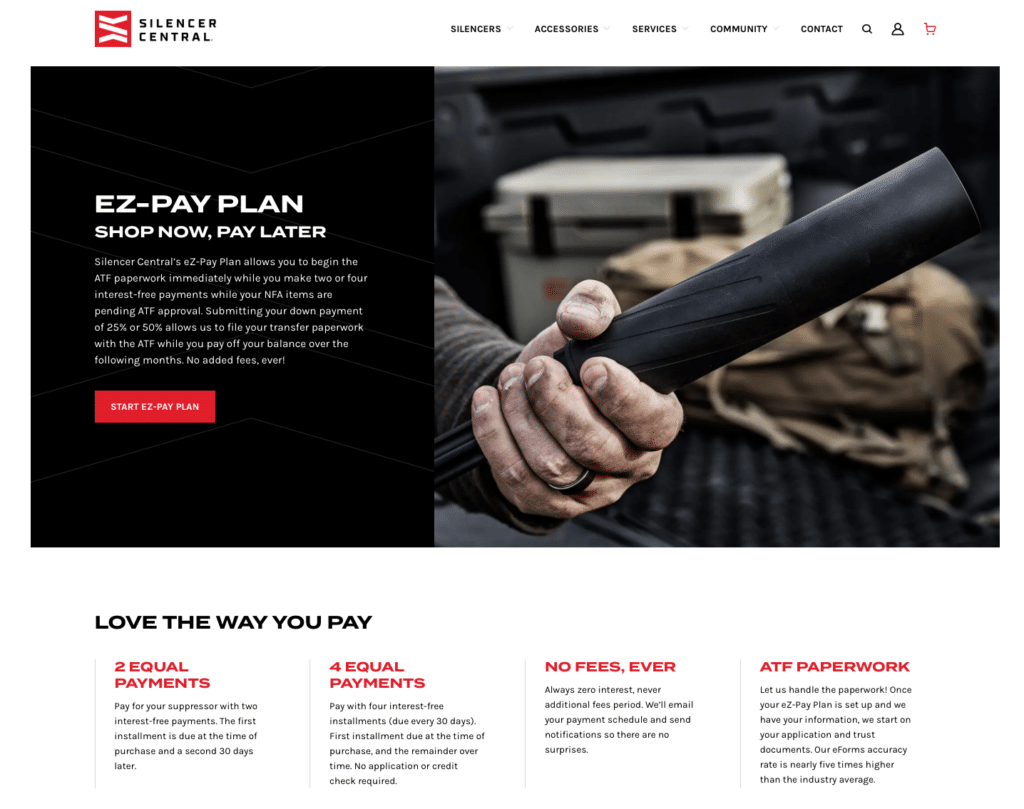
Many dealers offer payment plans or layaway that spread a suppressor’s cost over several months. Rather than paying $900 upfront, a plan breaks that into monthly payments, often $75 to $200 a month depending on the price and terms. See our suppressor financing guide for how the common plans work.
Financing usually requires a credit check and approval, and terms run from a few months to two years. Read the interest rate and fees before you sign, and ask whether the dealer files your Form 4 right away or waits until the plan is paid off.
Cost-Benefit of Financing
For many buyers, financing makes immediate sense. Instead of saving $900 for a suppressor purchase over 12 months (during which time you’re not protecting your hearing), you can start protecting your hearing now while spreading payments over time. Given that suppressors are one-time purchases lasting a lifetime, the interest cost of financing is often worth the benefit of immediate ownership and hearing protection.
Consider this scenario: A shooter wants a BANISH 30 Gold suppressor ($900). Saving for 12 months means 12 months of unsuppressed shooting—potential hearing damage. With financing, they pay $75/month for 12 months (roughly $900 + $80 interest = $980 total) but start protecting their hearing immediately. The $80 interest cost is minimal compared to the hearing protection benefit gained over those 12 months and decades of ownership.
Many shooters use financing for their first suppressor, then use cash for subsequent purchases once they understand the value and benefit. This graduated approach makes suppressor ownership accessible even for shooters on modest budgets.
Long-Term Value: Transferability and Lifetime Warranty
A registered suppressor can be passed on. When an owner dies, it goes to an heir on an ATF Form 5, which is a tax-exempt transfer, as long as the heir can legally own it. You can also sell a registered suppressor through a dealer on a Form 4. Used suppressors do hold value, though resale prices vary with the model, condition and demand.
Most major suppressor makers, including BANISH, Dead Air and YHM, offer lifetime warranties against defects. That means you are not buying a consumable that wears out with normal use; you are buying a permanent part of your shooting kit. Read each warranty for what it excludes, such as damage from a baffle strike.
This long-term value justifies the upfront investment. A $900 suppressor purchased today and used for 40 years works out to roughly $22.50 per year of ownership. If you shoot 200 rounds per year for those 40 years (8,000 rounds total), the suppressor costs less than 12 cents per shot for hearing protection. Compare that to $100+ per year in potential hearing aid costs if noise-induced hearing loss develops later. From a pure cost-benefit standpoint, suppressors are one of the most cost-effective hearing protection investments available.
If you decide suppressor ownership is not for you, a registered suppressor can be sold through a dealer, so it is not money thrown away.
Products and Brands Mentioned
- BANISH 30 Gold (multi-caliber rifle suppressor)
- BANISH 9 (9mm handgun suppressor)
- BANISH 45 (.45 ACP suppressor)
- BANISH 338 (magnum caliber suppressor)
- BANISH .22 LR (rimfire suppressor)
Official Resources
Frequently Asked Questions
How much does a silencer cost?
A silencer and a suppressor are the same thing, so the prices are the same: about $300 to $600 for rimfire, $500 to $800 for a 9mm pistol, and $700 to $1,400 for rifle and magnum models in 2026. There is no federal tax on top since January 1, 2026. Our suppressor cost calculator adds the dealer transfer and other fees into one total.
Do I need to pay the $200 NFA tax stamp in 2026?
No. The One Big Beautiful Bill Act cut the $200 federal NFA tax on suppressors to $0 starting January 1, 2026. You now pay only the suppressor’s price and dealer fees, and you still file an eForm 4, which costs nothing and currently takes about three days for most buyers.
What’s the cheapest way to get a suppressor?
The cheapest entry point is a .22 LR rimfire suppressor, about $300 to $600. If you want to suppress a centerfire rifle, a dedicated single-caliber suppressor ($700 to $1,100) usually costs a little less than a multi-caliber model. Holiday sales and dealer payment plans can also lower what you pay up front.
Are there any suppressors available used or on the secondary market?
Yes. Registered suppressors can be transferred via private sale, and used suppressors sometimes appear on forums and marketplaces. Buying used saves money but requires valid NFA transfer paperwork. Always work through a licensed dealer to ensure the transfer is legal and documented. Many lifetime warranties follow the suppressor, not the first owner, so ask the maker before you buy used.
Does every state allow suppressors?
No. Eight states plus Washington, D.C. ban civilian suppressor ownership: California, Delaware, Hawaii, Illinois, Massachusetts, New Jersey, New York and Rhode Island. Everywhere else you can own one after ATF approval, though a few states add their own rules. Our suppressor laws by state page has the details.
Is subsonic ammunition necessary?
Not necessary, but highly recommended if hearing protection is your goal. Supersonic ammunition creates a sonic boom regardless of suppressor use—the bullet’s speed breaks the sound barrier. Subsonic ammunition eliminates that boom, allowing a suppressor to achieve maximum noise reduction (117-125 dB depending on caliber). For most shooters, the extra ammunition cost is worth it.
Can I finance a suppressor purchase?
Yes. Many dealers offer payment plans or layaway, often over 3 to 24 months, which turns a $900 suppressor into monthly payments. Check the interest, fees and when the dealer files your Form 4 before you sign.


Similar Posts