
Suppressor Storage Guide: How to Properly Store Your Can Between Sessions
Store suppressors vertically (muzzle down) in a dry environment.
Suppressor Storage Guide: How to Store, Protect, and Transport Your NFA Item
Proper suppressor storage protects your investment from corrosion, mechanical damage, and legal complications — and given that your suppressor is both a valuable precision instrument and a federally registered NFA item, the stakes of getting storage wrong are higher than with most firearm accessories. Moisture is the primary enemy of suppressor longevity in storage, followed by physical impact damage and, for registered NFA items, unauthorized access or loss of control. A suppressor stored correctly in a dry, secure location with your registration paperwork accessible can last decades with no degradation. A suppressor stored wet, in a humid environment, or with heavy fouling remaining in the baffles can develop corrosion, seized components, and permanent damage within months.
In This Article
- Suppressor Storage Guide: How to Store, Protect, and Transport Your NFA Item
- Suppressor storage — Clean Before You Store: The Most Important Rule
- Suppressor storage — Moisture Control: The Most Important Environmental Factor
- Suppressor storage — Physical Storage: Cases, Safes, and Mounts
- Suppressor storage: NFA Legal Storage Requirements
- Suppressor storage: Storing Registration Paperwork
- Suppressor storage: Traveling with a Registered Suppressor
- Suppressor storage — Long-Term Storage: Extended Non-Use Periods
- Suppressor storage: Storing a Suppressor on the Host Firearm
- Suppressor Storage Products Worth Considering
- Frequently Asked Questions About Suppressor Storage
Last updated: September 15, 2026 · Originally published March 8, 2026

This guide covers everything you need to know about storing a suppressor safely and legally, how to prevent moisture damage and corrosion, the legal requirements around NFA item storage, how to travel with a registered suppressor, and what to do with your suppressor between extended periods of non-use.
Key Takeaways
- Store suppressors bore-up or horizontal — never bore-down (traps moisture/oil in end cap)
- Keep in a low-humidity environment — silica gel packets or a dehumidifier rod in your safe
- Centerfire suppressors do not need special storage — cooling between sessions is sufficient
- Store your ATF Form 4 approval letter in a fireproof safe separately from the suppressor itself
- NFA items must remain under your control — do not store at a location where non-authorized persons can access


Suppressor storage — Clean Before You Store: The Most Important Rule
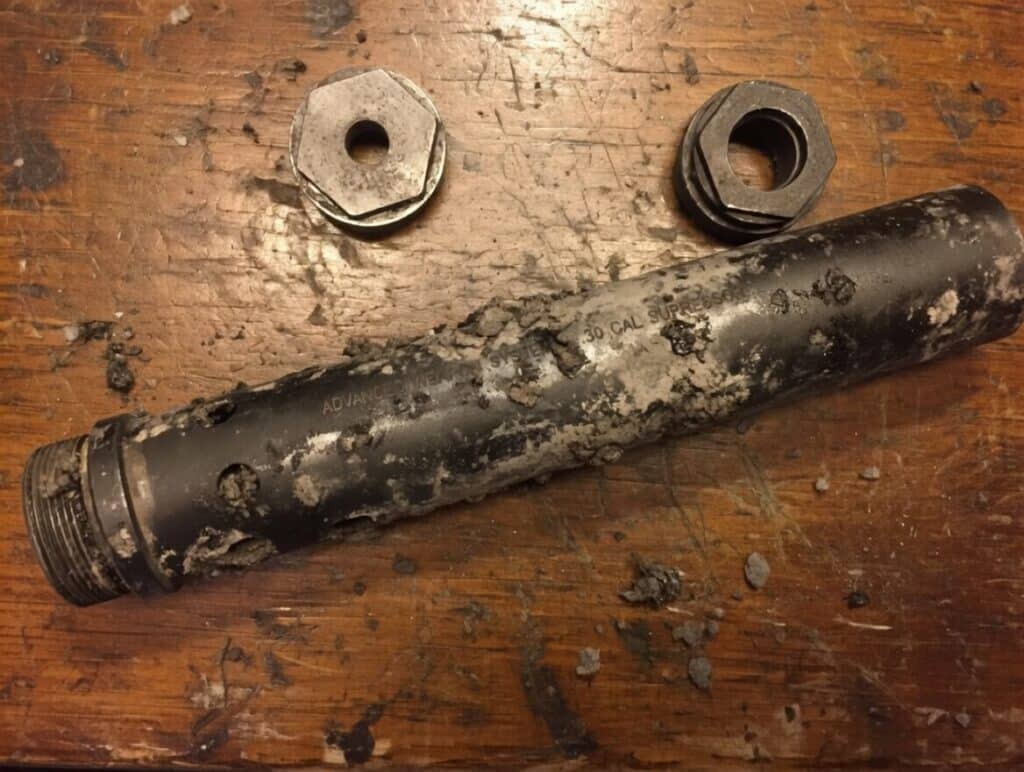
Never store a suppressor with carbon fouling, lead deposits, or moisture inside the baffles. Carbon and lead fouling in a stored suppressor slowly reacts with residual moisture in the air inside the can, producing acidic compounds that attack baffle surfaces and, in worst cases, permanently bond baffle components together. A suppressor that has seized internally because it was stored dirty may require professional disassembly with specialized tools or may be permanently damaged. The correct storage protocol: clean the suppressor thoroughly after every shooting session (or at least before any extended storage period), dry it completely, and apply a very light coat of rust-preventive oil or dry lubricant to external threads before storage. Internal surfaces in most quality suppressors do not require oiling — excessive internal oil can trap fouling and create additional compounds on the next session’s first shots.
Suppressor storage — Moisture Control: The Most Important Environmental Factor
Moisture is the enemy of all steel and aluminum suppressor components. While titanium is highly corrosion-resistant, steel baffles and stainless steel components are susceptible to surface rust in humid storage conditions, and aluminum-bodied suppressors can develop pitting corrosion when exposed to moisture combined with carbon fouling residue. The solutions: store in a low-humidity environment (below 50% relative humidity is ideal), use silica gel desiccant packets in the storage container or safe, and keep suppressor storage containers sealed when not in use. Many suppressor manufacturers provide a hard plastic or foam-lined case with purchase — using this case with one or two silica gel packs keeps humidity low and physical damage risk minimal. For gun safe storage, adding a GoldenRod or Eva-Dry electric dehumidifier to the safe is highly recommended for any firearms stored long-term, including suppressors.
Suppressor storage — Physical Storage: Cases, Safes, and Mounts
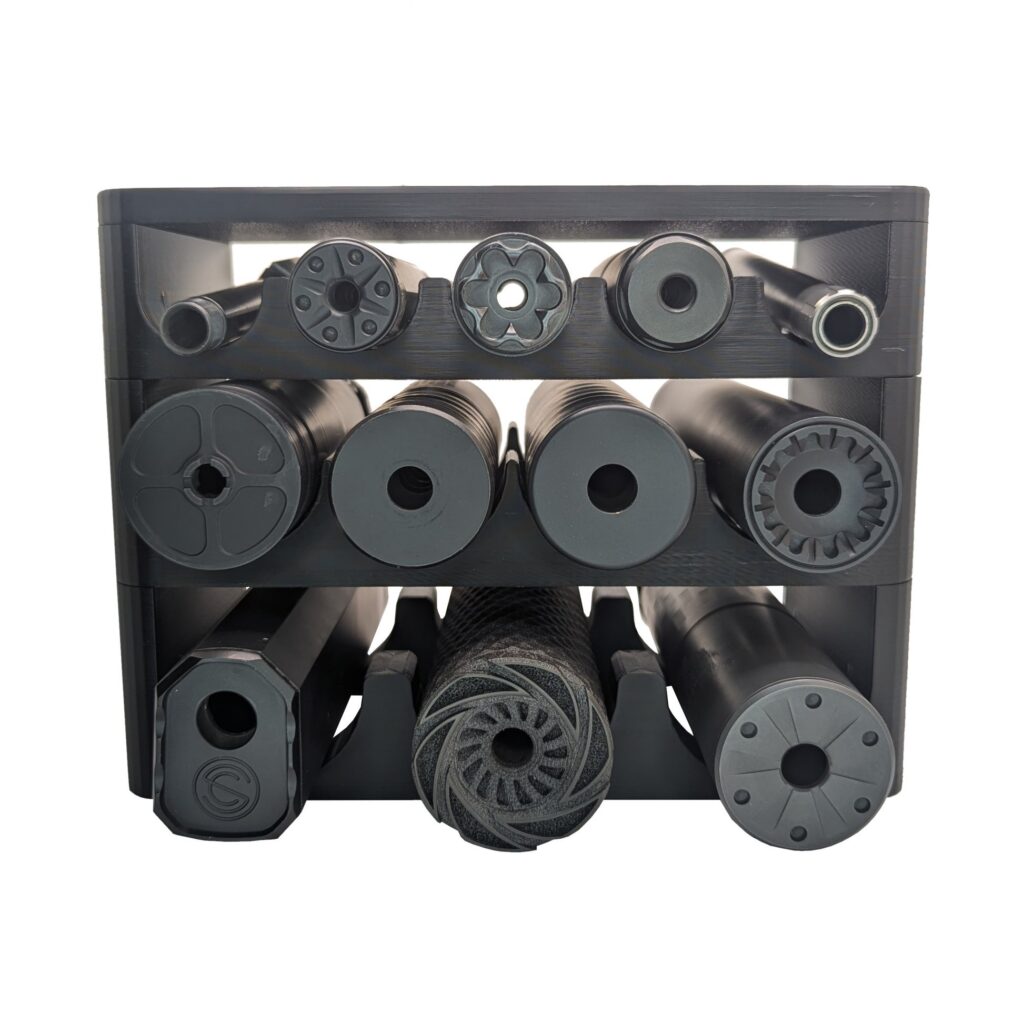
Suppressors stored loose in a bag or drawer are at risk of thread damage, end cap damage from impact, and accumulation of debris in the bore. The original case from the manufacturer — or a quality aftermarket suppressor case with foam cutouts — provides the ideal physical protection for storage. For gun safe storage, horizontal foam-lined racking keeps suppressors secure without thread contact stress. Wall-mounted suppressor rack systems are commercially available and convenient for regular users who cycle through suppressors frequently between different hosts. Do not store suppressors muzzle-down with any residual moisture or solvent inside — this pools fluid at the muzzle end cap and can create corrosion at the most vulnerable exit point. Horizontal storage or vertical storage bore-up (muzzle up) is preferred for suppressors with any internal moisture risk after cleaning. Thread protectors on both the muzzle and bore ends of the suppressor during storage protect the precision threads that ensure proper suppressor-to-host alignment.

Suppressor storage: NFA Legal Storage Requirements
As a registered NFA item, your suppressor must remain in the legal possession of the registered owner or, if held in an NFA Gun Trust, within the constructive possession of a named trustee. This has practical storage implications. Your suppressor cannot be stored in a location that is accessible to individuals who are not the registered owner or named trust co-trustees — leaving your suppressor in an unsecured location accessible to roommates, guests, or non-trustee family members creates a constructive possession issue that may constitute an NFA violation. Secure storage in a safe or locked container to which only the registered owner or co-trustees have access is the legally correct approach and is also best practice for firearm security in general. If you travel and leave your suppressor at home in a shared residence, ensure it is locked away from unauthorized access. If your suppressor is lost or stolen, report the loss or theft to local law enforcement and the ATF immediately.
Suppressor storage: Storing Registration Paperwork
The approved ATF Form 4 (or your NFA Gun Trust documentation) is the legal proof of your suppressor’s registration and should be stored securely and accessibly. A common practice is to keep a digital copy of the Form 4 in cloud storage (encrypted) for immediate access if needed, store the original in a fireproof safe, and keep a printed copy in the suppressor’s storage case for when the suppressor is transported. You are legally required to have documentation of your NFA registration available when traveling with your suppressor across state lines and when carrying it in public contexts — having the Form 4 accessible avoids complications in encounters with law enforcement unfamiliar with suppressor ownership. Replacing a lost Form 4 requires contacting the ATF NFA Branch — they can provide a certified copy, but the process takes time. Protecting the original paperwork is far easier than replacing it.
Suppressor storage: Traveling with a Registered Suppressor
Interstate travel with a registered suppressor is legal under federal law as long as you are traveling to and through states where suppressor ownership is legal. You do not need to notify ATF or obtain special approval for travel to suppressor-legal states — your Form 4 registration covers you nationwide in jurisdictions that permit civilian suppressor ownership. When transporting your suppressor in a vehicle, it should be stored in its case and ideally unattached from any host firearm during transport, following the same general principles as firearm transport. Carry your Form 4 paperwork with you during travel. Before crossing any state line, verify that the destination and any transit states permit civilian suppressor ownership — Illinois, California, New York, and several other states prohibit suppressors, and transporting your registered suppressor into a prohibiting state constitutes a federal and state firearms violation regardless of where you are registered.
Suppressor storage — Long-Term Storage: Extended Non-Use Periods
If you plan to store a suppressor for an extended period — six months or more without use — take additional precautions beyond the standard storage protocol. Clean and dry the suppressor thoroughly. For steel-baffle designs, apply a very light coat of Ballistol, RemOil, or similar rust-preventive oil to accessible baffle surfaces in user-serviceable designs before assembly. For sealed designs, a light coating of oil on the exterior and thread areas is sufficient. Store in a sealed case with fresh silica gel desiccant — replace desiccant packets that have reached saturation (most change color when saturated, or have indicator cards). Store in a climate-controlled indoor space rather than a garage, storage unit, or outbuilding where temperature and humidity fluctuate seasonally. When returning to service after extended storage, inspect and clean thoroughly before use, paying attention to any signs of surface rust or corrosion on steel components.
Suppressor storage: Storing a Suppressor on the Host Firearm
Many suppressor owners store their suppressor mounted on the host firearm for convenience, particularly with direct-thread designs that are not frequently moved between hosts. This is generally acceptable, with some caveats. Ensure that both the host firearm and suppressor are unloaded and that the combination is stored in a secure, locked location. Be aware that moisture can wick through the suppressor-to-muzzle interface if the firearm is stored in a high-humidity environment — periodic removal, cleaning, and inspection of the threaded interface is good practice for suppressed firearms stored long-term in this configuration. Carbon fouling can cause threads to seize over time if the suppressor is left mounted for months without removal — apply a thin coat of anti-seize compound or dry lubricant to threads at regular intervals to prevent this. For quick-detach suppressor systems, storage mounted on the host is straightforward and does not create the same thread seizure risk as direct-thread mounts.

Many suppressor owners store their suppressor mounted on the host firearm for convenience, particularly with direct-thread designs that are not frequently moved between hosts. This is generally acceptable, with some caveats. Ensure that both the host firearm and suppressor are unloaded and that the combination is stored in a secure, locked location. Be aware that moisture can wick through the suppressor-to-muzzle interface if the firearm is stored in a high-humidity environment — periodic removal, cleaning, and inspection of the threaded interface is good practice for suppressed firearms stored long-term in this configuration. Carbon fouling can cause threads to seize over time if the suppressor is left mounted for months without removal — apply a thin coat of anti-seize compound or dry lubricant to threads at regular intervals to prevent this. For quick-detach suppressor systems, storage mounted on the host is straightforward and does not create the same thread seizure risk as direct-thread mounts.
Suppressor Storage Products Worth Considering
Several products specifically designed for suppressor storage are available and worth considering for regular users. Suppressor-specific storage cases with individual foam cutouts protect against physical damage and provide a convenient carrying solution. Desiccant storage systems with indicator windows (like Browning’s gun safe dehumidifier line or Eva-Dry units) manage humidity passively or electrically in gun safes where suppressors are stored alongside firearms. Thread protector kits — sets of protectors in common thread pitches — allow suppressors to be stored with both ends protected from debris and impact. Suppressor pouches with moisture-wicking inner fabric protect against condensation during transport. For users with multiple suppressors, a dedicated suppressor rack that mounts inside a gun safe provides organized, protected storage without the hassle of managing individual cases for each item.
Frequently Asked Questions About Suppressor Storage
Do I need to keep my suppressor in a gun safe?
Federal law does not explicitly require a gun safe for NFA item storage — the legal requirement is that the registered NFA item remain within the constructive possession and control of the registered owner or named trust trustees. In practice, a locked container (gun safe, locked cabinet, or even a locked hard case) is the most reliable way to ensure unauthorized individuals cannot access the suppressor. Secure storage also protects against theft, which would require an ATF report and could result in your registered suppressor being used in crimes. A quality gun safe is strongly recommended as the storage solution for all NFA items, including suppressors, for both legal compliance and theft prevention.
Can I store my suppressor in my car?
Yes, with important conditions. Your suppressor may be transported in your vehicle as long as you remain in states where suppressor ownership is legal and you carry your Form 4 paperwork. For temporary storage in a parked vehicle — while you are running an errand near a range, for example — ensure the suppressor is in a locked container (trunk, locked gun case, or locked vehicle compartment) and out of sight. Leaving a suppressor in an unattended vehicle in an unsecured state creates both legal possession concerns (if others could access it) and theft risk. For routine daily storage, keep your suppressor in your home or office in a secure locked location rather than in your vehicle.
What happens to my suppressor’s registration if I move to a different state?
Your federal NFA registration travels with you — your approved Form 4 remains valid regardless of where you live in the United States, provided your new state of residence allows civilian suppressor ownership. If you move to a state that prohibits suppressors (Illinois, California, New York, Hawaii, Massachusetts, and others), you cannot legally bring your registered suppressor with you. In this case, you must transfer the suppressor to a legal owner in a suppressor-legal state before your move (via Form 4 transfer to a family member, friend, or dealer) or arrange for secure storage in a suppressor-legal state until you return. Contact the ATF NFA Branch for guidance specific to your situation if you are relocating to a state where your current registration may conflict with state law.
Disclosure: PopularSuppressors.com is operated by Brand Avalanche Media, Inc. This article contains information about suppressor storage and NFA regulations. It is not legal advice. Always verify current federal and state laws with a qualified attorney before making decisions about NFA item storage and transport. Silencer Central is a paid sponsor of this website.


Similar Posts





More Questions
How should I store my suppressor when not in use?
Store your suppressor in a cool, dry location — moisture is the primary enemy of suppressor longevity. A padded case or the original packaging works well. Silica gel packets in your storage area help prevent moisture buildup.
Should I remove my suppressor from the host firearm for storage?
Yes — storing a suppressor attached to the host for extended periods traps carbon fouling in both the suppressor threads and the barrel threads, making future removal difficult. Remove the suppressor, clean the threads of both the suppressor and host barrel, apply a light coat of anti-seize compound, and store separately.
Can I transport my suppressor in a gun case with my firearm?
Yes — transporting a suppressor in the same case as the host firearm is legal, provided you are the registered owner or a named trustee and are traveling within suppressor-legal states. Carry your ATF approval letter as proof of legal ownership. Never transport into a suppressor-ban state.