Best Suppressor for AR-15 in 2026: Top Picks for .223 and 5.56

The best AR-15 suppressor for most owners is the BANISH 30-V2 if you want one suppressor for every rifle you own, or a dedicated 5.56 model like the Dead Air Sandman-S if the AR-15 is your only rifle. Since October 9, 2026, buying one takes a Form 4473 and background check, with no tax stamp, wherever state law allows it.
In This Article
- Best Suppressor for AR-15: The Complete Buyer’s Guide
- AR-15 Suppressor Considerations
- .223/5.56 Suppression Specifics
- Versatile Multi-Caliber Options
- Sound Reduction Expectations
- Durability and Heat Management
- Attachment Reliability
- Direct Thread vs. Quick Detach on an AR-15
- Weight and Length on the Muzzle
- 5.56 vs. Subsonic .300 BLK on the Same AR
- Top Recommendations
- Frequently Asked Questions About AR-15 Suppressors
Last updated: October 19, 2026 · Originally published April 17, 2026
Best Suppressor for AR-15: The Complete Buyer’s Guide
Finding the best suppressor for AR-15 platforms requires sorting through a crowded market with a clear set of use-case priorities — because the right suppressor for a dedicated .223/5.56 competition rifle, a multi-caliber hunting AR, a home defense AR-15 with a 14.5-inch barrel, and a .300 Blackout short-barreled rifle are four different products with different trade-off profiles. The AR-15 platform is the most suppressor-friendly rifle architecture in civilian use: direct impingement and piston-driven operating systems both accommodate suppressors with appropriate adjustments, the standard 1/2×28 muzzle thread is universal, and the caliber range from .223 Remington through .300 Blackout and .458 SOCOM covers the full spectrum from dedicated sound reduction to terminal performance. This guide covers the AR-15-specific suppressor considerations that matter — caliber coverage, heat management, backpressure effects on the operating system, and the specific models that earn top recommendations across different AR-15 use cases.
For the leading multi-caliber recommendation, see the full BANISH 30-V2 complete guide. For .300 Blackout-specific suppressor selection, see the best suppressor for .300 Blackout guide. For hunting AR applications, see the best suppressor for hunting. For a complete BANISH lineup comparison, see the BANISH suppressor comparison guide. For the BANISH brand overview, see about BANISH suppressors.

AR-15 Suppressor Considerations
Platform-Specific Factors Before Choosing a Model
The AR-15 platform introduces suppressor selection considerations that bolt-action rifle users do not face. The operating system — either direct impingement (DI) or piston-driven — determines how the suppressor’s backpressure effect influences the rifle’s cycling behavior. In a DI AR-15, the gas system draws gas from the barrel at a tapped port and uses it to cycle the bolt carrier group; adding a suppressor increases the back-pressure in the gas system, accelerating BCG velocity and increasing bolt carrier energy. This manifests as more aggressive ejection patterns, potentially higher cyclic rates in fully-configured automatic variants, and increased fouling in the receiver due to higher gas volume entering through the gas key. Adjustable gas blocks ($50 to $200) allow the gas port to be restricted to normalize BCG velocity with the suppressor installed, and are the standard modification for suppressor-dedicated AR-15s. Piston-driven AR-15 platforms (Adams Arms, LWRCI, HK416-style) are inherently less affected by suppressor backpressure because the gas operates a piston external to the bolt carrier rather than entering the carrier directly — piston guns run significantly cleaner suppressed than DI guns.
Barrel length affects suppressor performance in a way that matters for AR-15 selection. Longer barrels burn more powder before the projectile exits the muzzle, leaving less residual gas pressure at the muzzle for the suppressor to manage — this translates to better suppressor performance and slightly lower sound levels on longer-barreled ARs. A 20-inch barrel AR-15 in .223 produces approximately 1 to 2 dB better suppressed performance than the same suppressor on a 10.5-inch SBR in the same caliber, because the short barrel has higher residual muzzle gas pressure that the suppressor must manage. For most AR-15 owners with 14.5- to 16-inch barrels, this difference is acoustically insignificant — both configurations produce suppressed sound levels well within the quality-suppressor performance range.
.223/5.56 Suppression Specifics
What to Expect From Rifle-Caliber Suppression
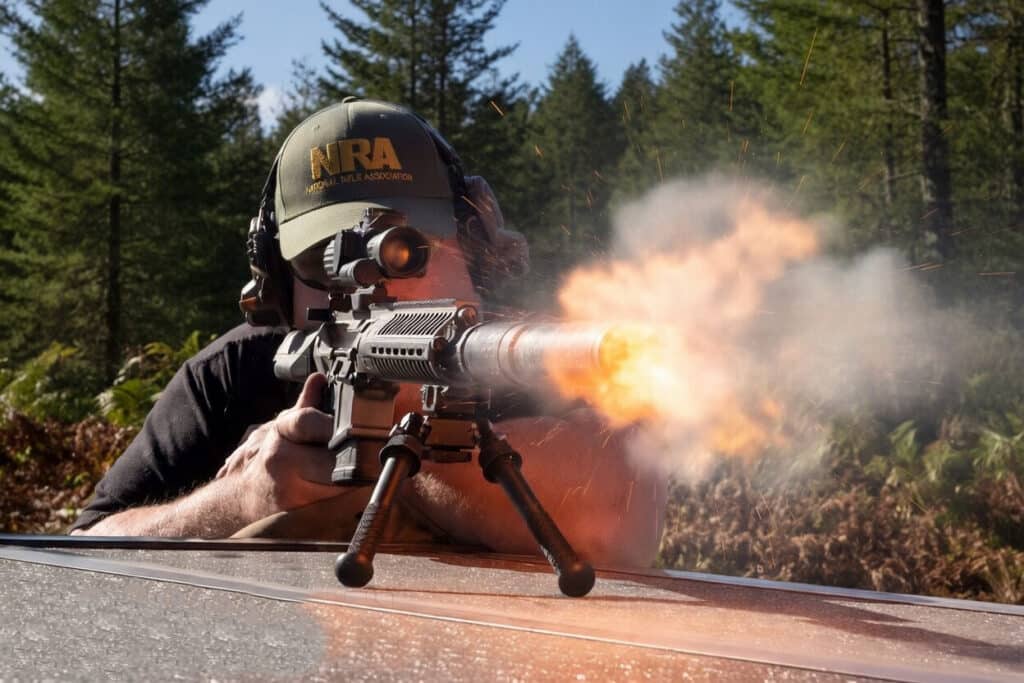
.223 Remington and 5.56×45 NATO are supersonic cartridges — all commercial loadings are significantly above the 1,125 fps sonic threshold — which means suppressor performance on .223/5.56 is bounded by the sonic crack that persists regardless of muzzle blast reduction. Quality .223 suppressors achieve 28 to 32 dB of muzzle blast reduction, producing final sound levels at the shooter’s ear of 130 to 138 dB from 16-inch barrels. This is still above the hearing-damage threshold for sustained exposure, so hearing protection remains important in training environments, but it is meaningfully quieter than unsuppressed .223 (approximately 163 dB) and produces a more comfortable shooting environment with less thermal discomfort and reduced concussion for training sessions. The noise reduction at bystander positions — particularly relevant for hunting and any shooting scenario with non-shooters nearby — is even more pronounced because the sonic crack is directional (following the projectile’s flight path) while the suppressor addresses the omnidirectional muzzle blast that affects the shooter and nearby observers equally.

Versatile Multi-Caliber Options
One Suppressor for Multiple AR Platforms
Multi-caliber suppressor selection for AR-15 platforms centers on the BANISH 30-V2 (Silencer Central) as the most versatile option in its class. The BANISH 30-V2 covers the full centerfire rifle range from .223 to .300 Win Mag, meaning an AR-15 owner who also runs a .308 AR-10, a 6.5 Creedmoor bolt gun, or any other standard centerfire rifle can use a single suppressor across all platforms. The per-platform cost efficiency of multi-caliber coverage is the primary argument for choosing the BANISH 30-V2 over a dedicated .223 suppressor when the owner has multiple rifle calibers. For the AR-15 owner who owns only .223/5.56 platforms and wants maximum .223-specific performance, dedicated .223 suppressors from SilencerCo (Omega 36M (Silencer Central), Specwar 556), Dead Air (Sandman-S (Silencer Central) in multi-caliber configuration), and AAC offer 1 to 2 dB additional performance over the BANISH 30-V2 on the .223 platform by optimizing their baffle geometry specifically for .223 gas volumes. For most shooters, the 1 to 2 dB difference is inaudible and the multi-caliber versatility of the BANISH 30-V2 is the more practical choice.
Sound Reduction Expectations
Setting Accurate Performance Benchmarks
Setting accurate sound reduction expectations for AR-15 suppressors prevents the disappointment that comes from comparing real suppressor performance to movie depictions. Quality AR-15 suppressors reduce sound by 28 to 32 dB from 16-inch barrels — the final sound level of 130 to 138 dB is dramatically quieter than unsuppressed but is not close to quiet by any objective standard. It is the difference between a sound level that causes permanent hearing damage without protection and a sound level that is managed to safe levels with appropriate ear protection. It is the difference between disturbing everyone within 500 yards and limiting the noise footprint to a much smaller radius. It is not, for .223 supersonic ammunition, the near-silent experience that the .22 LR subsonic category delivers — and setting that expectation before purchase prevents the most common new suppressor owner frustration.
Durability and Heat Management
What Extended AR-15 Suppressor Use Does to the Hardware
AR-15 suppressors in sustained semi-automatic fire generate significant heat. A quality suppressor rated for extended service (BANISH 30-V2, Dead Air Sandman, SilencerCo Omega) handles the thermal load of sustained semi-automatic fire without structural failure, but all suppressors reach temperatures that cause burns on skin contact within 2 to 5 minutes of 30-round-per-minute sustained fire. Suppressor covers (neoprene or woven fabric wraps that insulate the suppressor tube) address the burn risk and improve grip, and are a standard accessory for training and tactical AR-15 applications. Beyond user safety, heat also accelerates carbon fouling adhesion inside the suppressor — suppressors run hot from sustained fire accumulate the same round count of fouling in a more adherent form than suppressors cooled between strings. This is why cleaning interval adherence matters more for AR-15 suppressor users who conduct training drills than for hunters who fire in single shots with extended cooling between rounds.
Attachment Reliability
Preventing the Common Failures of Budget Mount Systems
Attachment reliability — the suppressor staying securely mounted at the correct bore alignment through sustained fire and thermal cycling — is the safety-critical requirement that separates quality suppressor products from cheaper alternatives. A suppressor that loosens during firing and shifts off bore centerline creates an asymmetric bore path that can result in a baffle strike (the projectile clipping an internal baffle instead of passing cleanly through the bore). Baffle strikes are catastrophic: they destroy the suppressor and can redirect the projectile in unpredictable directions. Quality attachment systems prevent this through precise thread specifications, timing mechanisms that ensure correct clock position at full torque, and thermal expansion management in the materials that prevents loosening as the suppressor heats and cools through its operating cycle. The BANISH 30-V2’s direct thread attachment system provides the highest bore alignment reliability of the common attachment categories — no mechanical interface variation to manage, just thread engagement that is either correct or not. Check attachment torque after every session until a known-stable torque level is established for each host firearm.

Direct Thread vs. Quick Detach on an AR-15
AR-15 suppressors come in direct-thread and quick-detach versions. A 5.56 or .223 AR barrel almost always uses a 1/2×28 muzzle thread. Direct thread is simple and skips the weight of a separate muzzle device, but it takes a wrench and careful timing to seat properly. Quick-detach mounts, such as ASR, Keymo, Anchor and the various maker-specific systems, let you pull the suppressor in seconds, which matters if you run one suppressor on several AR uppers or switch between suppressed and unsuppressed often. For most AR owners who shoot suppressed regularly, quick detach is the better choice.
Weight and Length on the Muzzle
Weight on the muzzle changes how an AR-15 handles, especially in fast transitions and long carries. Most full-size 5.56 suppressors weigh 12 to 20 ounces and add 6 to 9 inches to the rifle. Lightweight titanium or hybrid models come in under 12 ounces at the cost of some sound reduction, and compact models give up internal volume, and so some quiet, for a shorter rifle. For a duty or hunting rifle where balance matters, go lighter. For the most sound reduction from a bench or a fixed position, a full-size suppressor does better.
5.56 vs. Subsonic .300 BLK on the Same AR
Many AR-15 owners who want the quietest possible rifle end up adding a .300 Blackout upper. Supersonic 5.56 keeps its sonic crack no matter what is on the muzzle, so a good suppressor brings it to roughly 130 to 140 dB. Subsonic .300 BLK has no crack at all and lands in the 120s with a good suppressor. A .30-caliber suppressor covers both with nothing more than an upper swap. Keep 5.56 for range and flat trajectory; pick subsonic .300 BLK for quiet close-range work. Our .300 Blackout suppressor guide covers that side in detail.
Top Recommendations
The Models That Earn the Short List for AR-15 Applications
For multi-caliber AR-15 owners who want one suppressor for every centerfire rifle in the collection: the BANISH 30-V2 is the first recommendation. The multi-caliber coverage, titanium construction, competitive sound reduction, and BANISH’s lifetime warranty through Silencer Central’s service infrastructure make it the most practical choice for the common multi-gun owner. For dedicated .223/5.56 optimization on a single-platform collection: the SilencerCo Specwar 556 and Dead Air Sandman-S deliver 1 to 2 dB of additional .223-specific performance at comparable pricing; the trade-off is single-caliber limitation that matters if additional rifle calibers join the collection. For .300 Blackout subsonic AR builds where maximum suppression is the priority: a dedicated .300 Blackout suppressor (AAC Blackout, BANISH 30-V2 in multi-caliber role) delivers the full acoustic potential of the cartridge.
Frequently Asked Questions About AR-15 Suppressors
Do you still need a tax stamp for an AR-15 suppressor?
No. The federal tax on a suppressor transfer has been $0 since January 1, 2026, and since October 9, 2026, ATF no longer enforces the Form 4 or federal registration for suppressors either. A dealer still runs a Form 4473 and background check, and your state’s law still applies.
Is it legal to put a suppressor on an AR-15?
Federally, yes. Suppressors are banned in eight states and the District of Columbia (California, Delaware, Hawaii, Illinois, Massachusetts, New Jersey, New York and Rhode Island), and several more states allow one only if it is federally registered. Check your state on our suppressor laws by state page before you buy.
Is suppressing an AR-15 worth it?
For most owners, yes. A quality suppressor brings a 16-inch .223 rifle from about 163 dB down to roughly 130 to 138 dB at the shooter’s ear, which is easier on your hearing and cuts muzzle blast and flash. The trade-offs are added length and weight at the muzzle and more gas blown back toward the shooter.
What is the best suppressor for AR-15 .223 Remington?
The BANISH 30-V2 covers .223 and the entire centerfire rifle range with 28 to 32 dB reduction on .223/5.56, making it the top choice for multi-caliber AR-15 owners. For dedicated .223-only optimization, the SilencerCo Omega 36M and Dead Air Sandman-S offer marginally better .223-specific performance (1 to 2 dB) by restricting caliber coverage. For .300 Blackout AR builds, the BANISH 30-V2 covers the caliber while remaining versatile for other platforms. Choose the multi-caliber option unless .223 is the only caliber you plan to suppress.
How much hearing damage reduction does an AR-15 suppressor provide?
A quality .223 suppressor reduces unsuppressed .223 (approximately 163 dB) to 130 to 138 dB at the shooter’s ear from a 16-inch barrel — a 28 to 32 dB reduction. That is under the 140 dB peak limit OSHA sets for impulse noise but far above the 85 dB level it uses for an 8-hour average, so hearing protection still matters for long training sessions. The suppressor dramatically reduces the peak exposure and substantially reduces the risk of permanent hearing damage relative to unsuppressed shooting. Combined with quality foam ear protection, the total exposure is reduced to levels that allow extended training without meaningful cumulative risk.

Can AR-15 suppressors handle full-auto fire?
Quality suppressors (BANISH 30-V2, Dead Air Sandman, SilencerCo Omega) are constructed to handle full-auto fire — military and law enforcement applications in full-auto configurations validate this capability. Expect faster fouling accumulation and higher thermal loads in full-auto use than in semi-automatic applications, requiring more frequent cleaning and more careful heat management. Civilian semi-automatic AR-15 fire rarely approaches the sustained rates that military full-auto use generates, meaning the full-auto durability specification is largely irrelevant for civilian use but reflects the construction quality that makes the suppressor reliable under any lesser stress.
What thread pitch does an AR-15 need for a suppressor?
Standard AR-15 barrels in 5.56 NATO or .223 Remington use a 1/2×28 thread, which fits the large majority of 5.56 suppressors and quick-detach muzzle devices. Barrels in 6.5 Grendel, .458 SOCOM and other AR chamberings may use a different thread, so check your barrel before you order.
Can I use a 5.56 suppressor on a .308 AR-10?
No. A 5.56 suppressor has a bore sized for .224-caliber bullets, and a .30-caliber bullet through it causes a baffle strike, which can wreck the suppressor and is dangerous. An AR-10 needs a suppressor rated for .308 or larger. It works the other way around: many .30-caliber suppressors are rated for 5.56 too.
Disclosure: Silencer Central was a paid sponsor of PopularSuppressors.com through the 100 Days of Silence series, which has ended. This article reflects independent editorial judgment, and Silencer Central did not review or approve it.
Building out the host rifle? Guns & Gadgets Daily tracks the latest on AR-15 ammo supply.
Running subsonic .300 Blackout? Check our .300 BLK suppressor guide.
Related guides: how to clean a suppressor, and suppressor mounting systems.


Similar Posts