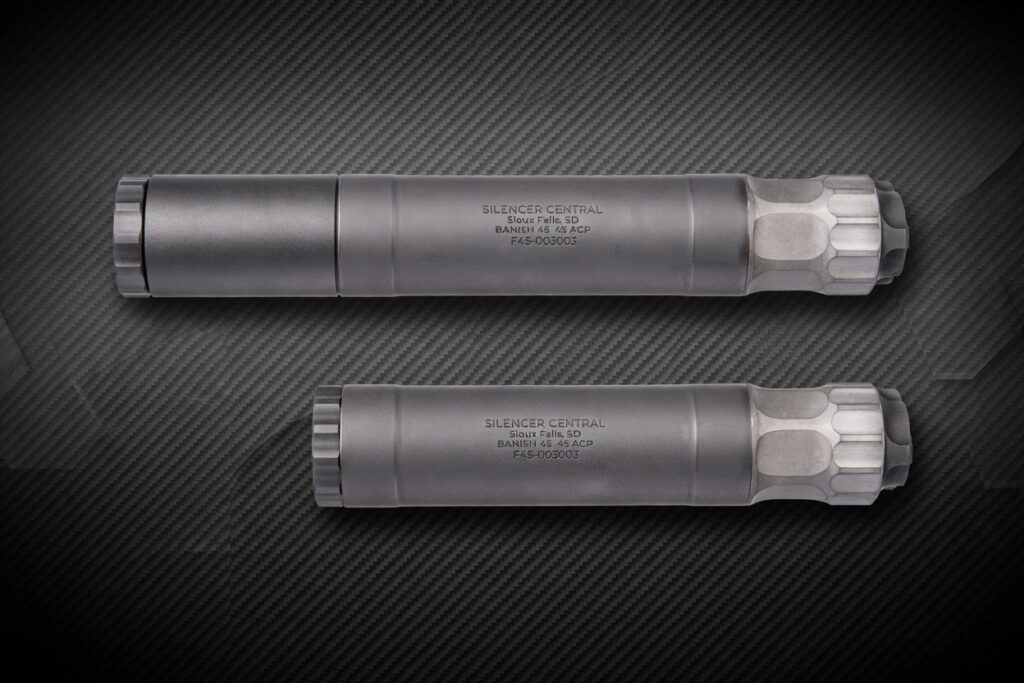
3D-Printed Suppressors vs. Welded: What Additive manufacturing Changes
A suppressor used to be a tube, a stack of baffles, and a lot of welding or machining. That still works. It still sells. It still holds up on plenty of rifles. But lately manufacturers have started building cans the way aerospace shops build turbine parts: layer by layer, from a pile of metal powder, with a laser doing the joining. The interesting part is not the buzzword. It is what happens when that powder is titanium. You get shapes a mill cannot reach, weight you can feel at the muzzle, and a can with no weld beads waiting to crack. This article walks through how that process works, what it actually changes, where old-school welded and machined cans still win, what the paperwork looks like.
In This Article
Last updated: October 19, 2026 · Originally published September 5, 2026
Update, October 10, 2026: On October 9, ATF stopped requiring a Form 4, federal registration or a tax stamp for suppressors, SBRs, SBSs and AOWs, for everyone nationwide. State law still applies. How buying a suppressor works now.
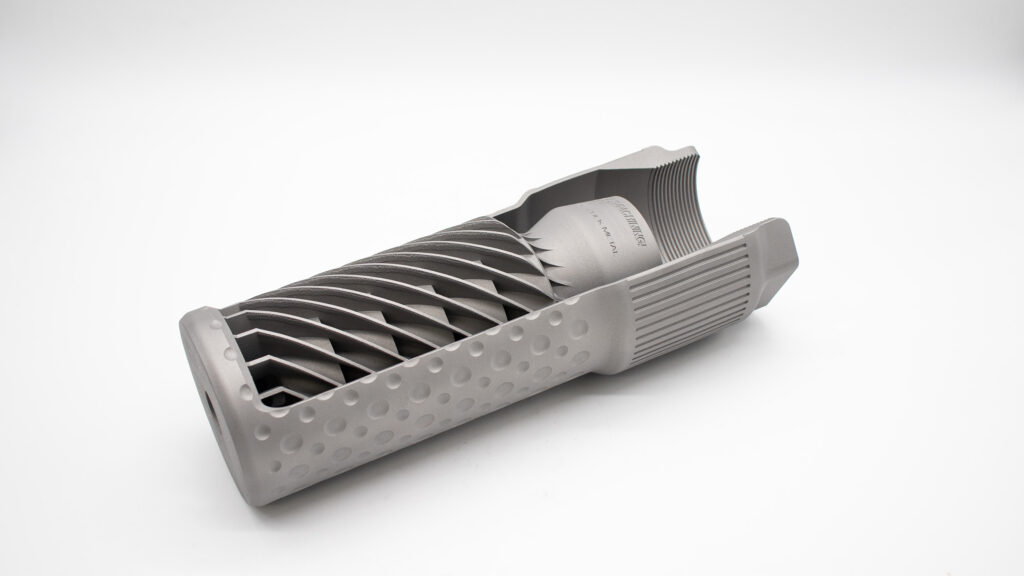
A 3D-printed suppressor is a silencer built by additive manufacturing instead of being cut from bar stock and assembled. Traditional cans start with a solid chunk of metal. Machines carve away what you do not want. Baffles get stacked or welded into a tube. End caps go on. You hope every piece lines up.
A printed can starts as a computer model. A machine then grows the part from nothing. For serious rifle and pistol cans, that usually means metal powder including titanium, Inconel, or stainless all fused by a laser. Some rimfire cans can even use high-strength polymers or carbon-fiber-filled plastic for the baffle stack, with a metal blast chamber taking the first blast hit.
The finished product is often one piece, or close to it. No stack of loose cones rattling in a tube. No row of weld joints around every baffle. The inside can look like a maze that would make a machine-shop foreman swear, because the printer does not care if a cutter can reach the feature. If the model says the gas should twist, split, and dump into a side channel, the printer just builds it.
Printed does not automatically mean better. It just means different design rules. Those rules matter most when the material is titanium.
How Direct Metal Laser Sintering Builds a Suppressor
The process most metal suppressor companies use is called direct metal laser sintering, or DMLS. Related names you will hear are selective laser melting and powder-bed fusion. Same idea.
An engineer draws the can in CAD. Software slices that model into layers thinner than a human hair, on the order of a few thousandths of an inch, sometimes less. The printer spreads a fine layer of metal powder across a build plate inside a chamber filled with inert gas so the hot metal does not oxidize. A high-power fiber laser traces the cross-section of that layer and welds the powder together. The plate drops a hair. A new layer of powder goes down. The laser welds that one to the last. Repeat until you have a suppressor sitting in a bed of unused powder.
Unused powder gets recycled. That is one reason shops like the process. Traditional machining starts with a fat bar and turns most of it into chips. Printing uses what the part needs.
The raw print is not ready for your muzzle. Shops still machine threads, true the bore, often with wire EDM so the hole is dead straight afterwards adding the coating. Some designs print the mount right into the body. Others print a core and then finish the interface the old way. Either way, the hard internal work is already one continuous piece of metal instead of a pile of parts waiting for a welder.
Titanium and Inconel both print well. Titanium is the lightweight play. Inconel is the “this thing is going to get angry and stay angry” capable of full auto and FRT use. Plenty of companies now offer both from the same design family.



What Additive Titanium Changes About 3D-Printed Suppressors
Titanium was already popular for hunting and precision cans because it is strong and light. Printing it changes the conversation from “light tube with simple baffles” to “light tube with internals you could not cut even if you wanted to.”
Geometry a mill cannot cut
A mill needs a path for the tool. If the cutter cannot reach a pocket, that pocket does not exist. Welded baffle stacks have the same problem in a different way: each baffle is a part you can hold, machine, and then join. Complex 3D flow paths for example helical tunnels, coaxial bypass channels, lattice walls, odd-shaped expansion chambers that wrap around the bore, are miserable or impossible to machine that way.
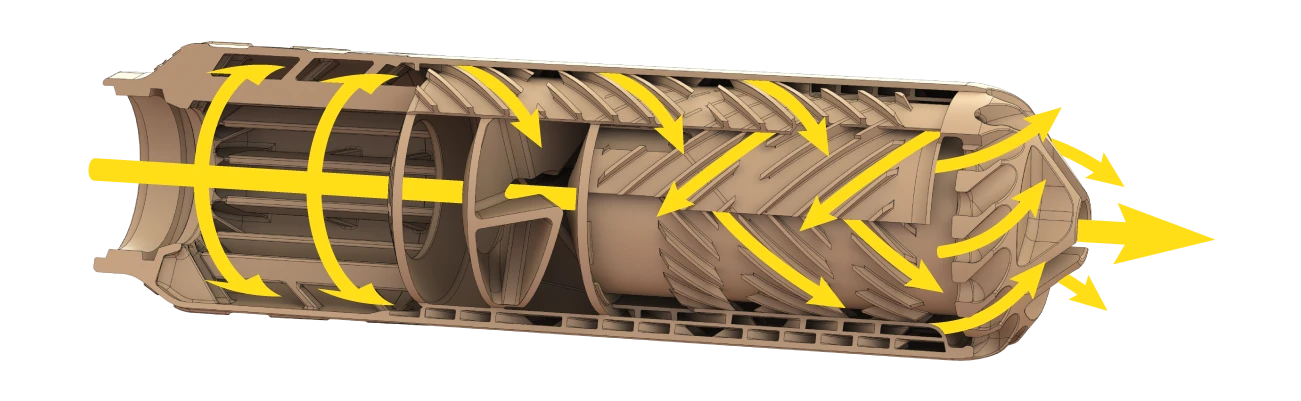
Printing does not need tool access. The laser only needs a line of sight to the powder. That is why flow-through and low-backpressure designs exploded once DMLS got cheap enough for the industry. Companies had ideas on the whiteboard for years. They could not make the parts. Then they could print them. Huxwrx has said out loud that they had a geometry problem, not a theory problem, until additive manufacturing showed up.
The practical result for you: gas can be sent around the bullet instead of slamming into a wall and bouncing back toward the ejection port. Quiet is still the job. Less blowback in your face is the bonus a lot of people actually notice first.
Weight, measured
Titanium already beats stainless on density. Printing lets designers put metal only where stress and heat demand it and leave air everywhere else. Lattice structures and thin, optimized walls are easy to model and hard to machine.
Where Welded and Machined Suppressors Earn Their Keep
Printed suppressors are not the only game in town. Plenty of excellent cans are still tubes and welds, and they earn their keep for boring, practical reasons.
High-volume fire still likes mass and heat-tolerant alloys. A welded Inconel or stainless can with a thick blast chamber will take a class dump that would make a featherweight titanium print glow. If your use case is a duty carbine that might go cyclic, “light and fancy” is the wrong shopping list.
Serviceability is another point. Rimfire is filthy. A user-serviceable machined stack you can soak and scrub is easier to live with than a sealed printed core you cannot take apart. Some printed designs now separate the serialized blast chamber from a replaceable core so you are not stuck with a paperweight when the internals wear out. A lot of classic welded or tubed cans already solved that problem with a simple end cap and a baffle stack.
If you hunt, shoot precision rifle, or want the lightest 9mm can you can hang on a pistol, printed titanium is hard to ignore. If you run a belt-fed or you want something you can hose out after a brick of bulk .22, the old methods are not obsolete. They are just honest about what they are.
The printer does not change the law. A suppressor is a suppressor whether it came out of a DMLS machine at a factory or off a desktop printer in a garage.
Remember that a Form 1 does not override your state. Several states ban civilian suppressors outright. Federal approval will not save you there. Check your state before you spend money on a printer for this purpose.
3D-printed suppressors: frequently asked questions
Are 3D-printed suppressors as durable as machined ones?
In titanium, yes, within their rating. A printed monolithic core has no welds, and welds are the usual failure point on conventional suppressors. Daniel Defense backs the MUTE 30Ti with a lifetime warranty. The limit is heat rather than construction: titanium handles hunting and precision use easily, while sustained full-auto schedules call for Inconel or stainless.
How long does a 3D-printed suppressor last?
Longer than most owners will test. Titanium suppressors used for hunting and range work routinely run for decades, because the shot volume is low and the metal cools between strings. Erosion at the blast baffle is the eventual wear point. On the TiTrex, that core can be replaced at the factory without altering the serialized band or the registration.
Do 3D-printed suppressors sound different?
They can, and the reason is geometry rather than the printing itself. Interior shapes that a lathe cannot cut allow designers to route gas along paths that lower peak sound pressure and reduce first-round pop. Pew Science measured the TiTrex 300 as one of the most optimized examples for its length. Results still vary by host, barrel length, and ammunition.
Why do 3D-printed suppressors cost more?
Machine time and powder. An industrial metal printer costs six figures and builds one plate at a time over many hours, and Grade-5 titanium powder is expensive. Those costs land in the MSRP, which is why printed titanium units generally list from roughly $899 to $1,199 while machined stainless designs start considerably lower.
Can I print my own suppressor at home?
Federally, yes, since October 9, 2026: ATF does not enforce prior approval for making a suppressor, though it still accepts Form 1 filings from people who want theirs registered. State law still applies. Eight states and D.C. ban suppressors, and 20 tie ownership to federal registration, so in those states file the Form 1 first.
Suppressor design spent 30 years constrained by what a cutting tool could physically reach inside a tube. A laser has never had that problem, and the 2026 releases are the first generation designed as though the constraint never existed.
The label will keep confusing people for another season or two. The hardware already moved on.
James Nicholas is the author of record at PopularSuppressors.com and covers suppressor hardware, NFA process, and hearing-safe shooting. Follow along at @therealxdman.


Similar Posts