Are Suppressors Legal in Texas? 2026 Suppressor Laws Buyer’s Guide
Yes. Suppressors are legal to own in Texas and legal to hunt with, bought through a licensed dealer and registered with the ATF on a Form 4.
In This Article

Yes — suppressors are legal to own in Texas, and they are legal for hunting. You buy through a licensed dealer, register the suppressor with the ATF on a Form 4, and pass a federal background check. As of January 1, 2026 there is no $200 tax stamp, though a suppressor (also called a silencer) remains an NFA-registered item.
The parts that matter
- Suppressor ownership is legal in Texas for residents who meet federal NFA requirements — there is no separate Texas permit.
- Texas is one of the most suppressor-friendly states and allows hunting with a suppressor, including year-round hog hunting.
- Minimum age is 21 to buy from a dealer, or 18 through an NFA gun trust or individual transfer.
- The $200 federal tax stamp was eliminated on January 1, 2026 — the ATF Form 4 and registration still apply.
- Possessing an unregistered suppressor is a felony under state and federal law. Governing statute: Tex. Penal Code § 46.05.
01Are suppressors legal to own in Texas?
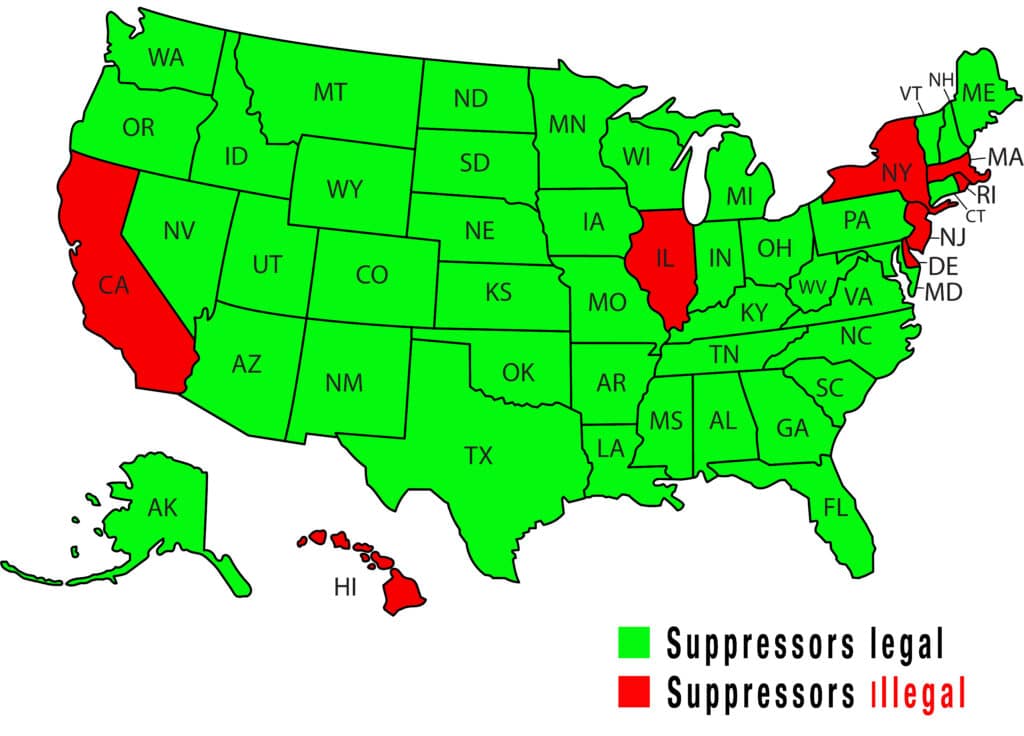
Yes. Texas is one of 42 states where civilian suppressor ownership is legal, and it has been among the most actively pro-suppressor states in the country. The terms “suppressor” and “silencer” mean the same device — federal paperwork uses “silencer,” while the industry prefers “suppressor.”
Texas law addresses suppressors in Texas Penal Code § 46.05, which lists a “firearm silencer” among prohibited weapons but exempts any suppressor that is registered and possessed in compliance with federal law. In practice, a suppressor you have lawfully transferred through the ATF is legal to own and carry in Texas. State lawmakers have also pushed further in favor of suppressor owners — including the 2021 Texas Suppressor Freedom Act (HB 957), which sought to shield Texas-made-and-kept suppressors from federal regulation. That state-sovereignty question remains contested in the courts, so the settled path for any buyer is the federal NFA process below.
The one bright line: possessing an unregistered suppressor — one that never went through the ATF — is a felony under both state and federal law. Owning one legally starts with registration.

02How to buy a suppressor in Texas
Buying a suppressor in Texas follows the standard federal NFA path. There is no extra Texas form or state license layered on top.
- Choose your suppressor and a licensed dealer. Pick your caliber and model, then work with a licensed FFL/SOT dealer that can transfer NFA items to Texas residents.
- Decide: individual or NFA gun trust. A trust lets more than one person legally possess the suppressor and simplifies inheritance.
- File the ATF Form 4 — no tax stamp. Your dealer submits the Form 4 (the eForm portal is fastest). As of 2026, the $200 transfer tax no longer applies.
- Submit fingerprints, photo, and pass the background check. Standard NFA requirements; the ATF runs the check and approves the transfer.
- Take delivery. Complete the transfer at your dealer — or, with a mail-order FFL, it ships directly to your door.
03The ATF process & 2026 wait times
Every suppressor is registered in the National Firearms Registration and Transfer Record before you can take it home. The good news for 2026 is speed: electronic Form 4 filing has cut wait times dramatically. As of early 2026, eForm 4 approvals for individual buyers have recently averaged around ten days, with paper filings and trust applications taking somewhat longer. Those are averages, not guarantees — but a world away from the five-to-fourteen-month waits common a few years ago.
04What does a suppressor cost in Texas in 2026?
Your total cost is the price of the suppressor itself plus your dealer’s transfer fee. Quality rimfire cans start a little under $400, while most centerfire rifle and pistol suppressors run roughly $700 to $1,300 depending on brand, materials, and mounting system.
The headline change is what is no longer on the bill: the $200 federal tax stamp that applied for nearly a century was eliminated on January 1, 2026. A new suppressor is effectively $200 cheaper than it was in 2025. You still complete the same Form 4 and registration; you just do not write the $200 check anymore.
05Can you hunt with a suppressor in Texas?
Yes — and this is one of the biggest reasons Texas has such a large suppressor-owning community. Texas allows suppressors for hunting all legal game and non-game animals. That includes feral hogs, which have no closed season and no bag limit on private land, making a suppressed rifle a popular tool for Texas landowners managing hog populations.
Suppressors protect your hearing, reduce recoil, and cut down on noise complaints near rural property lines. Hunting regulations are updated each season, so confirm current rules with Texas Parks & Wildlife before you head out.
06City & county rules in Texas
Texas has strong firearm preemption: state law bars cities and counties from adopting their own regulations on firearms, ammunition, and firearm components that are stricter than state law. In practical terms, a legally owned suppressor cannot be banned by a local ordinance. Where local rules can still matter is where you shoot — discharge ordinances, noise rules, and range or land-use restrictions are about the act of shooting, not suppressor ownership.
The $200 federal tax stamp on suppressors was eliminated on January 1, 2026 under the One Big Beautiful Bill Act. The Form 4, background check, and ATF registration all still apply — suppressors remain NFA items. Broader deregulation (the Hearing Protection Act) has been proposed but is not yet law, and related litigation is ongoing.
Verify Before You Buy — Texas
Laws change. Confirm current rules with the source before you rely on them.
More Questions
Do I need a permit to own a suppressor in Texas?
How much does a suppressor cost in Texas in 2026?
Is it a felony to own a suppressor in Texas?
Can you hunt hogs with a suppressor in Texas?
How many suppressors can you buy in Texas?
Are homemade or 3D-printed suppressors legal in Texas?
This guide is for general educational purposes only and is not legal advice. We are not attorneys. Firearm and suppressor laws change frequently and can vary by city, county, and individual circumstance. Before purchasing, transferring, or hunting with a suppressor, confirm the current rules with the official Texas and federal sources listed above, or consult a licensed attorney in your state.