Best Rimfire (.22 LR) Suppressors: Top Picks & Buying Guide (2026)
The best rimfire suppressors compared on weight, sound and how easily each one strips down, because a 22 can gets filthy faster than any other.
In This Article
Last updated: October 6, 2026 · Originally published September 20, 2026

Rimfire suppressors are a different animal from centerfire cans, and the reason comes down to one word: fouling. .22 LR ammunition uses exposed lead bullets and dirty priming compounds, which builds up inside a suppressor far faster than jacketed centerfire ammo ever does. That single fact shapes almost every purchasing decision in this category — material, design, and price all trace back to how easily a can handles that fouling over time. This guide breaks down the real, current models worth your money in 2026 and the rimfire-specific buying factors that matter most.
Choosing a Rimfire (.22 LR) Suppressor
Nearly every serious rimfire can on the market is a takedown or keyed-baffle design that disassembles for cleaning, and that’s a deliberate response to how quickly .22 LR fouls a suppressor. Rimfire cans typically need cleaning every 500–1,500 rounds, and carbon flakes can start appearing inside the baffle stack after as few as 100 rounds with some ammunition. Compare that to a welded, sealed centerfire can, and it’s clear why the rimfire category has standardized on user-serviceable construction almost across the board — a design a hunter would never bother with on a .308 can is essentially mandatory here.
A suppressor can’t eliminate the sonic crack of a supersonic bullet — only the muzzle blast. Most .22 LR “standard velocity” and dedicated subsonic loads stay under roughly 1,100 fps and are noticeably quieter suppressed, while high-velocity loads like CCI Mini-Mag will still produce a sharp downrange crack even through a top-tier can. For a actually quiet rimfire setup, pair any of the picks below with subsonic ammunition rather than expecting the suppressor alone to do all the work.
1/2×28 direct thread is essentially the universal mount for this category — every pick on this list ships with it, since most factory-threaded rimfire host barrels (10/22, CZ 455/457, and similar) already use that pattern. QD rimfire mounting systems exist but are far less standardized than on centerfire lines, so direct thread remains the practical default. One caution worth flagging: never run a rimfire can on a centerfire rifle it isn’t explicitly rated for. Lead fouling from rimfire ammo can permanently damage a sealed centerfire suppressor not designed to be disassembled, and centerfire cans aren’t optimized for rimfire’s dirtier ammo in the first place.

Top Rimfire Suppressors for 2026
| Brand | Model | Weight | Material | Notable Feature |
|---|---|---|---|---|
| Dead Air | Mask HD | 6.6 oz | 17-4 stainless baffles, Grade 9 titanium tube | Editor’s pick — strong sound performance, durability, and easy field cleaning |
| SilencerCo | Sparrow 22 | 6.5 oz | 17-4 stainless steel, monolithic core | The original user-serviceable rimfire can, tool-free disassembly |
| Rugged | Oculus22 | 4.3–6.9 oz | All 17-4PH stainless | PEW Science: among the strongest-performing rimfire cans tested to date |
| Otter Creek Labs | Titanium 22 | 4.0 oz | 100% titanium | PEW Science: 2nd-highest suppression performance recorded on its host platform |
| HUXWRX | FLOW 22 Ti | 3.9 oz | Grade 5 titanium, Cerakote rated to 1,800°F | Lightest can in this comparison |
| Rugged | Mustang22 | 2.4–3.3 oz | Grade 5 titanium mount, 7075 aluminum tube/baffles | Lightest modular .22 suppressor, includes takedown tool |
Pricing and specs current as of publish date — always confirm the latest configuration directly with the manufacturer or an authorized dealer before buying. Also worth considering: the SilencerCo Switchback 22 (modular, 4 configurations from 3.7–6.9 oz), Thunder Beast Arms’ 22 Take Down Gen 2, Q’s Erector 22 (fully modular, adjustable 1.9–7.6″), and the YHM Phantom .22 — all real, current dedicated rimfire products, though with less independent lab data available than the picks above.
Notable Picks
Dead Air Mask HD — Best Overall
At 6.6 ounces and 5.1 inches, the Mask HD pairs 17-4 stainless baffles with a titanium tube and is marketed heavily on ease of teardown and cleaning — a actually useful combination given how quickly rimfire cans foul. It’s rated for .22 LR, .22 Mag, .17 HMR, and .17 WSM up to 5.7×28, and is full-auto rated. It’s widely cited as the current class leader for buyers who want one can that does everything well rather than optimizing for a single spec.
SilencerCo Sparrow 22 — Best Value / Most Proven
The Sparrow was the original user-serviceable rimfire suppressor and remains one of the most widely owned cans in the category at 6.5 ounces with tool-free disassembly. PEW Science’s lab test measured a strong Composite Suppression Rating of 74.5, though it flagged a notably severe first-round pop compared to subsequent shots — worth knowing if you’re shooting suppressed indoors or in a hunting stand where that first shot matters most.
Rugged Oculus22 — Best Independently Verified Performance
PEW Science’s CZ452 rifle test measured a Suppression Rating of 92.8 in its long configuration and 86.8 short — among the strongest numbers recorded for any rimfire can PEW Science has tested. Built entirely from 17-4PH stainless with keyed, indexing baffles for repeatable return-to-zero after cleaning, it’s the pick for buyers who want the best lab-verified performance available in this category. See our Rugged Suppressors guide for the brand’s full lineup, including the ultralight Mustang22.
HUXWRX FLOW 22 Ti — Lightest Overall Pick
At 3.9 ounces new, the FLOW 22 Ti is the lightest can in this comparison, built from Grade 5 titanium with a Cerakote finish rated to 1,800°F. It’s full-auto rated across .22 LR, .22 Mag, .17 HMR, and 5.7×28. Rugged’s Mustang22 is the closest competitor on weight (2.4–3.3 oz) using a titanium mount paired with an aluminum tube and baffles instead of an all-titanium build — a worthwhile comparison if outright weight is your top priority.
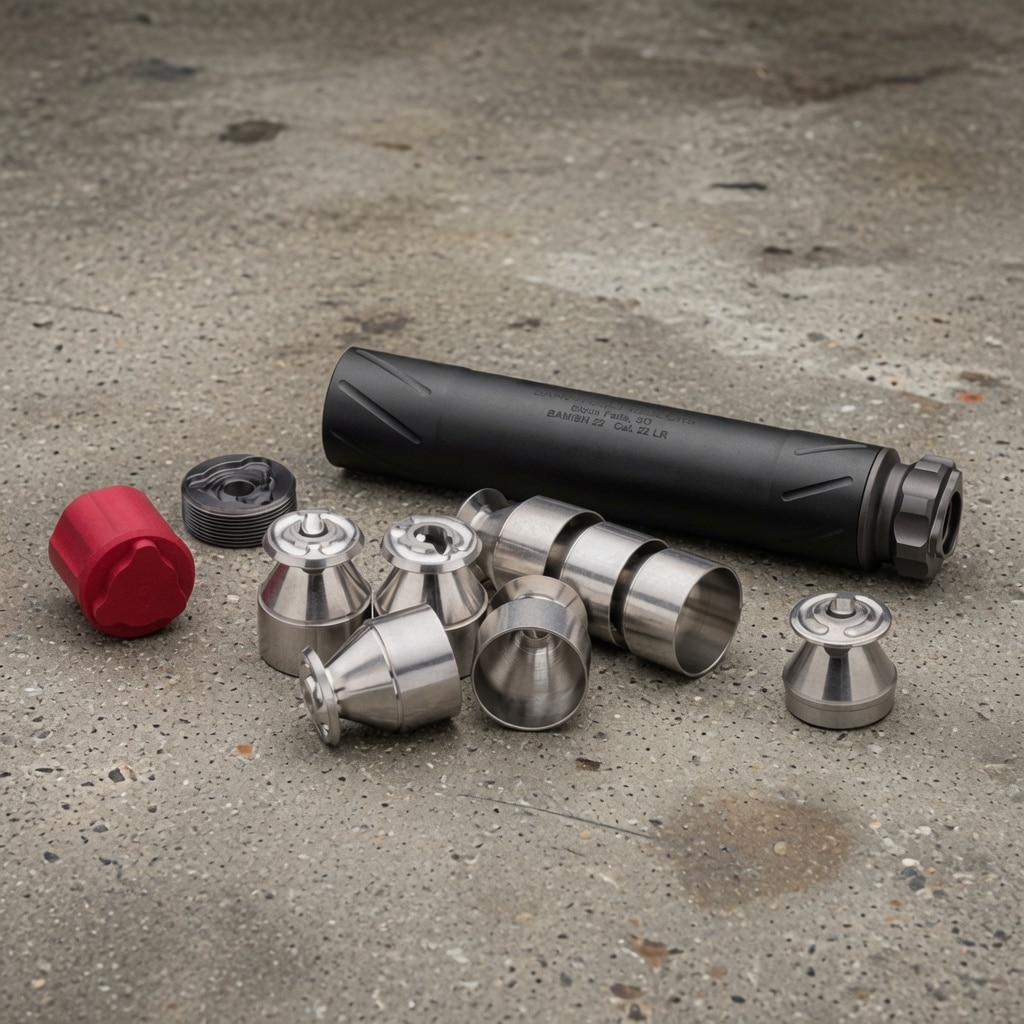
The BANISH 22 is Silencer Central’s lightweight titanium rimfire suppressor, made to quiet .22 LR and similar small-caliber guns while staying easy to take apart and clean.
Buying Considerations
- User-serviceability matters more here than any other caliber: Rimfire cans need cleaning every 500–1,500 rounds due to lead fouling. Nearly every model on this list is a takedown or keyed-baffle design for exactly that reason — avoid a sealed, welded rimfire can if one crosses your path.
- Subsonic ammo is doing half the work: A suppressor can’t stop a supersonic crack. Pair any pick above with subsonic or standard-velocity .22 LR ammunition for a actually quiet setup rather than relying on the can alone.
- 1/2×28 direct thread is the practical standard: Every pick above uses it, matching most factory-threaded rimfire barrels. QD rimfire mounting exists but isn’t standardized the way centerfire QD systems are.
- Never cross-use a rimfire can on centerfire calibers it isn’t rated for: Lead fouling can permanently damage a sealed centerfire suppressor, and centerfire cans aren’t optimized for rimfire’s dirtier ammo or sound signature.
- Weight versus caliber flexibility: The lightest picks (HUXWRX FLOW 22 Ti, Rugged Mustang22) trade some caliber breadth for minimum weight; models like the Dead Air Mask HD and Rugged Oculus22 cover a wider range of rimfire calibers (.22 Mag, .17 HMR/WSM, 5.7×28) at a modest weight cost.
Frequently Asked Questions About Rimfire Suppressors
Why do rimfire suppressors need to be user-serviceable for cleaning?
.22 LR ammunition uses exposed lead bullets and dirty priming compounds, producing far more fouling than jacketed centerfire ammo. Rimfire cans typically need cleaning every 500–1,500 rounds, via solvent soak, ultrasonic cleaning, or dry brushing. That’s why nearly every major rimfire can on the market is built as a takedown or keyed-baffle design, unlike many welded, sealed centerfire cans.
Subsonic versus supersonic .22 LR — does it matter for suppression?
Yes. A suppressor cannot eliminate the sonic crack of a supersonic bullet — only the muzzle blast. Most .22 LR “standard velocity” and dedicated subsonic loads stay under ~1,100 fps and are noticeably quieter suppressed; high-velocity loads like CCI Mini-Mag will still produce a sharp downrange crack even through a top-tier can. For a truly quiet rimfire setup, pair any suppressor with subsonic ammunition. See our subsonic ammo guide for more.
Can a rimfire suppressor be used on other calibers?
Most dedicated rimfire cans are rated across a small family of small-bore rounds — typically .22 LR, .22 WMR, .17 HMR, .17 WSM, and up to 5.7x28mm — and several are also full-auto rated on .22 LR. Rimfire cans should never be used on centerfire rifle calibers they aren’t explicitly rated for: lead fouling can permanently damage a sealed centerfire suppressor not designed to be disassembled.
Direct-thread versus QD mounts for rimfire cans?
Nearly every rimfire can on the market ships as 1/2×28 direct thread, since most factory-threaded rimfire host barrels already use that pattern. QD rimfire mounting systems exist but are less common and less standardized than on centerfire lines, so direct thread remains the practical default for most buyers.
Related guides: Before you buy, read our primers on how to buy a suppressor and suppressor mounting systems. For deeper dives into the brands covered above, see our Dead Air suppressors guide, SilencerCo suppressors guide, Rugged Suppressors guide, and Otter Creek Labs suppressors guide. Pairing your rimfire can with a bigger caliber build? Our best titanium suppressors guide covers the material tradeoffs behind the lightest picks above, and our subsonic ammo guide covers what to feed any of them for maximum quiet.


Similar Posts